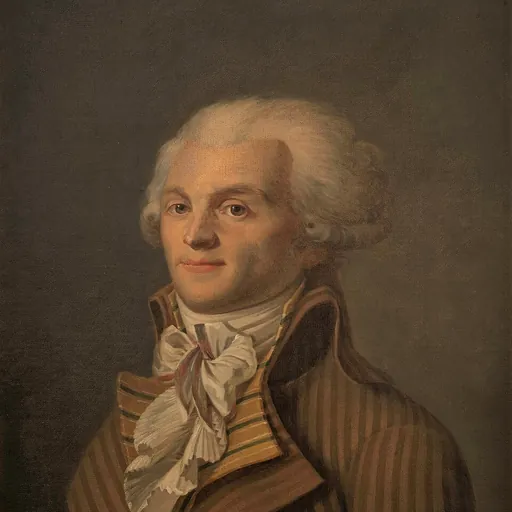
Maximilien Robespierre
French revolutionary lawyer and politician
About Maximilien Robespierre
Lived 1758 – 1794 (aged 36). Maximilien Robespierre was a French politician, lawyer, journalist and revolutionary.
Early life 1794 print with the slogan "Supreme Being, Sovereign People, French Republic". An elderly Voltaire is depicted along with a bust of Brutus and the grave of Rousseau. Maximilien de Robespierre was baptised on 6 May 1758 in Arras, Artois (modern day Hauts-de-France). His father, François Maximilien Barthélémy de Robespierre, a lawyer, married Jacqueline Marguerite Carrault, the daughter of a brewer, in January 1758. Maximilien, the eldest of four children, was born four months later. His siblings were Charlotte Robespierre, Henriette Robespierre, and Augustin Robespierre.
Robespierre's mother died on 16 July 1764, after delivering a stillborn son at age 29. Charlotte's memoirs indicate that she believed that the death of their mother had a major effect on her brother. About three years after the death of his wife, their father left the children in Arras. Maximilien and his brother were raised by their maternal grandparents and his sisters were raised by their unmarried paternal aunts.
Demonstrating literacy at an early age, Maximilien commenced his education at the Arras College when he was eight. In October 1769, recommended by the bishop , he secured a scholarship at the prestigious Collège Louis-le-Grand in Paris. Among his peers were Camille Desmoulins and Stanislas Fréron. During his schooling, he developed a profound admiration for the Roman Republic and the rhetorical skills of Cicero, Cato and Lucius Junius Brutus. In 1776 he earned the first prize for rhetoric.
His appreciation for the classics inspired him to aspire to Roman virtues, particularly the embodiment of Rousseau's citizen-soldier. Robespierre was drawn to the concepts of the influential philosophe regarding political reforms expounded in his work, The Social Contract. Aligning with Rousseau, he considered the general will of the people as the foundation of political legitimacy.
Formative years, 1780–1789
During his three-year study of law at the Sorbonne, Robespierre distinguished himself academically, culminating in his graduation in July 1780, where he received a special prize of 600 for his exceptional academic achievements and exemplary conduct. Admitted to the bar, he was appointed as one of the five judges in the local criminal court in March 1782. However, Robespierre soon resigned, due to his ethical discomfort in adjudicating capital cases, stemming from his opposition to the death penalty.
Robespierre was elected to the literary Academy of Arras in November 1783. The following year, the Academy of Metz honoured him with a medal for his essay pondering collective punishment, thus establishing him as a literary figure. Robespierre's social circle expanded to include influential figures such as the lawyer Martial Herman, the officer and engineer Lazare Carnot and the teacher Joseph Fouché, all of whom would hold significance in his later endeavours. On 26 April 1789, Robespierre secured his place as one of 16 deputies representing French Flanders in the Estates-General.
1789 On 6 June, Robespierre delivered his introductory speech in the Estates General, targeting the hierarchical structure of the church. His impassioned oratory prompted observers to comment, "This young man is as yet inexperienced; unaware of when to cease, but possesses an eloquence that sets him apart from the rest." By 13 June, Robespierre aligned with deputies, who later proclaimed themselves the National Assembly, asserting representation for 96% of the nation. On 13 July, the National Assembly proposed reinstating the "bourgeois militia" in Paris to quell the unrest. The following day, the populace demanded weapons and stormed both the Hôtel des Invalides and the Bastille. The local militia transitioned into the National Guard, a move that distanced the most impoverished citizens from active involvement.
In October, alongside Louvet, Robespierre supported Maillard following the Women's March on Versailles. Through December and January Robespierre notably drew attention from marginalised groups, particularly Protestants, Jews, people of African descent, domestic servants, and actors. A frequent orator in the Assembly, Robespierre championed the ideals in the Declaration of the Rights of Man and of the Citizen, but his views rarely garnered majority support among fellow deputies.
Despite his commitment to democratic principles, Robespierre did not adopt the change of dress influenced by the Revolution; instead he persistently donned knee-breeches and retained a meticulously groomed appearance with a curled, perfumed, and powdered wig tied in a queue in line with the old-fashioned style of the 18th century. Some accounts described him as "nervous, timid, and suspicious".
Following the forcible relocation of the King and National Constituent Assembly from Versailles to Paris, Robespierre lived at 30 Rue de Saintonge in Le Marais, a district with relatively wealthy inhabitants. He shared an apartment on the third floor with Pierre Villiers who was his secretary for several months. Robespierre associated with the new Society of the Friends of the Constitution, commonly known as the Jacobin Club. Among these 1,200 men, Robespierre found a sympathetic audience. Equality before the law was the keystone of the Jacobin ideology. Beginning in October and continuing through January he made several speeches in response to proposals for property qualifications for voting and officeholding under the proposed constitution. This was a position he vigorously opposed, arguing in a speech on 22 October the position that he derived from Rousseau: ... sovereignty resides in the people, in all the individuals of the people. Each individual therefore has the right to participate in making the law which governs him and in the administration of the public good which is his own. If not, it is not true that all men are equal in rights, that every man is a citizen.
1790 During the continuing debate on suffrage, Robespierre ended his speech of 25 January 1790 with a demand that "all Frenchmen must be admissible to all public positions without any other distinction than that of virtues and talents." On 31 March 1790 he was elected as president of the Jacobin Club. Robespierre supported the cooperation of all the National Guards in a general federation on 11 May. On 19 June he was elected secretary of the National Assembly. In July Robespierre demanded "fraternal equality" in salaries. Before the end of the year, he was seen as one of the leaders of the small body of the extreme left of the Assembly, known as "the thirty voices".
On 5 December Robespierre delivered another speech on the National Guard. "To be armed for personal defence is the right of every man, to be armed to defend freedom and the existence of the common fatherland is the right of every citizen." Robespierre also coined the famous motto by adding the word fraternity on the flags of the National Guard.
1791
In 1791, Robespierre gave 328 speeches, almost one a day. On 28 January, in the Assembly, he spoke on the organisation of the National Guard, On 27 and 28 April, Robespierre opposed plans to reorganise it and to restrict its membership to active citizens. He demanded that it should be reconstituted on a democratic basis, with an end to military decorations and an equal number of officers and soldiers in courts martial. He argued that the National Guard had to become the instrument of defending liberty rather than a threat to it. On 15 May, the Constituent Assembly declared full and equal citizenship for all free people of colour. In the debate Robespierre said: "I feel that I am here to defend the rights of men; I cannot consent to any amendment and I ask that the principle be adopted in its entirety." He descended from the rostrum in the middle of the repeated applause of the left and of all the galleries.
On 16–18 May when the elections began, Robespierre proposed and carried the motion that no deputy who sat in the Constituent assembly could sit in the succeeding Legislative assembly. On 28 May, Robespierre proposed all Frenchmen should be declared active citizens and eligible to vote. Hillary Mantel described his speech as "perfectly constructed, a brilliant fusion of logic and emotion, as much a work of art as a building or a piece of music could be."
On 10 June, Robespierre delivered a speech on the state of the police and proposed to dismiss officers. On 15 June, Pétion de Villeneuve became president of the "tribunal criminel provisoire", after Duport refused to work with Robespierre.
Courtyard of the house of Maurice Duplay, Robespierre's landlord. Robespierre's room was on the second floor, above the fountain. Other lodgers were his sister, brother and Joseph Le Bas.
After Louis XVI's flight to Varennes, the Assembly suspended the king from his duties on 25 June. Robespierre declared in the Jacobin Club on 13 July: "The current French constitution is a republic with a monarch. She is therefore neither a monarchy nor a republic. She is both."
After the Champ de Mars massacre, the authorities ordered numerous arrests. Robespierre, after attending the Jacobin club, did not go back to the Rue Saintonge where he lodged, and asked Laurent Lecointre if he knew a patriot near the Tuileries who could put him up for the night. Lecointre suggested Duplay's house and took him there. Maurice Duplay, a cabinetmaker and ardent admirer, lived at 398 Rue Saint-Honoré near the Tuileries. After a few days, Robespierre decided to move in permanently, motivated by a desire to live closer to the Assembly and the Jacobin club. Robespierre took up residence in the back house where he was distracted by the noises of work.
In September, the French Constitution of 1791 was accepted and the Assembly had therefore completed its task. On 30 September, the day of the dissolution of the Assembly, Robespierre opposed Jean Le Chapelier, who wanted to proclaim an end to the revolution and restrict freedom of expression. He succeeded in getting any requirement for inspection out of the constitution's guarantee of freedom of expression: "The freedom of every man to speak, to write, to print and publish his thoughts, without the writings having to be subject to censorship or inspection prior to their publication..." Pétion and Robespierre were brought back in triumph to their homes. Madame Roland labelled Pétion de Villeneuve, François Buzot, and Robespierre the "incorruptibles" in honour of their principles, their modest ways of living, and their refusal to take bribes.
On 16 October, Robespierre delivered a speech in Arras; one week later in Béthune. On 28 November, he was back in the Jacobin club, where he met with a triumphant reception. Collot d'Herbois gave his chair to Robespierre, who presided that evening. On 5 December he gave a speech on the organisation of the Garde National, which he saw as a unique institution born from the ideals of the French Revolution. On 11 December, Robespierre was finally installed as accusateur public.
Opposition to war with Austria, 1791–1792 Portrait of Robespierre (1792) by Jean-Baptist Fouquet. By using a physiognotrace a "grand trait" was produced within a few minutes. This life-size drawing on pink paper was completed by Fouquet.
The Declaration of Pillnitz issued by Austria and Prussia on 27 August 1791 warned the people of France not to harm Louis XVI or these nations would "militarily intervene". Brissot rallied the support of the Legislative Assembly for war with Austria. As Jean-Paul Marat, Georges Danton and Robespierre had not been elected in the new legislature, thanks to the Self-Denying Ordinance, anti-war politics mainly took place outside the Assembly. On 18 December 1791, Robespierre gave a second speech at the Jacobin club against war, warning against the threat of dictatorship stemming from it:
At the end of December, Guadet, the chairman of the Assembly, suggested that a war would be a benefit to the nation and boost the economy. Marat and Robespierre opposed him, arguing that victory would create a dictatorship, while defeat would restore the king to his former powers.
This opposition from expected allies irritated the Girondins, and the war became a major point of contention between the factions. In his third speech on the war, Robespierre countered on 25 January 1792 in the Jacobin club, "A revolutionary war must be waged to free subjects and slaves from unjust tyranny, not for the traditional reasons of defending dynasties and expanding frontiers..." Robespierre argued such a war could only favour the forces of counter-revolution, since it would play into the hands of those who opposed the sovereignty of the people. The risks of Caesarism were clear: "in troubled periods of history, generals often became the arbiters of the fate of their countries." Robespierre failed to gather a majority, but his speech was nevertheless published and sent to all clubs and Jacobin societies of France.
On 10 February 1792, Robespierre gave a speech on how to save the State and Liberty. He advocated specific measures to strengthen, not so much the national defences as the forces that could be relied on to defend the revolution. Robespierre promoted a people's army, continuously under arms and able to impose its will on Feuillants and Girondins in the Constitutional Cabinet of Louis XVI and the Legislative Assembly.
On 26 March, Guadet accused Robespierre of superstition, relying on divine providence. Shortly after Robespierre was accused by Brissot and Guadet of "trying to become the idol of the people". Being against the war, Robespierre was also accused of acting as a secret agent for the "Austrian Committee". The Girondins planned strategies to out-maneuver Robespierre's influence among the Jacobins. On 27 April, as part of his speech responding to the accusations by Brissot and Guadet against him, he threatened to leave the Jacobins, claiming he preferred to continue his mission as an ordinary citizen.
On 17 May, Robespierre released the first issue of his weekly periodical (The Defender of the Constitution). In this publication, he criticised Brissot and expressed his scepticism over the war movement. The periodical, printed by his neighbour Nicolas, served multiple purposes: to print his speeches, to counter the influence of the royal court in public policy, to defend him from the accusations of Girondist leaders; and to give voice to the economic and democratic interests of the broader masses in Paris and defend their rights.
Insurrectionary Commune of Paris, 1792 February–July 1792
On 15 February, Robespierre failed to get elected to the city council (Conseil général); on the same day the installation of the criminal trial court of the department of Paris took place. For Robespierre this meant a thankless position as public prosecutor. Robespierre was responsible for the coordination of the local and the federal police in the department and the sections. Along with other Jacobins, he urged the creation of an in Paris, consisting of at least 20,000–23,000 men, to defend the city, "liberty" (the revolution), maintain order and educate the members in democratic and republican principles, an idea he borrowed from Jean-Jacques Rousseau. According to Jean Jaures, he considered this even more important than the right to strike.
Because French forces suffered disastrous defeats and a series of defections at the onset of the war, Robespierre and Marat feared the possibility of a military coup d'état. One was led by Lafayette, head of the National Guard, who at the end of June advocated the suppression of the Jacobin Club. Robespierre publicly attacked him in scathing terms:
On 2 July, the Assembly authorised the National Guard to go to the Festival of Federation on 14 July, circumventing a royal veto. On 11 July, the Jacobins won an emergency vote in the wavering Assembly, declaring the nation in danger and drafting all Parisians with pikes into the National Guard. On 15 July, Billaud-Varenne in the Jacobin club outlined the program for the next insurrection: the deportation of the Bourbons and "enemies of the people", the cleansing of the National Guard, the election of a Convention, the "transfer of the Royal veto to the people", and exemption of the poorest from taxation. On 24 July a "Central Office of Co-ordination" was formed and the sections received the right to be in a "permanent" session. On 25 July, according to the , Carnot promoted the use of pikes and provided to every citizen. On 29 July Robespierre called for the deposition of the King and the election of a Convention.
August 1792
On 1 August, the Assembly voted on Carnot's proposal, enforcing the distribution of pikes to all citizens, excluding vagabonds. By 3 August, the mayor and 47 sections demanded the removal of the king. On 5 August Robespierre disclosed the discovery of a plan for the king to escape to Château de Gaillon. Aligning with Robespierre's stance, almost all sections in Paris rallied for the dethronement of the king and issued a decisive ultimatum.
In the early hours of Friday, 10 August 30,000 Fédérés (volunteers hailing from the countryside) and sans-culottes (militant citizens from Paris) mounted a successful assault upon the royal palace of the Tuileries. Robespierre considered it a triumph for the "passive" (non-voting) citizens. The Assembly, rattled by the events, suspended the king's powers and authorised the election of a new National Convention in the light of the changing role of the monarchy. On the night of 11 August, Robespierre secured a position in the Paris Commune, representing the Section de Piques, his residential district. The governing committee advocated universal male suffrage in the election of the new National Convention. Despite Camille Desmoulins' belief that the turmoil had concluded, Robespierre asserted that it marked merely the beginning. By 13 August, Robespierre openly opposed the reinforcement of the départements. Subsequently, Danton invited him to join the Council of Justice. Robespierre published the twelfth and final edition of Le Défenseur de la Constitution, serving as an account and political testament.
On 16 August, Robespierre submitted a petition to the Legislative Assembly, endorsed by the Paris Commune, urging the establishment of a provisional Revolutionary Tribunal specifically tasked with dealing with perceived "traitors" and "enemies of the people". The following day, he was appointed as one of eight judges for this tribunal. However, citing a lack of impartiality, Robespierre declined to preside over it. This decision drew criticism.
The Prussian army crossed the French frontier on 19 August. To fortify defence, the Paris armed sections were integrated into 48 battalions of the National Guard under Santerre's command. The Assembly decreed that all the nonjuring priests must leave Paris within a week and leave the country within two weeks. On 28 August, the assembly ordered a curfew for the next two days. The city gates were closed; all communication with the country was stopped. At the behest of Justice Minister Danton, thirty commissioners from the sections were ordered to search every suspect house for weapons, munitions, swords, carriages, and horses. "As a result of this inquisition, more than 1,000 "suspects" were added to the immense body of political prisoners already confined in the jails and convents of the city". Marat and Robespierre both disliked Condorcet who proposed that the "enemies of the people" belonged to the whole nation and should be judged constitutionally in its name. On 30 August the interim minister of Interior Roland and Guadet tried to suppress the influence of the Commune because the searches of suspect houses had been completed. The Assembly, tired of the pressures, declared the Commune illegal and suggested the organisation of communal elections.
Robespierre was no longer willing to cooperate with Brissot and Roland. On Sunday morning 2 September the members of the Commune, gathering in the town hall to proceed the election of deputies to the National Convention, decided to maintain their seats and have Roland and Brissot arrested.
National Convention
Elections
On 2 September, the 1792 French National Convention election began. Meanwhile Paris was organising its defence against the Prussians, but there was a lack of arms for the thousands of volunteers. Danton delivered a speech in which he said: "We ask that anyone who refuses to serve in person, or surrender their weapons, is punished with death." His speech acted as a call for direct action among the citizens, as well as a strike against the external enemy. Not long after, the September Massacres began. Robespierre and Manuel, the public prosecutor, responsible for the police administration, visited the Temple prison to check on the safety of the royal family.
In Paris, suspected Girondin and royalist candidates were excluded both before and after the vote due to "Robespierre's unabashed vote rigging"; The election was not the triumph for the Jacobins that they had anticipated, but during the next nine months they gradually eliminated their opponents and gained control of the Convention.
The Mountain On 21 September, the Convention gathered for the first time. The Jacobins and Cordeliers took the high benches at the back of the former Salle du Manège, giving them the label the Montagnards ("the Mountain"); below them were the "Manège" of the Girondists, the moderate Republicans. The majority, known as the Plain, was formed by independents like Barère, Cambon and Carnot. The deputies decided to abolish the monarchy and founded the First French Republic. On 25 and 26 September, Barbaroux and the Girondist Lasource accused Robespierre of wanting to form a dictatorship.
On 30 September, Robespierre advocated several laws; the registration of marriages, births, and burials was taken away from the church. On 29 October, Louvet de Couvrai attacked Robespierre. He accused him of governing the Paris "Conseil Général" and of having done nothing to stop the September massacre; instead, according to him, he had used it to have more Montagnards elected; Robespierre, who was sick, was given a week to respond. On 5 November, Robespierre defended himself, the Jacobin Club, and his supporters:
Turning the accusations upon his accusers, Robespierre delivered one of the most famous lines of the French Revolution to the Assembly:
After publishing his speech "A Maximilien Robespierre et à ses royalistes (accusation)", Louvet was no longer admitted to the Jacobin Club. Condorcet considered the French Revolution as a religion and believed that Robespierre had all the characteristics of a leader of a sect, or a cult. As his opponents knew well, Robespierre had a strong base of support among the women of Paris called tricoteuses (knitters). According to Moore, "He [Robespierre] refuses offices in which he might be of service, takes those where he can govern; appears when he can make a figure, disappears when others occupy the stage".
Execution of Louis XVI
Louis XVI stands trial before the Convention, as Robespierre watches from the first row. Engraving by Reinier Vinkeles thumb
After the Convention's unanimous declaration of a French Republic on 21 September 1792, opinion turned sharply against Louis XVI following the discovery of a secret cache of 726 documents consisting of his communications with bankers and ministers. The National Convention decreed that the king should be put on trial. On 28 December, Robespierre was asked to repeat his speech on the fate of the king in the Jacobin club. On 14 January 1793, the king was unanimously voted guilty of conspiracy and attacks upon public safety. On 16 January, voting began to determine the king's sentence; Robespierre worked fervently to ensure the king's execution. The Jacobins successfully defeated the Girondins' final appeal for clemency. On 20 January, half of the deputies voted for immediate death. The next day Louis XVI was guillotined. The influence of Robespierre, Danton, and the Montagnards had reached its peak.
February–April 1793
On 1 February, the Convention declared war on Great Britain and the United Provinces. On 24 February, it decreed a levy of 300,000 men to reinforce the French armies. The measure proved deeply unpopular and contributed to unrest in rural France, particularly in the west, where the War in the Vendée soon broke out. In Paris, meanwhile, rising prices and food shortages intensified popular hostility towards the Girondins, who were accused by the Enragés and other radicals of opposing measures against hoarding and high prices.
The military situation also deteriorated. French forces were driven back in the Austrian Netherlands, while on 7 March France declared war on Spain. On 9–10 March, amid news of military defeats, crowds in Paris demanded action against deputies regarded as traitors and destroyed the printing presses of several Girondin newspapers. On 10 March, the Convention established the Revolutionary Tribunal to try counter-revolutionary offences. Fouquier-Tinville was subsequently appointed accusateur public. Robespierre was initially wary of the new tribunal, fearing that it might become the political instrument of a faction.
Meanwhile, French rule in the Austrian Netherlands encountered growing resistance. Following the French military defeats in early March, indiscipline and looting spread among the retreating troops, while some French commissioners resorted to arbitrary arrests and the confiscation of church property. Anti-French unrest subsequently developed into open insurrection in several parts of Belgium.
On 11 March, Charles François Dumouriez addressed the Brussels assembly, acknowledged abuses committed by French commissioners and soldiers, and promised to restore order and release Belgians who had been arbitrarily arrested. The following day, he informed the Convention that he had suspended several commissioners and blamed French policy in Belgium for alienating the population. His actions, taken without prior authorization, contributed to growing suspicion of him in Paris.
On 25 March, Robespierre became one of the 25 members of the reorganized Committee of General Defence, which coordinated the war effort. His attitude towards Dumouriez had by then changed markedly. On 26 March, Robespierre argued in the committee that Dumouriez had assumed dictatorial powers in Belgium and called for his removal from command, although Danton and Camus opposed the proposal. Three days later, after the committee had considered further accusations against Dumouriez and a defiant letter from the general, it recommended his arrest. On 30 March, the Convention ordered Dumouriez and his staff to be brought to Paris.
When the minister of war, Beurnonville, and four deputies arrived at Dumouriez's headquarters on 1 April to arrest him, Dumouriez instead had them arrested and handed over to the Austrians. He then attempted to rally his army behind a march on Paris to overthrow the Convention and restore the Constitution of 1791, but most commanders and troops remained loyal to the Republic. Dumouriez's defection intensified the political struggle between the Montagnards and Girondins, as the former increasingly associated the Girondin leadership with the disgraced general. On 3 April, Robespierre accused Brissot and his allies of having conspired with Dumouriez to overthrow the Republic.
On 6 April, the Committee of Public Safety replaced the Committee of General Defence. Its nine members included neither Robespierre nor the leading Girondins. The political repercussions of Dumouriez's defection meanwhile intensified the struggle between the Montagnards and Girondins. Robespierre increasingly presented the general's treason as evidence against Brissot and his political allies. On 10 April, in a lengthy speech against Brissot and the Girondins, he accused them of sharing responsibility for the policies pursued by Dumouriez, including the decision to prevent the circulation of assignats in Belgium.
Excluded from the Committee of Public Safety, Robespierre became increasingly pessimistic about achieving political change through the Convention alone. At the Jacobin Club he called for the mobilisation of the Paris sections and proposed raising an army of sans-culottes to defend the capital against internal and external enemies.
During April, Robespierre's speeches became increasingly concerned with the threat of counter-revolution and treason. He supported exceptional measures against those suspected of assisting France's enemies and called for the mobilisation of sans-culottes against internal rebellion. He also proposed the death penalty for anyone advocating negotiations with the enemy.
Meanwhile, the Convention was debating a new Declaration of the Rights of Man and of the Citizen. On 24 April, Robespierre presented his own draft declaration. He challenged an unrestricted conception of property rights and proposed that property should be limited by the rights of others and by obligations to society. He also advocated progressive taxation and emphasized fraternity among peoples.
May 1793
On 1 May, according to the Girondin deputé Jacques-Antoine Dulaure, 8,000 armed men surrounded the Convention and threatened not to leave if the emergency measures they demanded (a decent salary and maximum on food prices) were not adopted. On 4 May, the Convention agreed to support the families of soldiers and sailors who left their home to fight the enemy. Robespierre pressed ahead with his strategy of class war. On 8 and 12 May in the Jacobin Club, Robespierre restated the necessity of founding a revolutionary army that would search for grain, to be funded by a tax on the rich, and would be intended to defeat aristocrats and counter-revolutionaries. He said that public squares should be used to produce arms and pikes. In mid-May, Marat and the Commune supported him publicly and secretly. The Convention decided to set up a commission of inquiry of twelve members, with a very strong Girondin majority. Jacques Hébert, the editor of Le Père Duchesne, was arrested after attacking or calling for the death of the twenty-two Girondins. The next day, the Commune demanded that Hébert be released.
On 26 May, after a week of silence, Robespierre delivered one of the most decisive speeches of his career. He called on the Jacobin Club "to place themselves in insurrection against corrupt deputies". Isnard declared that the Convention would not be influenced by any violence and that Paris had to respect the representatives from elsewhere in France. Robespierre left the Convention after applause from the left side and went to the town hall. There he called for an armed insurrection against the majority of the Convention. "If the Commune does not unite closely with the people, it violates its most sacred duty", he said. In the afternoon, the Commune demanded the creation of a revolutionary army of sans-culottes in every town of France, including 20,000 men to defend Paris.
On 29 May, Robespierre was occupied in preparing the public mind. He attacked Charles Jean Marie Barbaroux, but admitted he almost gave up his political career because of his anxieties. The Commune decided to petition the Convention. The Convention decided to allow men to carry arms on days of crisis and pay them for each day and promised to indemnify the workers for the interruption in the past four days.
Unsatisfied with the result, the Commune demanded and prepared a Supplement to the revolution. Hanriot offered (or was ordered) to march the National Guard from the town hall to the National Palace. The next morning a large force of armed citizens (some estimated 80,000 or 100,000, but Danton spoke of only 30,000) surrounded the Convention with artillery. "The armed force", Hanriot said, "will retire only when the Convention has delivered to the people the deputies denounced by the Commune." The Girondins believed they were protected by the law, but the people in the galleries called for their arrest. Twenty-two Girondins were seized.
The Montagnards now had control of the Convention. The Girondins, going to the provinces, joined the counter-revolution.
During the insurrection, Robespierre had scrawled a note in his memorandum-book:
On 3 June, the Convention decided to split up the land belonging to Émigrés and sell it to farmers. On 12 June, Robespierre announced his intention to resign due to health issues. On 13 July, Robespierre defended the plans of Le Peletier to teach revolutionary ideas in boarding schools. On the following day, the Convention rushed to praise Marat – who had been murdered in his bathtub – for his fervor and revolutionary diligence. Opposing Pierre-Louis Bentabole, Robespierre simply called for an inquiry into the circumstances of Marat's death. On 17 or 22 July the property of the Émigres were expropriated by decree; proofs of ownership had to be collected and burnt.
Reign of Terror
The Pavillon de Flore, the seat of the Committee of Public Safety and General Police Bureau. Joachim Vilate lived there in an apartment. Drawing in brown ink (1814) Peasants and commoners (insurgent royalists or Chouans) in the Vendée, Maine, the south of Normandy or the eastern part of Brittany defending a Catholic church. Artist unknown
The French government confronted significant internal challenges as the provincial cities rebelled against the more radical revolutionaries in Paris. Marat and Le Peletier were assassinated, instilling fear in Robespierre and other prominent figures for their own safety. Corsica formally seceded from France and sought protection from the British government. In July, France teetered on the brink of civil war, besieged by aristocratic uprisings in Vendée and Brittany, by federalist revolts in Lyon, Le Midi, and Normandy, and confronted with hostility from across Europe and foreign factions.
June–July 1793
At the end of June, Robespierre launched an attack on Jacques Roux, portraying him as a foreign agent, which led to Roux's expulsion from the Jacobin Club. On 13 July, the day Marat was assassinated, Robespierre voiced support for Louis-Michel le Peletier's proposals to introduce revolutionary concepts into schools.
August 1793
On 4 August, the Convention promulgated the French Constitution of 1793. However, by the end of August, the rebellious cities of Marseille, Bordeaux, and Lyon had not yet accepted the new Constitution. French historian Albert Soboul suggests that Robespierre opposed its implementation before the rebellious départements had acknowledged it. By mid-September, the Jacobin Club proposed that the Constitution should not be published, arguing that the general will was absent, despite an overwhelming majority favouring it.
On 21 August, Robespierre was elected as president of the Convention. Robespierre was particularly concerned with ensuring the virtue of public officials.
September 1793
On 4 September, the sans-culottes once again stormed the Convention, demanding stricter measures against rising prices, even though the circulating assignats had doubled in the preceding months. They also called for the establishment of a system of terror to eradicate counter-revolution. During the session on 5 September, Robespierre yielded the chair to Jacques Thuriot, as he needed to attend the Committee of Public Safety to supervise the report on the constitution of the revolutionary army. During that day's session, Barère, representing the Committee of Public Safety, introduced a decree that was promptly passed, establishing a paid armed force of 6,000 men and 1,200 gunners "tasked with crushing counter-revolutionaries, enforcing revolutionary laws and public safety measures decreed by the National Convention, and safeguarding provisions."
On 11 September, the authority of the Committee of Public Safety was extended for one month. Robespierre threw his support behind Hanriot in the Jacobin Club and voiced opposition to the appointment of Lazare Carnot on 23 August to the committee, citing Carnot's non-membership in the Jacobin Club and his refusal to endorse the events of 31 May.
Thuriot resigned on 20 September due to irreconcilable differences with Robespierre, becoming one of his more vocal opponents. The Revolutionary Tribunal underwent reorganisation, being divided into four sections, with two sections always active simultaneously. On 29 September, the Committee introduced the price controls, particularly in the area supplying Paris. According to historian Augustin Cochin, shops were emptied within a week due to these measures.
October 1793
On 3 October, Robespierre perceived the Convention as split into two factions: those aligned with the people, and those he deemed conspirators. He defended seventy-three Girondins "as useful", but over twenty were subsequently brought to trial. He criticised Danton, who had declined a seat on the Committee of Public Safety, advocating instead for a stable government capable of resisting the Committee's directives. Danton, who had been dangerously ill for a few weeks, withdrew from politics and departed for Arcis-sur-Aube. By 8 October, the Convention resolved to arrest Brissot and the Girondins.
On 10 October, the Convention officially recognised the Committee of Public Safety as the supreme "Revolutionary Government", a designation that was solidified on 4 December. Despite the overwhelming popularity of the Constitution and its drafting, which bolstered support for the Montagnards, the Convention indefinitely suspended it on 10 October until a future peace could be achieved. The verdict on the former queen was delivered by the jury of the Revolutionary Tribunal on 16 October at four o'clock in the morning, and she was guillotined at noon. Courtois reportedly discovered Marie-Antoinette's will among Robespierre's papers, concealed beneath his bed.
On 25 October, the Revolutionary government faced accusations of inaction. Several members of the Committee of General Security, aided by , were dispatched to quell active resistance against the Revolution in the provinces. Robespierre's landlord, Maurice Duplay, became a member of the Revolutionary Tribunal. On 31 October, Brissot and twenty-one other Girondins were guillotined.
November 1793
On the morning of 14 November, François Chabot allegedly barged into Robespierre's room, dragging him from bed with accusations of counter-revolution and a foreign conspiracy. Chabot waved a hundred thousand livres in assignat notes, claiming that a group of royalist plotters had given it to him to buy votes. Chabot was arrested three days later; Courtois urged Danton to return to Paris immediately.
On 25 November, the remains of the Comte de Mirabeau were removed from the Pantheon and replaced with those of Jean-Paul Marat. Robespierre initiated this change upon discovering that Mirabeau had secretly conspired with the court of Louis XVI in his final months. At the end of November, under intense emotional pressure from Lyonnaise women, who protested and gathered 10,000 signatures, Robespierre proposed the establishment of a secret commission to examine the cases of the Lyon rebels and investigate potential injustices.
December 1793 On 3 December, according to reports in the Moniteur universel, Robespierre accused Danton of feigning an illness to emigrate to Switzerland. Danton, according to him, showed too often his vices and not his virtue. Robespierre was stopped in his attack. The gathering was closed after applause for Danton. On 4 December, by the Law of Revolutionary Government, the independence of departmental and local authorities came to an end when extensive powers of the Committee of Public Safety were codified. Submitted by Billaud and implemented within 24 hours, the law was a drastic decision against the independence of deputies and commissionaires on a mission; coordinated action among the sections became illegal. On 5 December, the journalist Camille Desmoulins launched a new journal. He defended Danton, attacked the de-Christianisers, and later compared Robespierre with Julius Caesar as dictator. Robespierre made a counterproposal of setting up a Committee of Justice to examine some of the cases under the Law of Suspects. Seventy-three deputies who had voted against the insurrection on 2 June were allowed to take their seats in the Convention. Robespierre denounced the "de-Christianisers" as foreign enemies. The Indulgents mounted an attack on the Committee of Public Safety, accusing them of being murderers. Desmoulins addressed Robespierre directly, writing, "My dear Robespierre... my old school friend... Remember the lessons of history and philosophy: love is stronger, more lasting than fear."
On 25 December, provoked by Desmoulins' insistent challenges, Robespierre produced his "Report on the Principles of Revolutionary Government". Robespierre replied to the plea for an end to the Terror, justifying the collective authority of the National Convention, administrative centralisation, and the purging of local authorities. He said he had to avoid two cliffs: indulgence and severity. He could not consult the 18th-century political authors, because they had not foreseen such a course of events. He protested against the various factions that he believed threatened the government, such as the Hébertists and Dantonists. Robespierre strongly believed that the strict legal system was still necessary:
Robespierre would suppress chaos and anarchy: "the Government has to defend itself" [against conspirators] and "to the enemies of the people it owes only death". R. R. Palmer and Donald C. Hodges have interpreted the report as an early formulation of a theory of revolutionary dictatorship. By contrast, Simon Schama emphasized its connection to the revolutionary government consolidated by the Law of 14 Frimaire and the political crises confronting the Republic in 1793–1794.
February–March 1794 In his Report on the Principles of Political Morality made on 5 February, Robespierre praised the revolutionary government and argued that both terror and virtue were necessary:
Aulard sums up the Jacobin train of thought: "All politics, according to Robespierre, must tend to establish the reign of virtue and confound vice. He reasoned thus: those who are virtuous are right; error is a corruption of the heart; error cannot be sincere; error is always deliberate." According to the German journalist K. E. Oelsner, Robespierre behaved "more like a leader of a religious sect than of a political party. He can be eloquent but most of the time he is boring, especially when he goes on too long, which is often the case."
From 13 February to 13 March, Robespierre had withdrawn from active business on the Committee due to illness.
In early March, in a speech at the Cordeliers Club, Hébert attacked both Robespierre and Danton as being too soft. Hébert used the latest issue of to criticise Robespierre. There were queues and near-riots at the shops and in the markets; there were strikes and threatening public demonstrations. Some of the Hébertistes and their friends were calling for a new insurrection. Robespierre managed to acquire a small army of secret agents, which reported to him.
A majority of the Committee decided that the ultra-left Hébertists would have to perish or their opposition within the committee would overshadow the other factions due to its influence in the Commune of Paris. Robespierre also had personal reasons for disliking the Hébertists for their "bloodthirstiness" and atheism, which he associated with the old aristocracy. On the night of 13–14 March, Hébert and 18 of his followers were arrested as the agents of foreign powers. On 15 March, Robespierre reappeared in the Convention. The next day, Robespierre denounced a petition demanding that all merchants should be excluded from public offices while the war lasted. Subsequently, he joined Saint-Just in his attacks on Hébert. The leaders of the "armées révolutionnaires" were denounced by the Revolutionary Tribunal as accomplices of Hébert. Their armies were dissolved on 27 March. Robespierre protected Hanriot, the commander of the Paris National Guards, and Pache. Around twenty people, including Hébert, Cloots and De Kock, were guillotined on the evening of 24 March. On 25 March, Condorcet was arrested, as he was seen as an enemy of the Revolution; he committed suicide two days later.
On 29 March, Danton met again with Robespierre privately. On 30 March the two committees decided to arrest Danton and Desmoulins. On 31 March, Saint-Just publicly attacked both. In the Convention, criticism was voiced against the arrests, which Robespierre silenced with "whoever trembles at this moment is guilty." Legendre suggested that "before you listen to any report, you send for the prisoners, and hear them". Robespierre replied, "It would be violating the laws of impartiality to grant to Danton what was refused to others, who had an equal right to make the same demand." This answer silenced at once all solicitations in his favour. No friend of the Dantonists dared speak up in case he too should be accused of putting friendship before virtue.
April 1794 Cartoon showing Robespierre guillotining the executioner after having guillotined everyone else in France.
Danton, Desmoulins, and several others faced trial from 3 to 5 April before the Revolutionary Tribunal, presided over by Martial Herman. Described as more politically charged than criminally focused, the trial proceeded in an irregular manner. Hanriot had been informed not to arrest the president and the "public accuser" of the Revolutionary Tribunal. The accusations of theft, corruption, and the scandal involving the French East India Company paved the way for Danton's downfall, accusing him of conspiracy with count Mirabeau, Marquis de Lafayette, the Duke of Orléans and Dumouriez. In Robespierre's eyes, the Dantonists had ceased to be true patriots, instead prioritising personal and foreign interests over the nation's welfare.
Fouquier-Tinville asked the tribunal to order the defendants who "confused the hearing" and insulted "National Justice" to the guillotine. Desmoulins struggled to accept his fate and accused Robespierre, the Committee of General Security, and the Revolutionary Tribunal. He was dragged up the scaffold by force.
On the last day of their trial, Desmoulins's wife, Lucile Desmoulins, was imprisoned. She was accused of organising a revolt against the patriots and the tribunal to free her husband and Danton. She admitted to having warned the prisoners of a course of events as in September 1792, and that it was her duty to revolt against it. Robespierre was not only his school friend but also had witnessed at their marriage in December 1790, together with Pétion and Brissot. When Barras and Fréron paid a visit to Robespierre, they were received in an extremely unfriendly manner. The decree of 8 May suppressed the revolutionary courts and committees in the provinces and brought all political cases for trial in the capital. The police bureau, directed by Martial Herman, became a serious rival of the Committee of General Security after a month. Payan, even advised Robespierre to get rid of the Committee of General Security, saying it broke the unity of action of the government. Legal defence was sidelined in favour of efficiency and centralisation, as all assistance for defendants before the revolutionary tribunal was outlawed. The Tribunal transformed into a court of condemnation, denying suspects the right to counsel and offering only two verdicts: complete acquittal or death, often based more on jurors' moral convictions than evidence. Within three days, 156 people were sent in batches to the guillotine, including all the members of Parlement of Toulouse.
Abolition of slavery
Robespierre's stance on abolition exhibits certain contradictions, prompting doubts about his intentions regarding slavery. He emphasised that slavery contradicted the Declaration of the Rights of Man and of the Citizen. Robespierre passionately argued in the Assembly against the Colonial Committee, which was composed predominantly of plantation owners and slaveholders in the Caribbean. The colonial lobby contended that granting political rights to black people would lead to France losing her colonies. In response, Robespierre asserted, "We should not compromise the interests humanity holds most dear, the sacred rights of a significant number of our fellow citizens," later exclaiming, "Perish the colonies, if it will cost you your happiness, your glory, your freedom. Perish the colonies!". On 2 June 1792, the National Assembly appointed a three-man Civil Commission, led by Léger Félicité Sonthonax, to travel to Saint-Domingue and ensure the enforcement of the 4 April decree. However, the commission eventually issued a proclamation of general emancipation that included black slaves. Robespierre condemned the slave trade in a speech before the Convention in April 1793.
Babeuf urged Chaumette to spearhead efforts to persuade the Convention to adopt the seven additional articles proposed by Maximilien Robespierre on 24 April 1793, regarding the scale and scope of property rights, to be incorporated into the new Declaration of Rights. On 3 June 1793, Robespierre attended a Jacobin meeting to lend support for a decree aimed at ending slavery. On 4 June 1793, a delegation of sans-culottes and men of colour, led by Chaumette, presented a petition to the Convention requesting the general emancipation of the blacks in the colonies. The abolition of slavery was officially included into the Declaration of the Rights of Man and Citizen of 1793. On 31 October 1793, slavery was officially abolished in St Domingue. Robespierre criticised the actions of the former governor of Saint-Domingue Sonthonax and Étienne Polverel, who initially had freed slaves in Haïti, but then proposed arming them. Robespierre also cautioned the Committee against relying on white individuals to govern the colony. In 1794 the National Convention passed a decree abolishing slavery in all the colonies. On the day following the emancipation decree, Robespierre addressed the Convention, lauding the French as pioneers to "summon all men to equality and liberty, and their full rights as citizens". Although Robespierre mentioned slavery twice in his speech, he did not specifically reference the French colonies. Despite petitions from the slaveholding delegation, the Convention resolved to fully endorse the decree. However, its implementation and application were limited to St Domingue (1793), Guadeloupe (December 1794) and French Guiana.
Robespierre's stance on the decree of 16 Pluviose year II regarding the emancipation of the slaves remains a topic of contention. French historian Claude Mazauric interpreted Robespierre's cautious approach in February 1794 toward the abolition decree as an attempt to avoid controversy. On 11 April 1794, the decree underwent alterations, with Robespierre endorsing orders to ratify it.
Cult of the Supreme Being
Stage of the Festival of the Supreme Being constructed by Maurice Duplay.
Robespierre's quest for revolutionary change extended beyond politics to his opposition to the Catholic Church and its policies, particularly clerical celibacy. Despite denouncing excesses in the dechristianisation efforts of his political adversaries, he aimed to rejuvenate spirituality in France through deist beliefs. On 6 May 1794, Robespierre announced the Committee of Public Safety's recognition of the existence of God and the immortality of the human soul. The following day, he delivered a detailed presentation to the Convention on religious and moral principles intertwined with republican ideals, introducing festivals dedicated to the Supreme Being and other virtues.
On 8 June, during the "Festival of the Supreme Being", Robespierre made his public debut as a leader and Convention president, expressing his passion for virtue, nature, and deist beliefs. Climaxing at the Champ de Mars, he delivered speeches emphasising his concept of a Supreme Being devoid of religious figures like Jesus or Mohammed. Criticism ensued, with some accusing him of aspiring to godhood and creating a new religion, particularly after allegations of involvement in Catherine Théot's prophecy conspiracy. The Cult of the Supreme Being that he championed aroused suspicion among anticlericals and political factions, leading to doubts about his grasp on reality and ultimately contributing to his downfall. According to Madame de Staël, this period marked Robespierre's decline.
Downfall
May–June 1794 On 20 May, Robespierre signed Theresa Cabarrus's arrest warrant, and on 23 May, following an attempted assassination on Collot d'Herbois, Cécile Renault was arrested near Robespierre's residence with two penknives. She was executed on 17 June. Robespierre refused to reunite dispersed families in different prisons into common detention facilities, citing security concerns after the assassination attempt.
The Law of 22 Prairial, introduced on 10 June without consultation from the Committee of General Security, intensified the conflict between the two committees, and led to a doubling of executions in Paris. Moderate judges were dismissed; Robespierre ensured only his supporters became judges, marking the beginning of the "Great Terror". Between 10 June and 27 July, another 1,366 were executed. There was widespread agreement among deputies that their parliamentary immunity, in place since 1 April 1793, had become perilous.
On 11 June, Robespierre accused Fouché of leading a conspiracy and on 12 June, he appeared in the Convention to denounce his opponents for trying to turn the Montagnards against the government, claiming a conspiracy to discredit him. Facing minority opposition on 12 and 13 June, Robespierre withdrew, vowing not to return to the committee while the conflict persisted. His presidency of the Convention ended on 18 June. Robespierre also censured the journalists of the .
July 1794 On 1 July, Robespierre addressed the Jacobin club, denouncing slanders against him in London and Paris. He stormed out of a Committee meeting on 3 July, expressing resignation from saving the country without his involvement. The following day, he lamented his failing health and excluded Tallien from the Jacobin club. Robespierre occasionally sought refuge in Maisons-Alfort, outside of Paris. He walked through the fields and along the Marne river with his Danish dog. He had four friends in the revolutionary government, Couthon and Saint-Just in the Committee of Public Safety, and the painter Jacques-Louis David and Joseph Le Bas in the Committee of General Security, with whom he met privately, as they lived under the same roof.
Robespierre desired to maintain the Committee of General Security's subordination to the Committee of Public Safety, viewing them as acting as two separate governments. Saint-Just negotiated concessions with Barère, proposing more cooperation between committees. On 22 and 23 July, he attended a plenary session of the committees but underestimated his opponents' strength.
On Saturday, 26 July, Robespierre reappeared at the Convention and delivered a two-hour-long speech on the villainous factions. He defended himself against charges of dictatorship and tyranny and then proceeded to warn of a conspiracy against the Committee of Public Safety. Collot questioned Robespierre's motives, accusing him of seeking to become a dictator. When called upon to name those whom he accused, Robespierre simply refused, except referring to Joseph Cambon, who flew to the rostrum: "One man paralyses the will of the National Convention". His vehemence changed the course of the debate. At length, Lecointre of Versailles arose and proposed that the speech should be printed. This motion was the signal for agitation, discussion, and resistance. The Convention decided not to have the text printed, as Robespierre's speech had first to be submitted to the two committees. It contained matters sufficiently weighty that it needed to first be examined. Robespierre was surprised that his speech would be sent to the very deputies he had intended to sue. According to Saint-Just, he understood nothing of the reasons for his persecution; he knew only his misery. A bitter debate ensued until Barère forced an end to it. According to Couthon, not his speech, but the conspiracy had to be examined. Saint-Just promised to prepare a report how to break the deadlock.
In the evening, Robespierre delivered the same speech, which he regarded as his last will, at the Jacobin Club, where it was very well received. He spoke of drinking hemlock, and Jacques-Louis David cried out: "I will drink it with you." Collot d'Herbois and Billaud-Varenne were driven out because of their opposition to the printing and distribution of the text. Billaud managed to escape before he was assaulted, but Collot d'Herbois was knocked down. They set off to the Committee of Public Safety, where they found Saint-Just working. They asked him if he was drawing up their bill of indictment. Saint-Just promised to show them his speech before the session began. Collot d'Herbois, who chaired the Convention, decided not to let him speak and to make sure he could not be heard on the next day.
Gathering in secret, nine members of the two committees decided that it was all or nothing; to protect themselves, Robespierre had to be arrested. Barras said they would all die if Robespierre did not die. The crucial factor that drove them to make up their minds to join the conspiracy seems in most cases to have been emotional rather than ideological—fear of Robespierre's intentions towards them, or enmity, or revenge. The Convention had lost 144 delegates in 13 months; 67 were executed, committed suicide, or died in prison. The Convention often insisted on deputies' executions as the final steps in a process of political revival through purging. Now extremists and indulgents joined against him. Laurent Lecointre was the instigator of the coup. He contacted Robert Lindet on the 6th, and Vadier on the 7th Thermidor. Lecointre was assisted by Barère, Fréron, Barras, Tallien, Thuriot, Courtois, Rovère, Garnier de l'Aube and Guffroy. Each one of them prepared his part in the attack. They decided that Hanriot, his aides-de-camp, Lavalette and , the public prosecutor Dumas, the family Duplay and the printer Charles-Léopold Nicolas had to be arrested first, so Robespierre would be without support. little is known about his part on the actual day.)
9 Thermidor Saint-Just and Robespierre at the Hôtel de Ville on the night of 9 to 10 Thermidor Year II. Painting by Jean-Joseph Weerts Proclamation by the Commune, found in the pocket of Couthon. Couthon was invited by Robespierre, for which they used official police writing paper. The troops of Convention Nationale attack the Commune. Print by Pierre-Gabriel Berthault and Jean Duplessis-Bertaux (1804)
At noon, Saint-Just entered the Convention and prepared to place blame on Billaud, Collot d'Herbois, and Carnot. After a few minutes, Tallien (who had a double reason for desiring Robespierre's end following Robespierre's refusal, the evening before, to release Theresa Cabarrus) interrupted him and began to speak against him. According to Tallien, "Robespierre wanted to attack us by turns, to isolate us, and finally he would be left one day only with the base and abandoned and debauched men who serve him". Almost thirty-five deputies spoke against Robespierre that day, most of them from The Mountain. As the accusations began to pile up, Saint-Just remained silent. Robespierre rushed toward the rostrum, appealed to the Plain to defend him against the Montagnards, but his voice was shouted down. Robespierre rushed to the benches of the Left but someone cried: "Get away from here; Condorcet used to sit here". He soon found himself at a loss for words after Vadier gave a mocking impression of him referring to the discovery of a letter under the mattress of the illiterate Catherine Théot.
When Robespierre, very upset, was unable to speak, Garnier shouted, "The blood of Danton chokes him!" Robespierre then regained his voice: "Is it Danton you regret?... Cowards! Why didn't you defend him?" At some time called for Robespierre's arrest; Augustin Robespierre demanded to share his fate. The whole Convention agreed, including Couthon, and Saint-Just. Le Bas decided to join Saint-Just. Robespierre shouted that the revolution was lost when he descended the tribune. The five deputies were taken to the Committee of General Security and questioned.
Not long after, Hanriot was ordered to appear in the Convention; he warned the sections that there would be an attempt to murder Robespierre, and mobilised 2,400 National Guards in front of the town hall. What had happened was not very clear to Henri Sanson; either the Convention was closed down or the Paris Commune. Around six o'clock, the city council summoned an immediate meeting to consider the dangers threatening the fatherland. It gave orders to close the gates and to ring the tocsin. For the Convention, that was an illegal action without the permission of the two committees. It was decreed that anyone leading an "armed force" against the Convention would be regarded as an outlaw. The city council was in league with the Jacobins to bring off an insurrection, asking them to send over reinforcements from the galleries, "even the women who are regulars there". like Le Bas, who was refused at the Conciergerie. but was taken prisoner. After 9 p.m., the vice-president of the Tribunal Coffinhal went to the Committee of General Security with 3,000 men and their artillery. As Robespierre and his allies had been taken to a prison in the meantime, he succeeded only in freeing Hanriot and his adjutants.
How the five deputies escaped from prison was disputed. According to Le Moniteur Universel, the jailers refused to follow the order of arrest, taken by the Convention. Around 8 p.m., Robespierre was taken to the police administration on Île de la Cité, but refused to go to the Hôtel de Ville and insisted on being received in a prison. For legal reasons, he hesitated for possibly two hours. At around 10 p.m., the mayor sent a second delegation to go and convince Robespierre to join the Commune movement. Robespierre was taken to the Hôtel de Ville. The Convention declared the five deputies (plus the supporting members) to be outlaws. It then appointed Barras and ordered troops totalling 4,000 men to be called out.
After a whole evening spent waiting in vain for action by the Commune, losing time in fruitless deliberation without supplies or instructions, the armed sections began to disperse. Around 400 men seem to have stayed on the Place de Grève, according to Courtois. At around 2 a.m., Barras and Bourdon, accompanied by several members of the Convention, arrived in two columns. Barras deliberately advanced slowly, in the hope of avoiding conflict by a display of force. Fifty-one insurgents were gathering on the first floor. Robespierre and his allies withdrew to the smaller secrétariat.
There are many stories about what happened next, but it seems in order to avoid capture, Augustin Robespierre took off his shoes and jumped from a broad cornice. He landed on some bayonets and a citizen, resulting in a pelvic fracture, several serious head contusions, and an alarming state of "weakness and anxiety". Le Bas handed a pistol to Robespierre, then killed himself with another pistol. According to Barras and Courtois, Robespierre wounded himself when he tried to commit suicide by pointing the pistol at his mouth, but the gendarme Méda prevented him from killing himself successfully. Couthon was found lying at the bottom of a staircase. Saint-Just gave himself up without a word. According to Méda, Hanriot tried to escape by a concealed staircase. According to contemporary Thermidorian reports, Hanriot was discovered at about one o'clock in the afternoon in an isolated courtyard of the Hôtel de Ville complex and was immediately taken to the Conciergerie. The same report states that Hanriot claimed to have been thrown from a third-floor window by Coffinhal. Coffinhal, who had successfully escaped, was arrested seven days later.
Execution Robespierre spent the remainder of the night at the antechamber of the Committee of General Security. He lay on the table, his head on a pine box, his shirt stained with blood. By 5 a.m., his brother and Couthon were transported to the nearest hospital, the Hôtel-Dieu de Paris. However, Barras prohibited Robespierre from being taken there. At ten in the morning, a military doctor was summoned and extracted some of his teeth and fragments of his broken jaw. Subsequently, Robespierre was confined to a cell in the Conciergerie. On 28 July 1794, the Revolutionary Tribunal assembled around noon. Robespierre and his associates were interred in a mass grave at the newly established Errancis Cemetery. Between 1844 and 1859 (likely in 1848), the remains of all those buried there were transferred to the Catacombs of Paris.
Legacy and memory
Robespierre is best known for his role as a member of the Committee of Public Safety. He exerted his influence to suppress the republican Girondins to the right, the radical Hébertists to the left and the indulgent Dantonists in the centre. Though nominally all members of the committee were equally responsible, the Thermidorians held Robespierre as the most culpable for the bloodshed. For Carnot: "this monster was above all a hypocrite; it is because he knew how to seduce the people".
In mid-August, Courtois was appointed by the Convention to collect evidence against Robespierre, Le Bas and Saint-Just, whose report has a poor reputation, selecting and destroying papers. At the end of the month, Tallien stated that all that the country had just been through was the "Terror" and that the "monster" Robespierre, the "king" of the Revolution, was the orchestrator. According to Charles Barbaroux, who visited him early August 1792, his pretty boudoir was full of images of himself in every form and art; a painting, a drawing, a bust, a relief and six physiognotraces on the tables. The eyewitness Helen Maria Williams attributed all the grim events to his hypocrisy and cunning. She described him as the great conspirator against the liberty of France. For Samuel Coleridge, one of the authors of The Fall of Robespierre, he was worse than Oliver Cromwell. For Madame de Staël: "Robespierre acquired the reputation of high democratic virtue and so was believed to be incapable of personal views. As soon as he was suspected of having them, his power was at an end." Vanity was Robespierre's ruling passion according to Sir Walter Scott.
Robespierre's reputation has undergone several cycles of reappraisal. His name reached peaks of public interest in the mid-nineteenth century, particularly under the Second French Republic, and again between 1880 and 1910, and around 1940. During the 1830s and 1840s, Christian socialists such as Philippe Buchez portrayed him as a moral prophet and a messianic figure of civic virtue, the sacrificial redeemer of the Revolution. By contrast, Jules Michelet saw him as the "priest Robespierre", and Alphonse Aulard denounced him as a "bigot monomaniac" and "mystic assassin". To Mary Duclaux, he remained "the apostle of Unity".
His reputation peaked in the 1920s, during the Third French Republic, when the influential French historian Albert Mathiez rejected the common view of Robespierre as demagogic, dictatorial, and fanatical. Mathiez argued he was an eloquent spokesman for the poor and oppressed, an enemy of royalist intrigues, a vigilant adversary of dishonest and corrupt politicians, a guardian of the First French Republic, an intrepid leader of the French Revolutionary government, and a prophet of a socially responsible state. Lenin referred to Robespierre as a "Bolshevik avant la lettre" (before the term was coined) and erected the Robespierre Monument to him in 1918. In the Soviet Union, he was used as an example of a revolutionary figure. However the Marxist approach that portrayed Robespierre as a hero has largely faded away.
In 1941, Marc Bloch, a French historian, sighed disillusioned (a year before he decided to join the French Resistance): "Robespierrists, anti-robespierrists ... for pity's sake, just tell us who was Robespierre?" According to R. R. Palmer: the easiest way to justify Robespierre is to represent the other Revolutionists in an unfavourable or disgraceful light. This was the method used by Robespierre himself. Soboul argues that Robespierre and Saint-Just "were too preoccupied in defeating the interest of the bourgeoisie to give their total support to the sans-culottes, and yet too attentive to the needs of the sans-culottes to get support from the middle class". For Peter McPhee, Robespierre's achievements were monumental, but so was the tragedy of his final weeks of indecision. Jean-Clément Martin and McPhee interpret the repression of the revolutionary government as a response to anarchy and popular violence, and not as the assertion of a precise ideology. Martin holds Tallien responsible for Robespierre's bad reputation, and that the "Thermidorians" invented the "Terror" as there is no law that proves its introduction.
He is a major figure in the history of France, and a controversial subject, studied by the favourable Jacobin School and the unfavorable neo-liberal school, by "lawyers and prosecutors". François Crouzet collected many interesting details from French historians dealing with Robespierre. In an interview, Marcel Gauchet said that Robespierre confused his private opinion and virtue. The sale at Sotheby's in 2011 of selected manuscripts, including speeches, draft newspaper articles, drafts of reports to be read at the Convention, a fragment of the speech of 8 Thermidor, and a letter on virtue and happiness, kept by the Le Bas family after the death of Robespierre, sparked interest among historians and politicians; Pierre Serna published an article entitled: "We must save Robespierre!" in Le Monde, and the Society of Robespierrist Studies launched a call for subscriptions, while the French Communist Party, the Socialist Party and the Radical Party of the Left alerted the French Ministry of Culture.
Many historians neglected Robespierre's attitude towards the French National Guard from July 1789, and as "public accuser", responsible for the officers within the police till April 1792. He then began promoting civilian armament and the creation of a revolutionary army of 23,000 men in his periodical. Dubois-Crancé described Robespierre as the general of the Sans-culottes. The revisionist historian Furet thought that Terror was inherent in the ideology of the French Revolution and was not just a violent episode. Equally important is his conclusion that revolutionary violence is connected with extreme voluntarism.
Historians in support of Robespierre have been at pains to try to prove that he was not the dictator of France in the year II. He refers to the Girondin deputies Thomas Paine, Condorcet, Daunou, Cloots, Destutt and Abbé Gregoire denouncing Robespierre's ruthlessness, hypocrisy, dishonesty, lust for power, and intellectual mediocrity. Zhu Xueqin became famous for his 1994 book titled The Demise of the Republic of Virtue: From Rousseau to Robespierre. For Aldous Huxley, "Robespierre achieved the most superficial kind of revolution, the political." Georges Lefebvre believed Robespierre to be a "staunch defender of democracy, a determined opponent of foreign war, saviour of the Republic and man of integrity and vision. Robespierre remains as controversial as ever, two centuries after his death."
Portrayals Over 300 actors have portrayed Robespierre, in both French and English. Prominent examples include: Sidney Herbert in Orphans of the Storm (1921) Werner Krauss in Danton (1921) Edmond Van Daële in Napoléon (1927) George Hackathorne in Captain of the Guard (1930) Ernest Milton in The Scarlet Pimpernel (1934) Henry Oscar in The Return of the Scarlet Pimpernel (1937) Leonard Penn in Marie Antoinette (1938) Richard Basehart in Reign of Terror (1949) Keith Anderson in the Doctor Who episode, The Reign of Terror (1964) Peter Gilmore as a character referred to only as "Citizen Robespierre" in Don't Lose Your Head, a Carry On spoof of The Scarlet Pimpernel (1967) Christopher Ellison in Lady Oscar (1979) Richard Morant in The Scarlet Pimpernel (1982) Wojciech Pszoniak in Danton (1983) Andrzej Seweryn in La Révolution française (1989) Ronan Vibert in The Scarlet Pimpernel (1999–2000) Simon Harvey in Chucklevision (2005) Guillaume Aretos in Mr. Peabody & Sherman (2014) Nicolas Vaude in The Visitors: Bastille Day (2016) Louis Garrel in One Nation, One King (2018) Sam Troughton in Napoleon (2023) Jonathan Slinger in The Sandman (2025)
Don’t just read it —
keep it.
Full-length biographies made to live with: read them, listen on the way to work, watch them tonight.
- E-book
- Audio
- Video
Instant download · yours to keep · every purchase keeps this site free
Important facts
People in Maximilien Robespierre's life
Named in this biography and alive at the same time


Related people
Same field, nearest in time


Contemporaries
People whose lives overlapped Maximilien Robespierre's





Frequently asked questions
Who was Maximilien Robespierre?
French revolutionary lawyer and politician (1758–1794)
When was Maximilien Robespierre born?
Maximilien Robespierre was born on 6 May 1758 in Arras.
When did Maximilien Robespierre die?
Maximilien Robespierre died on 28 July 1794 in Paris.
What was Maximilien Robespierre's occupation?
Maximilien Robespierre was a politician, lawyer, journalist and revolutionary.
What nationality was Maximilien Robespierre?
Maximilien Robespierre was French.
Sources & further reading
· Wikipedia: Maximilien Robespierre
· DBpedia: Maximilien Robespierre
Cite this page
APA: Biography.guide. (2026). Maximilien Robespierre. https://biography.guide/maximilien-robespierre/
MLA: "Maximilien Robespierre." Biography.guide, https://biography.guide/maximilien-robespierre/.
Chicago: "Maximilien Robespierre." Biography.guide. https://biography.guide/maximilien-robespierre/.
Data last updated: 2026-09-24 · Spot an error? Report a correction.
Portrait: Wikimedia Commons · author & licence
Page generated 2026-09-27 05:09 UTC