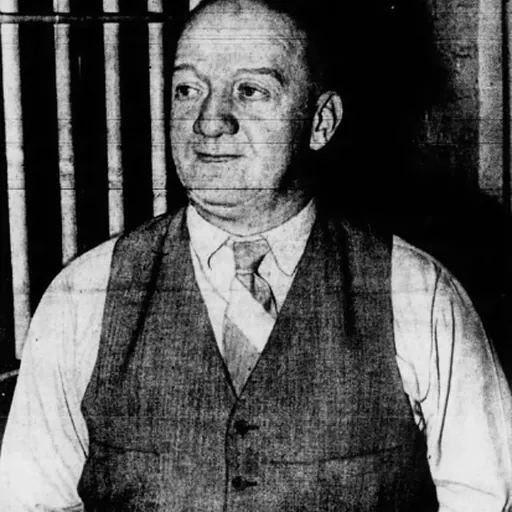
About Max Stephan
Lived 1892 – 1952 (aged 59–60). Max Stephan was a German and American restaurant owner and police officer.
Max Stephan (July 10, 1892 – January 13, 1952) was a German-born American citizen convicted of treason for aiding Peter Krug, a German pilot who had escaped from a prisoner of war camp in Canada. Stephan was initially sentenced to death by hanging. However, President Franklin D. Roosevelt, believing a death sentence was too harsh, commuted his sentence to life in prison just nine hours before he was scheduled to be executed. Stephan died in prison in 1952.
Stephan became the first person to be convicted of federal treason charges in a civilian court since the 1790s Whiskey Rebellion. Had Roosevelt not commuted his death sentence, he would have been the first to be executed.
Background Germany Stephan's biographical details were chronicled at length in the August 1942 court judgment sentencing him to death. Except where other sourcing is noted, the following summary is based on the details set forth in that judgment.
Stephan was born in Cologne, Germany, in 1892. He entered the Imperial German Army at age 20 for two years of compulsory military service. When World War I began, he held the rank of lance corporal (Gefreiter) and was promoted to sergeant. He was injured in battle in 1915.
After recovering from his injuries, Stephan served until 1917 as a guard at a military prison camp for deserters. During the final year of the war, he was assigned to a military post office, where he was tasked with reading and censoring soldiers' mail. Stephan and his wife applied for and received American citizenship in 1935. Judge Tuttle concluded that, in their citizenship applications, both Stephan and his wife had misrepresented the length of their residence in the United States.
Stephan also claimed that, during the time he lived in the United States, he never communicated with anyone in Germany and completely cut off his connections with Germany. As proof of his loyalty, Stephan noted that, after the war with Germany began, he purchased two $50 war bonds on December 17, 1941.
On the night of April 18, William J. Nagel visited Stephan's restaurant. Nagel was a prominent member of Detroit's German-American community; he had served as Detroit postmaster (1913–22), Detroit city controller (1923–24), managing director of the Michigan Liquor Control Commission (1933), and president of the Grosse Pointe Savings Bank. Stephan claimed that he had told Nagel about Krug and sought his advice. According to Stephan, Nagel advised that the war was over for Krug, that it was impossible for him to leave the country, and that if Nagel had the time he would personally drive him to Chicago to enjoy a couple days more of freedom. As Nagel was busy, he advised Stephan to take Krug to the bus station where the first bus for Chicago left at 10 a.m. Nagel advised that the bus was preferable to the train. According to Stephan, Nagel also gave him $3 for Krug, a sum Stephan used to purchase Krug's bus ticket. When questioned by the FBI, Nagel denied having spoken to Stephan or knowing anything about Krug. In the days following his arrest, Stephan granted interviews to reporters. In a jailhouse interview with James Melton of the Detroit Times, Stephan reportedly admitted that he was aware that Krug sought to escape in order to return to the fight and help Germany win the war. Stephan was quoted as saying:
All he wants to do is to get a stick in his hands again. And he'll do it, too ... Krug plans to go to South America and get on a Spanish boat for Germany ... He says the Germans will win the war next fall, so he has to get back in the fight fast.
Following Stephan's arrest, a manhunt was launched to capture Krug before he could reach neutral territory in Mexico. Krug was arrested on May 1, 1942, in San Antonio, Texas. Krug was returned to Detroit as a witness in the Stephan case.
Prosecution Push for a treason charge Stephan was initially charged with harboring an alien fugitive, but John C. Lehr, the United States Attorney for the Eastern District of Michigan, sought permission to charge Stephan with treason. The local press also advocated for the higher charge, the Detroit Free Press stating in an editorial:
There is but one charge that can be sensibly made against this man and that is treason. . . . [Nazi sympathizers and Hitler tools] are laughing at us! Stephan is charged with the panty-waist accusation that he 'harbored' an alien. . . . Yes, this is a free country; but freedom does not include treason according to the Constitution – contrary to a lot of soft-headed parlor-pink theorizing. We are at war.
Through mid-May, the U.S. Attorney General refused to charge Stephan with treason. The Detroit Free Press repeated its cry for the heightened charge: The police authorities, on the other hand, say that what Detroit needs more than anything else just now, is a trial for treason which will show that the Government means business. This alone, they say, would do more to discourage friends of the Axis powers here – and they figure Detroit alone has several thousand – than anything else.
The Detroit Times described Stephan as "an insignificant pawn" and called his specific act to be "negligible in consequence." Nevertheless, the Times urged that Stephan be given "short shrift" in order to demonstrate to Nazi and Japanese followers that Americans are not "softies and dilettantes in the war business" and to deliver "a severe blow to the entire fraternity" of "phoney naturalized citizens of German birth."
On June 2, 1942, a federal grand jury was impaneled in Detroit to consider treason charges against Stephan. The grand jury heard from 17 witnesses, including Krug.
On June 17, the grand jury indicted Stephan for treason. The indictment charged Stephan with 11 overt acts of treason as follows:
Driving to Margareta Bertelmann's home for the purpose of taking Krug under his protection; Obtaining money from Bertelmann for Krug's benefit; Escorting Krug from Bertelmann's home to his restaurant; Providing Krug with food, drink, personal effects and clothing; Making inquiry regarding Detroit-Chicago train schedules with intent to aid Krug; Escorting Krug to Haller's Cafe, 1407 Randolph Street, and buying drinks for Krug and concealing Krug's identity by introducing him as "one of the Meyer boys"; Taking Krug to the Progressive Club, 3003 Elmwood Avenue, buying him drinks, and introducing him as a friend from Milwaukee; Taking Krug to Theodore Donay's business, 3152 Gratiot Avenue, and obtaining money which was given to Krug; Escorting Krug to a disorderly house; Taking Krug back to Stephan's restaurant, feeding him, and introducing him as a friend from Milwaukee; and Taking Krug to the bus terminal and buying him a ticket to Chicago, the start of a journey intended to return Krug to active status with the German army.
Stephan was arraigned on June 20, and the trial was set to start nine days later.
Trial On June 29, 1942, Stephan's trial began in the courtroom of U.S. District Court Judge Arthur J. Tuttle, a federal judge since 1912. It was the first treason trial to be held in the United States since World War I.
Krug as the star witness
The trial began with testimony from Krug. Appearing in a dress uniform with gold epaulets and Nazi Luftwaffe wings, As a prisoner of war, Krug was under no obligation to testify, but agreed to do so voluntarily. He described Stephan's acts of kindness, including buying him a bag, a necktie, and a billfold and a "birthday trip" through Detroit that included multiple stops for food and drinks.
After testifying at length about Stephan's acts, Krug realized on questioning from the defense that his testimony might harm Stephan. When questioning then returned to the prosecutor, Krug "suddenly balked" and demanded to know whether his testimony was to be used against Stephan and asked the judge to be relieved from further questioning. Krug said: It was not my intention to testify against him. I was told by the FBI to clear things up. I never wanted to testify against the man who helped me. The FBI said it was just a statement of facts already known.
In response, Judge Tuttle folded his arms and shook his head, saying:
I can't help who you are testifying against. All I can do is try to get the truth and all I can say is to tell the truth. and "clicked his heels together in best Nazi fashion."
Additional evidence of overt acts Under the U.S. Constitution, conviction for treason requires "the testimony of two Witnesses to the same overt Act, or on Confession in open court." In an attempt to meet its constitutional burden, on June 30 and July 1 the government called other witnesses to confirm Stephan's overt acts. These witnesses included: William Lens testified to seeing Stephan and Krug together and that Stephan asked Lens about trains to Chicago. Carl Erhardt, a restaurant owner, testified that Stephan and Krug visited his restaurant during Krug's birthday tour, that Stephan introduced the young man as a friend from Milwaukee, and that Stephan asked Erhardt to sit with them. Erhardt did not remember details of the conversation, noting that some of it was in German. Eva Erhardt, wife of Carl, confirmed her husband's testimony.
The government also presented testimony by FBI agent John Bugas that Stephan had admitted following his arrest to having arranged Krug's shelter, purchased him gifts and a bus ticket, and taken him to the bus. Juror Marion B. Williams explained that the only discussion turned on whether Stephan intended to help the German government, saying "We decided that he had plenty of time to realize what he was doing and that he intended to help Germany." The full jury posed for a group portrait outside the courtroom following the verdict.
With the conviction, Stephan became the first person convicted of treason through a trial in a federal civilian court since the Whiskey Rebellion in the 1790s.
Death sentence
On August 6, 1942, Judge Tuttle sentenced Stephan to be hanged by the neck until dead, setting an execution date of November 13, 1942. In explaining his decision, Tuttle stated: This goes far beyond seeing to it that Max Stephan does not again commit treason. It has to do with others in our country who, like Max Stephan, are citizens of our country, but at heart are disloyal to our country and love the enemy better than they do the cause of the United States. They want the Axis to win this war. This Court would fall far short of doing its duty if it did not by this sentence teach a lesson to every disloyal citizen of the United States... It is a dreadful thing to take a human life, but we must remember that treason has to do with war and war has to do with death. The life of the traitor Max Stephan is less valuable than the lives of our loyal sons which are being given to the cause of the United States. We have been too soft, to the extent of being mushy. This is no ordinary war. In this war, we think of death in figures of millions. If the lives of many of our boys are to be taken to help such a cause, this Court should not hesitate to take the life of one traitor if it will help that same just cause. This Court should, in no hesitating or uncertain way, say to the disloyal element that during this war the penalty for treason is death.
In his comments from the bench, Judge Tuttle also reported that he had learned that the Stephans obtained their American citizenship by lying about residing in Detroit when they had been living in Windsor, Ontario (across the river in Canada) and operating a saloon and bed-house for unmarried couples. Tuttle also criticized Stephan's wife for disloyal statements and urged that proceedings be launched to revoke her citizenship and have her interned. Tuttle further offered his belief that there was a well-established "underground railway" of German loyalists to aid escaped prisoners with Stephan as an essential link. On his return to prison from the sentencing, Stephan reportedly told a deputy U.S. marshal who was guarding him, "I'll bet all the tea in China I won't hang." After the Sixth Circuit Court of Appeals affirmed the judgment and the Supreme Court declined to intercede, Tuttle reset the execution date for April 27 during a hearing at which the Detroit Times described Stephan as "a cringing, sobbing, whimpering treasonist."
After the Sixth Circuit rejected his appeal, Stephan's appellate attorneys, Nicholas Salowich and James E. McCabe, in April 1943 filed an appeal with President Franklin D. Roosevelt for executive clemency. They also filed a further petition for review to the Supreme Court. The Supreme Court rejected the petition for review in late May.
On June 5, 1943, after the petition for rehearing was rejected, Judge Tuttle reset the execution date for July 2, 1943, between the hours of 1 and 2 a.m. at the Federal Correctional Institution, Milan in Washtenaw County, Michigan. At the time, Judge Tuttle rebuked those petitioning President Roosevelt for clemency on Stephan's behalf. He rejected the uninformed opinion being advanced that Stephan did not intend to help Germany win the war. He noted that thousands of American soldiers were dying while Stephan's execution was postponed, and questioned the judgment of those who would hesitate to take the life of a traitor. A temporary scaffold was installed at the prison for use in the execution. As the execution approached, Stephan was described in the press as "a broken sobbing man." He told the prison chaplain that he had nightmares of the scaffold every night, a vision that haunted him; he awakened each night with a start; and "I've died a hundred deaths upon it."
At 4:55 p.m. on July 1, nine hours before the scheduled execution, word was received by the warden that President Roosevelt had commuted Stephan's sentence to life imprisonment. The White House issued a statement providing the basis for the commutation as follows: The President has commuted the death sentence of Max Stephan, of Detroit, to imprisonment for the term of his natural life. The man was properly convicted of treason. He was guilty. The statute provides the death penalty, or at the discretion of the court, imprisonment for not less than five years, together with fines. Thus the statute definitely contemplates, with respect to the sentence, treason of different qualities. In the case of the saboteurs who landed from German submarines – members of the German armed forces but wearing civilian clothes – a mature plan was concocted in Germany, initiated by the men in question and to be carried out in detail in the United States. Their offenses were, therefore, akin to a carefully planned murder in the first degree.
In the case of Stephan, however, his treason did not come from a plan maturely initiated by him. A German prisoner, who escaped from Canada and was put in touch with Stephan after reaching the city, stated he was trying to escape in order to rejoin the German armed forces, and was assisted by Stephan in proceeding to the next place. There is no question in the President's mind that Stephan was, and probably is, pro-German or pro-Nazi. His treason, however, was not part of a preconceived plan. His treason bore something of a parallel to murder in the second degree or manslaughter in the first degree. Therefore, his case was less of an offense than the case of the saboteurs last year. The President believes that the sentence imposed by the court was too severe in that it did not sufficiently take into account the statute which provides for the consideration of different qualities of treason. Stephan will go to prison for life, and the President hopes that no one of his successors will commute that sentence.
Aftermath After his sentence was commuted, Stephan was sent to the United States Penitentiary, Atlanta. He remained there for eight years, at which time he was transferred to the United States Medical Center for Federal Prisoners in Springfield, Missouri. He died of intestinal cancer at the Springfield Medical Center in January 1952.
Krug was returned to the Canadian POW camp. He escaped again in August 1943 and was captured three days later. He was transferred to a POW camp in Great Britain, where he remained until he was released in 1946. After his release, he worked as a steel salesman in West Germany. He was the subject of a feature story in the Detroit Free Press in April 1992, 50 years after his weekend in Detroit. A suicide note was found in his hotel room. In it, he explained his decision with the fact that his nerves had been wrecked by the "constant fear of deportation", which he saw as "a very dark outlook for [his] future" and did not have the financial means to appeal. He also asserted that he had not believed Krug to be a real soldier, that he had told Dietrick Rinterlen so and that Rinterlen had perjured himself by testifying otherwise in order to please the prosecution.
Bertelmann, the woman who called on Stephan to help Krug, was interned for the rest of the war and then deported to Germany. Upon her release, she filed for divorce on the grounds that her husband had not visited her while she was in prison.
Don’t just read it —
keep it.
Full-length biographies made to live with: read them, listen on the way to work, watch them tonight.
- E-book
- Audio
- Video
Instant download · yours to keep · every purchase keeps this site free
Important facts
People in Max Stephan's life
Named in this biography and alive at the same time



Related people
Same field, nearest in time



Contemporaries
People whose lives overlapped Max Stephan's

Frequently asked questions
Who was Max Stephan?
German-American convicted of treason 1942
When was Max Stephan born?
Max Stephan was born in 1892 in Cologne.
When did Max Stephan die?
Max Stephan died in 1952 in United States Medical Center for Federal Prisoners.
What was Max Stephan's occupation?
Max Stephan was a restaurant owner and police officer.
What nationality was Max Stephan?
Max Stephan was German and American.
Sources & further reading
Cite this page
APA: Biography.guide. (2026). Max Stephan. https://biography.guide/max-stephan/
MLA: "Max Stephan." Biography.guide, https://biography.guide/max-stephan/.
Chicago: "Max Stephan." Biography.guide. https://biography.guide/max-stephan/.
Data last updated: 2026-09-23 · Spot an error? Report a correction.
Portrait: Wikimedia Commons · author & licence
Page generated 2026-09-27 05:05 UTC