
About John Bugas
Lived 1908 – 1982 (aged 74). John Bugas was an American basketball player.
John Stephen Bugas (April 26, 1908 – December 2, 1982) was the second in command at Ford Motor Company during the presidency and chairmanship reign of Henry Ford II (the oldest grandson of founder Henry Ford). He is best known for taking control of the company away from Harry Bennett so that John could be in command of it—including drawing pistols on each other—following the death of Edsel Ford.
As the Detroit Free Press wrote of Bugas:
Early life The Bugas family originated from Slovakia. The parents of Jack Bugas, Andrew (Andrej) P. Bugas (born in 1867) and Helena L. Bugas (the name "Bugas" was then spelled "Bugos"), were both born in eastern Slovakia, in the village Lučina near Prešov. Andrew Bugas immigrated to the United States in 1882 (following his father, John P. Bugos, who immigrated in 1878, though died back in Slovakia, at that time part of Austria-Hungary, in 1902) and became a naturalized U.S. citizen at age 26 in 1891.
In 1901, Andrew Bugas was elected to the Wyoming State Legislature (as a Republican) and served six terms until 1907. Andrew and Helena Bugas married in 1902 and from 1903 to 1929 had a total of eight sons and two daughters. Bugas later recalled standing with his father outside the Eagle's Nest weeping as they burned the paid-off note.
Bugas had a favorite story about ranch life in Wyoming:
Bugas claimed that as a child he would punch cows for entertainment.
Bugas graduated from Laramie High School.
The "tall, rangy" Bugas (at 6'1"
Bugas established a reputation as a "man with unlimited patience and efficiency" in his work on "notorious kidnapping, espionage, bank robbery and other major cases." Some say Bennett (who had originally been hired by Henry Ford to stifle attempts at unionization) targeted hiring the "tough-as-nails former FBI man" in hopes of neutralizing him, as Bugas's 1941 FBI investigation and discovery of theft from Ford's Rouge plant implicated some of Bennett's cronies.
Edsel Ford, Henry Ford's only child, once mentioned to Bugas "how vulnerable he felt his family was to Bennett's machinations." When Edsel Ford died an early death in 1943 at the age of 49, his widow Eleanor blamed Bennett.
After Edsel's death, Eleanor struggled to get Henry Ford to step down and let Edsel's oldest son Henry Ford II take control of the company, including by threatening to liquidate her and Edsel's Ford stock—almost half of the outstanding shares in the company. But according to Ford II, it was a few allies, most notably Jack Bugas, who ultimately swayed the senior Ford to step aside.
When 28-year-old Ford II was selected by his grandfather in 1945 to succeed him as president of Ford (at that time America's largest private corporation), Bugas was immediately put in charge of taking control of the company from Harry Bennett's entrenched gangster element in management, and of ousting Bennett.
Kiplinger Magazine wrote in 1947 that "no one has risen faster in the Ford organization than big, brown-eyed John Bugas." The "practical and energetic man" ultimately became second in command at Ford as "Henry Ford II's closest confidant,". He helped restructure and revitalize the struggling company, which faced considerable financial and strategic challenges transitioning from military manufacturing to a peacetime economy, and by 1956 make it a publicly traded corporation. The Ford initial public offering was the largest and most oversubscribed the United States had ever seen, raising nearly $700 million — roughly $5 billion in today's terms.
Bugas even came to play a role in car design at Ford, most notably of the Cortina (which later became the Corsair). One of the most distinctive features of the Cortina's styling came about because Bugas, as head of Ford's International Division, "demanded circular tail-lights in the Ford tradition" rather than the three-pointed star shape in Charles Thompson's original design. Bugas made the change while Thompson was off ill.
At Ford, Bugas held various vice president titles (among them industrial relations, international import-export group), as well as consulted directly with Henry Ford. Bugas also served as a member of the board of directors starting in 1950.
Bugas took on new directorships in other companies. He moved into an office in the Standard Oil of Indiana Building and worked on oil leases for a partnership he had with Marathon Oil Company and Max Fisher, Bugas also became more deeply involved in the management of his vast Wyoming cattle ranches.
In the major reshuffling of Richard Nixon's cabinet posts in 1973 during the growing Watergate scandal, Bugas narrowly missed being selected by Nixon as Director of the FBI (instead of William Ruckelshaus).
A 1991 book claimed, anecdotally: "As if to illustrate the power of directives at Ford, the company still insists on spelling employee with one final e ['employe'], a practice begun by a directive from John Bugas in the mid 1940s! He is said to have insisted that the spelling of employee conform to current newspaper style," while another story says that his intention was to "save a lot of money in typing and paper costs."
Wyoming cowboy
Bugas would always retain a love for his home state of Wyoming, saying "Its wide, un-cramped spaces ... give me a feeling of personal freedom I have never felt anywhere else." ("by far the largest private ownership" within the Absaroka Mountain Range in northwest Wyoming (near what is historically known for being the home of Buffalo Bill). There he owned multiple working cattle ranches, with over 800 head of Hereford cattle, He would spend his time there riding, fishing, and hunting amidst the ranch's twelve-thousand foot mountain peaks, canyons, waterfalls, and rivers.
Bugas had a strong belief that his ranchland "ought to have fewer elk and more cattle" (and he put up miles of high fencing to keep migratory elk out of his pastures), and fought for restrictions on private development there ("provided they do not interfere with his cattle ranching activities"). It remained one of the most remote working ranches still in existence in the United States, accessible only by air or horseback, with no conventional roads leading to the ranch.
Bugas's ranch in Sunlight Basin contains the Bugas-Holding site, a notable Late Prehistoric age winter hunting campsite located along Sunlight Creek, a stream in the lower elevations with evidence of bison and mountain sheep hunting.
Author Loren Estleman wrote that Bugas "exhibited a rough frontier charm that might not have been all artifice, helped along by frank dark eyes slanting away from a nose like the prow of an icebreaker and a shy smile that showed no teeth. His pioneer inflections were gentle. Company scuttlebutt said he was embarrassed by stories about his obstreperous past and had taken steps to eradicate the frontier influence from his manner, including speech lessons." ) as well as wingshooter (frequenting partridge, pheasant, and grouse shoots at his ranches and throughout the world
Personal life
In addition to his Wyoming ranches, for the last twenty-five years of his life Bugas's main home was his sprawling country estate in Bloomfield Hills, Michigan, which he named Woodland. Woodland became the unofficial site for many discreet Ford meetings (as well as discreet poker games), including with Henry Ford, McNamara, Lee Iacocca, Carroll Shelby, and Hoover. and in 1980 with presidential candidate Ronald Reagan. Woodland is not unlike the fortified "Castle" compound built by Henry Ford for Bugas's predecessor and nemesis Bennett, where Bugas and his family spent much time. Like Henry's and Edsel's houses, Woodland also had a Ford-built, detached industrial power house serving the main house. Bugas also owned riding stables nearby. (Upon Bugas's death, Woodland was purchased by Max Fisher's close friend and fellow Forbes 400 member Alfred Taubman, and the house was later featured in a Vogue magazine spread. )
Bugas was a significant patron of the University of Wyoming, the Whitney Western Art Museum, and Cranbrook Kingswood, as well as a major Republican Party supporter. He was the recipient of many awards, ranging from Automotive Executive of the Year to the Anti-Defamation League's Human Relations Award ("for a life-time of service in the field of human rights").
Bugas was a practicing Catholic, and was among the "weighty, prominent list" of financial advisors to the church (and had periodic meetings with Pope John XXIII at Vatican City ). He was director of the National Conference of Christians and Jews, making many public appearances in support of the conference.
He was married to Margaret Stowe McCarty (a descendant of Harriet Beecher Stowe He also headed up security at Republican National Conventions.
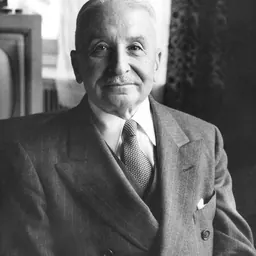
Despite his "erstwhile G-man" ) as a rare instance of a prominent historical businessman who "followed in the footsteps" of Austrian economist Ludwig von Mises (in a Mises Institute article John Bugas: G-Man, Ford Executive, Misesian?). Like Mises, Bugas "made the notion of 'consumer sovereignty' a key plank in his economic analysis and defense of the market economy." Bugas "realized that this insight from objective economic science was very useful rhetorically in battling the foes of (what is usually called) capitalism."
In a 1955 speech, Bugas notably coined the term "consumerism" as a substitute for "capitalism" to better describe the American economy:
Though the term "consumerism" first appeared in 1915, it was Bugas who first adopted it to illustrate the "consumer sovereignty" concept of Mises, "as a means of contrasting the American economy to that of the Soviet Union."
Don’t just read it —
keep it.
Full-length biographies made to live with: read them, listen on the way to work, watch them tonight.
- E-book
- Audio
- Video
Instant download · yours to keep · every purchase keeps this site free
Important facts
People in John Bugas's life
Named in this biography and alive at the same time




Related people
Same field, nearest in time

Contemporaries
People whose lives overlapped John Bugas's



Frequently asked questions
Who was John Bugas?
American automotive industry executive
When was John Bugas born?
John Bugas was born on 26 April 1908 in Rock Springs.
When did John Bugas die?
John Bugas died on 2 December 1982 in Ann Arbor.
What was John Bugas's occupation?
John Bugas was a basketball player.
What nationality was John Bugas?
John Bugas was American.
Sources & further reading
Cite this page
APA: Biography.guide. (2026). John Bugas. https://biography.guide/john-bugas/
MLA: "John Bugas." Biography.guide, https://biography.guide/john-bugas/.
Chicago: "John Bugas." Biography.guide. https://biography.guide/john-bugas/.
Data last updated: 2026-09-25 · Spot an error? Report a correction.
Page generated 2026-09-27 05:10 UTC