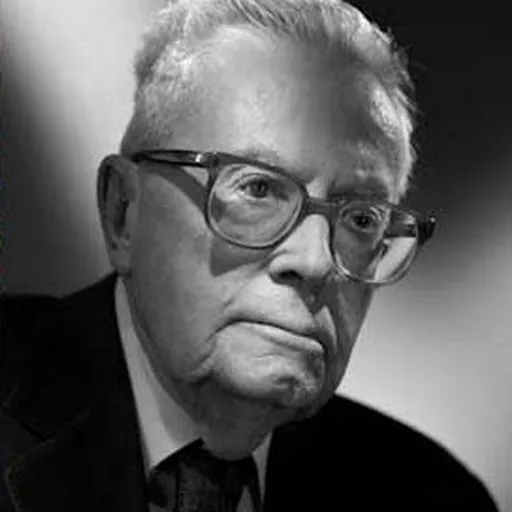
About Maurice Allais
Lived 1911 – 2010 (aged 99). Maurice Allais was a French economist, physicist, engineer and researcher.
Maurice Félix Charles Allais (; 31 May 19119 October 2010) was a French physicist and economist, the 1988 winner of the Nobel Memorial Prize in Economic Sciences "for his pioneering contributions to the theory of markets and efficient utilization of resources", along with John Hicks (Value and Capital, 1939) and Paul Samuelson (The Foundations of Economic Analysis, 1947), to neoclassical synthesis. They formalize the self-regulation of markets, which Keynes refuted but reiterated some of Allais's ideas.
Born in Paris, France, Allais attended the Lycée Lakanal, graduated from the École Polytechnique in Paris and studied at the École nationale supérieure des mines de Paris. His academic and other posts have included being Professor of Economics at the École Nationale Supérieure des Mines de Paris (since 1944) and Director of its Economic Analysis Centre (since 1946). In 1949, he received the title of doctor-engineer from the University of Paris, Faculty of Science. He also held teaching positions at various institutions, including at the university of Paris X–Nanterre. His first works oriented him towards the sciences of the concrete and the experiments of fundamental physics, on which he will also publish numerous works, notably on pendular oscillations and the laws of gravitation. It's after a trip in 1933 to the United States during the Great Depression, that he decides to make the economy. Allais died at his home in Saint-Cloud, near Paris, at the age of 99.
Allais considered Léon Walras, Wilfredo Pareto, and Irving Fisher to be his primary influences. He was reluctant to write in or translate his work into English, and many of his major contributions became known to the dominant community only when they were independently rediscovered or popularized by English-speaking economists. At the same time, he claimed Keynes's liberalism and declared himself in favor of an important public sector. Allais attended the inaugural meeting of the Mont Pelerin Society, but he was alone among the attendees to refuse to sign the statement of aims because of a disagreement over the extent of property rights. He exerted an important influence, at the end of the war, on French economists such as Gérard Debreu, Jacques Lesourne, Edmond Malinvaud and Marcel Boiteux.
Paul Samuelson said "Had Allais earliest writings been in English, a generation of economic theory would have taken a different course", and felt the Nobel Prize should have been awarded to him much earlier. Assar Lindbeck, the chairman of the selection committee, considered Allais as "a giant within the world of economic analysis".
Economist Author of several theoretical and applied economics studies,
He was also responsible for early work in Behavioral economics, which in the US is generally attributed to Daniel Kahneman and Amos Tversky. In the 1940s, Allais worked on "decision theory" (or "theory of choice") under uncertainty and developed a theory of cardinal utility. Due to war conditions and his commitment to publish in French, his work was undertaken independently of Theory of games and economic behavior developed by John von Neumann and Oskar Morgenstern. He formulated the Allais paradox in 1953, which questions the traditional model of rationality of choices and contradicts the expected utility hypothesis.
Liberalism and socialism Although he participated in the Mont Pelerin Society, Allais was convinced of an affinity between liberalism and socialism, stating: "'For the true liberal, as for the true socialist, it matters little whether the means of production are privately or collectively owned, so long as the essential goals they pursue, namely efficiency and justice, are achieved." He advocated "competitive planning" as a "possible synthesis of liberalism and socialism." In 1959, he and other French members of Mont Pelerin such as Jacques Rueff established an organization, Mouvement pour une société libre, which spoke readily of a social liberalism that would go "beyond laissez-faire and socialism." It was praised by Milton Friedman in 1968 with the following words: "This work [the HRL formulation] introduces a very basic and important distinction between psychological time and chronological time. It is one of the most important and original paper that has been written for a long time ... for its consideration of the problem of the formation of expectations". Allais's contribution has nevertheless been "lost": it has been absent from the debate about expectations.
Position against globalization On the first page, he dedicates his book La mondialisation: destruction des emplois et de la croissance (1990), Globalization: destruction of jobs and growth, "To the countless victims worldwide of the free-trade ideology, ideology as fatal as it is erroneous, and to all those who are not blind to some partisan passion". Allais believes that Ricardo's theory is valid only in a steady state, but disappears when the specializations evolve and when the capital is mobile.
According to him,
In his opinion, crisis and globalization are linked: "The financial and banking crisis which, is only the spectacular symptom of a deeper economic crisis: the deregulation of competition in the global labor market ". "Current unemployment is due to this total liberalization of trade[...] As such, it constitutes a major foolishness, starting from an unbelievable contradiction. Just as attributing the crisis of 1929 to protectionist causes is a historical contradiction. The true origin was already in the careless development of credit in the years preceding it."
In 1992, Allais criticised the Maastricht Treaty for its excessive emphasis on free trade. He also expressed reservations on the single European currency. In 2005, he expressed similar reservations concerning the European Constitution.
Physics
Besides his career in economics, he performed experiments between 1952 and 1960 in the fields of gravitation, special relativity and electromagnetism, to investigate possible links between the fields. He reported three effects: An unexpected anomalous effect in the angular velocity of the plane of oscillation of a paraconical pendulum, detected during two partial solar eclipses in 1954 and 1959. The claimed effect is now called the Allais effect. Anomalous irregularities in the oscillation of the paraconical pendulum with respect to a sidereal diurnal periodicity of 23 hours 56 minutes and tidal periodicity of 24 hours 50 minutes. Anomalous irregularities in optical theodolite measurements, with the same lunisolar periodicities.
Over the years, a number of pendulum experiments were performed by scientists around the world to test his findings. However, the results were mixed.
Don’t just read it —
keep it.
Full-length biographies made to live with: read them, listen on the way to work, watch them tonight.
- E-book
- Audio
- Video
Instant download · yours to keep · every purchase keeps this site free
Important facts
People in Maurice Allais's life
Named in this biography and alive at the same time



Related people
Same field, nearest in time



Contemporaries
People whose lives overlapped Maurice Allais's






Frequently asked questions
Who was Maurice Allais?
French economist (1911–2010)
When was Maurice Allais born?
Maurice Allais was born on 31 May 1911 in 14th arrondissement of Paris.
When did Maurice Allais die?
Maurice Allais died on 9 October 2010 in Saint-Cloud.
What was Maurice Allais's occupation?
Maurice Allais was an economist, physicist, engineer and researcher.
What nationality was Maurice Allais?
Maurice Allais was French.
Sources & further reading
Cite this page
APA: Biography.guide. (2026). Maurice Allais. https://biography.guide/maurice-allais/
MLA: "Maurice Allais." Biography.guide, https://biography.guide/maurice-allais/.
Chicago: "Maurice Allais." Biography.guide. https://biography.guide/maurice-allais/.
Data last updated: 2026-09-23 · Spot an error? Report a correction.
Portrait: Wikimedia Commons · author & licence
Page generated 2026-09-27 05:06 UTC