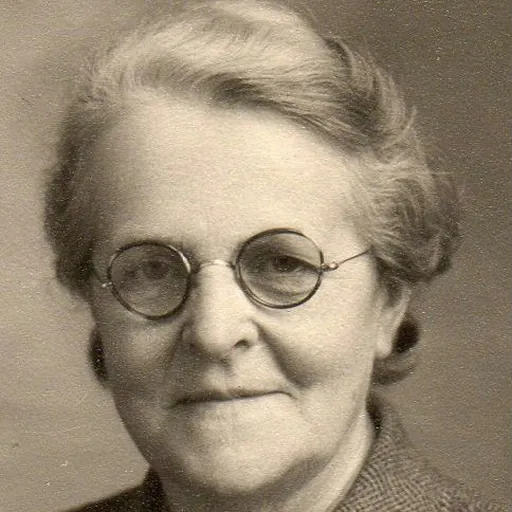
About Mary Fisher
Lived 1884 – 1972 (aged 87). Mary Fisher was a butcher and mayor.
Mary Fisher (; 6 June 1884 – 28 February 1972) was an English charity worker and politician. She was a Conservative councillor, and justice of the peace who became the first woman mayor of Harrogate, in the North Riding of Yorkshire, England, and devoted 60 years of her life to public service.
Fisher introduced the Girl Guides movement to Harrogate, and involved herself with education, hospital visiting and the poor. She gave her support to the work of Soroptimist International, the British Deaf Association and the Royal National Lifeboat Institution (RNLI). She was a justice of the peace and a Conservative councillor. Along with other councillors she co-founded a care home which was named after her. Her committee duties included the local Unemployment Assistance committee and, during the Second World War, the war savings committee and the local Ministry of Information committee. She oversaw the hosting in Harrogate of twenty distressed children from war-torn Austria, and was interviewed by Richard Dimbleby in the Down Your Way radio programme.
Although referred to in a patronising manner by a group of journalists, Fisher oversaw the successful move of the Great Yorkshire Show to a permanent venue in Harrogate. She presided over Yorkshire's first arena stage production at the Royal Hall, Harrogate. In recognition of her public service work, she was appointed Member of the Order of the British Empire (MBE) in the 1958 Birthday Honours. She was made an honorary freeman of the borough of Harrogate, and was elected to the Roll of Honorary Aldermen of Harrogate. In 2025 a brown plaque was erected in Harrogate to commemorate Fisher's work.
Background Fisher's maternal grandfather was Lister Holmes, a farmer of in Yorkshire. Her parents were Swires Stott, a groom, gardener and innkeeper, and Jane Stott née Holmes, who ran a shop in Commercial Street, Harrogate, and they had a home not far from the business, at 1 Mount Parade. and their daughter was Clara Colman née Fisher, a butcher's clerk before she married. Her death made the front page of the Harrogate Herald. She was buried at Stonefall Cemetery, Harrogate,
In the 1920s, Fisher was one of the persons who founded the Girl Guides movement in Harrogate.
From 1939 Fisher served as a magistrate, or justice of the peace. In 1943 she became a justice of the juvenile court. In the same year she was elected Conservative councillor for Harrogate's West Ward, and in 1945 West Central Ward. She served on the local Unemployment Assistance committee, besides various council committees. During the Second World War she served on the war savings committee and the local Ministry of Information committee.
Mayoral duties in 1949
On 7 February 1949, Fisher accepted Harrogate Council's invitation to become its first female mayor. The Yorkshire Evening Post said that her election was "enthusiastically acclaimed by an audience among whom women were predominant". Fisher said: "I feel that this is not only an honour to myself, but an honour to the women of Harrogate, who have done such splendid work in so many ways and for so many years". On 13 June 1949 Harrogate Council saw a woman in the mayoral chair for the first time, at its monthly meeting. Her niece Kathleen Mary Niner was her mayoress, and they were officially installed in May. As mayor she appeared in an episode of Down Your Way, a radio series in which Richard Dimbleby interviewed her. She also hosted twenty distressed children from war-torn Austria, writing to the local newspaper and begging for donations of clothing for the children.
By June, the British Medical Association's conference officials were still confused by having to address Fisher formally as "Mr Mayor". At a Harrogate conference, the Chartered Institute of Journalists described Fisher and her lady mayoress in a patronising manner, and the local papers followed suit:
The grey-haired, spectacled Mayor (Mrs. Mary Fisher) and her niece, the chubby-faced Mayoress (Mrs. Kathleen Mary Niner), became great favourites with the conference. They were personifications of a homely Yorkshire welcome. A London delegate described them as a "couple of dears". The show continued to be successful in its Harrogate venue, and by 2023 was being described by the Harrogate Advertiser as "one of the best agricultural shows in the United Kingdom". In June 1949 at the Royal Hall, Harrogate, Fisher presided over Yorkshire's first arena stage production, in which the audience surrounded the players.
When Princess Elizabeth and Prince Philip visited the West Riding of Yorkshire for a royal tour in the summer of 1949, Fisher asked the Harrogate householders along the processional route to decorate their houses as a welcome gesture. The chairman of West Riding County Council invited the royal couple to dinner at the Majestic Hotel, Harrogate where Fisher, in a black georgette dress and mayoral chain of office, met them. In June 1949 Fisher was invited by the Lord Mayor of London to attend a London meeting about the projected 1951 Festival of All Arts, in response to a suggestion that Harrogate should provide its own concurrent event referencing the festival.
There were some dark moments when, for example, in June 1949 Fisher attended a radiographers' conference in which the speaker voiced the contemporary fear of a World War III and the atomic bomb. In August 1949, Fisher was involved in some controversy, when she objected to a noisy greyhound racetrack being opened by a local window cleaner in peaceful Harrogate. She condemned the proposals as "not quite the right thing for Harrogate". However the position of mayor had some light-hearted moments, for example when in August 1949 Fisher presented the prizes for the Yorkshire beauty queen competition at the Royal Baths, Harrogate, and two of the top three finalists were Harrogate women. It was the mayor's job to crown the new beauty queen in September of that year, when the Bradford Observer reported: "One of the most attractive scenes [of the gala] was the crowning by the mayor (councillor Mrs Mary Fisher) of the Yorkshire Beauty Queen". Another pleasant event for Fisher and her mayoress was an invitation to attend the wedding of the Earl of Harewood and Marion Stein on 29 September at St Mark's, Mayfair and the reception at St James' Palace, which they attended alongside Frederick Ashton, John Barbirolli, Benjamin Britten and Douglas Fairbanks Jr.
There was more controversy in October, when the Convocation of York and the Council of Women's conference in Harrogate separately pronounced upon or debated the unprecedented "sale of birth control requisites in slot machines" in Yorkshire. Fisher welcomed the women delegates to their conference, but in York the convocation recorded its "abhorrence of the use of automatic machines for the indiscriminate sale of birth control requisites". The women's conference did, however, pass a resolution to raise the old age pension from £1 a week to 26 shillings .
Fisher accepted a gift on behalf of Harrogate when in November 1949 a Harrogate dealer received from the South of England a chased, solid silver snuffbox measuring , with the inscription, "Harrogate Races. The gift of the Visitors. Won by Peggy, the property of F. Green esquire, 29th August 1838". Twelve prominent Harrogate antique dealers agreed that as a significant historical artefact of Harrogate's past, "its rightful place was in the mayor's parlour". One of their number, A.A. Greenwood, said "It is unique, and a beautiful piece of workmanship". On 13 December it was presented to Fisher for the town. The box remains today in Harrogate Council's collection. At the end of 1949 during her mayoral year, Fisher and her mayoress attended a carnival ball at the Royal Hall, while the bells of St Mary's Church rang out for the start of 1950.
Subsequent public service
In February 1950, Fisher had the use of a "luxurious" Rolls-Royce car, which she used to transport the Empire Games gold medallist Len Eyre on his triumphal return home. After Eyre stepped into Harrogate railway station from the train to meet Fisher and a crowd of well-wishers, Fisher, Eyre, Eyre's wife and the Rolls made a triumphal entry into Eyre's home village of Beckwithshaw, while the bells of St Michael and All Angels rang and the villagers cheered. In the same month, Fisher and her mayoress welcomed eighteen mayors and other civic representatives to Harrogate's first post-war civic ball at the Royal Hall. The ball included eight hundred guests. The Yorkshire Post reported: "Not since Princess Elizabeth and the Duke of Edinburgh came to Harrogate [in summer 1949] has such a large scale civic function been arranged for the spa". A striking event at that meeting was, as described by the Yorkshire Post, a "grand march of the guests round the ballroom floor – a ceremonial which greatly impressed [Fisher] when she attended a civic function in Huddersfield recently".
In April 1950, Fisher oversaw Harrogate's involvement in a radio competition called Top Town. This was a light-hearted series in which various local towns competed to provide fifteen minutes of the best amateur entertainment. Fisher and the mayor of Huddersfield tossed a coin for the first spot. Huddersfield won both the toss and the match. Fisher was succeeded as mayor by alderman C.E. Whiteley, a member of the Liberal Party. Fisher was elected as the first female alderman of Harrogate Council in 1954.
Awards Fisher was appointed Member of the Order of the British Empire (MBE) in the 1958 Birthday Honours. She was made an honorary freeman of the borough of Harrogate in 1970, and elected to the Roll of Honorary Aldermen of Harrogate in the same year.
Don’t just read it —
keep it.
Full-length biographies made to live with: read them, listen on the way to work, watch them tonight.
- E-book
- Audio
- Video
Instant download · yours to keep · every purchase keeps this site free
Important facts
People in Mary Fisher's life
Named in this biography and alive at the same time




Related people
Same field, nearest in time


Contemporaries
People whose lives overlapped Mary Fisher's
Frequently asked questions
Who was Mary Fisher?
English politician (1884–1972)
When was Mary Fisher born?
Mary Fisher was born on 6 June 1884 in Kirby Hill.
When did Mary Fisher die?
Mary Fisher died on 28 February 1972 in Harrogate.
What was Mary Fisher's occupation?
Mary Fisher was a butcher and mayor.
Sources & further reading
· DBpedia: Mary Fisher (mayor)
Cite this page
APA: Biography.guide. (2026). Mary Fisher. https://biography.guide/mary-fisher-butcher/
MLA: "Mary Fisher." Biography.guide, https://biography.guide/mary-fisher-butcher/.
Chicago: "Mary Fisher." Biography.guide. https://biography.guide/mary-fisher-butcher/.
Data last updated: 2026-09-21 · Spot an error? Report a correction.
Portrait: Wikimedia Commons · author & licence
Page generated 2026-09-27 04:59 UTC