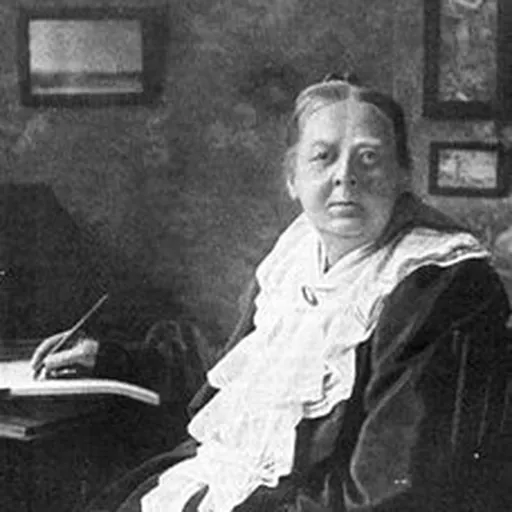
About Mary Everest Boole
Lived 1832 – 1916 (aged 83–84). Mary Everest Boole was a British mathematician and philosopher.
Mary Everest Boole (11 March 183217 May 1916) was a self-taught mathematician married to logical pioneer George Boole during his years in Cork, Ireland. She is known as an author of didactic works on mathematics, such as Philosophy and Fun of Algebra. Her unconventional ideas on education, as expounded in The Preparation of the Child for Science, included encouraging children to explore mathematics through playful activities such as curve stitching. Her life is of interest to feminists as an example of how women made careers in an academic system that did not welcome them. The deed was witnessed by "John Knights, Porter at Queens College, Harley Street, London and Jane White, Housekeeper at 68 Harley Street, London". As well as working as a librarian, she also tutored privately in mathematics and developed a philosophy of teaching that involved the use of natural materials and physical activities to encourage an imaginative conception of the subject. Her interest extended beyond mathematics to Darwinian theory, philosophy and psychology and she organised discussion groups on these subjects among others. At Queen's College, against the approval of the authorities, she organised discussion groups of students with the unconventional James Hinton, a promulgator of polygamy. This in part led to her mental breakdown and the dispersal of her children.
In later life, she belonged to the circle of the Tolstoyan pacifist publisher, C. W. Daniel; she chose the name The Crank for his magazine because, she said, 'a crank was a little thing that made revolutions'.
Mary took an active interest in politics, introducing her daughter Ethel to the Russian anti-tsarist cause under Sergei Stepniak. After the Boer war 1899–1902 she became more outspoken in her writings against imperialism, organized religion, the financial world and the tokenism she felt that Parliament represented. She opposed women's suffrage and probably for this reason has not generally been regarded as a feminist. She died in 1916, at the age of 84.
Boole was a practitioner of homeopathic medicine.
Contributions to education Mary first became interested in mathematics and teaching through her tutor in France, Monsieur Deplace. He helped her understand mathematics through questioning and journal writing. After marrying George Boole she began contributing to the scientific world by advising her husband in his work while attending his lectures, both of which were unheard of for a woman to do in that time period. During this time she also shared ideas with Victoria Welby, another female scholar and dear friend. They discussed everything from logic and mathematics, to pedagogy, theology, and science.
Her teaching first began while working as a librarian. Mary would tutor students with new methods; using natural objects, such as sticks or stones. She theorized that using physical manipulations would strengthen the unconscious understanding of materials learned in a classroom setting. One of her most notable contributions in the area of physical manipulations is curve stitching with the use of sewing cards, which she discovered as a form of amusement as a child. This helped to encourage the connections of mathematical concepts to outside sources.
Her book Philosophy and Fun of Algebra explained algebra and logic to children in interesting ways, starting with a fable, and including bits of history throughout. In the first chapter, "From Arithmetic to Algebra," Mary opens her book by explaining "Logos" or as she calls it "hidden wisdom" through an analogy with a tale about a King or Parliament passing an act that would be against the Logos described in her book. Moving onto chapter 2, "The Making of Algebras," Mary writes a about a story of two groups, the Arabs and their cousins who lived outside of Arabia, the Hebrews. She explains more about the uses of algebra, taking from her husbands form of algebra, Boolean Algebra. She further explains with an example of two babies, both of whom, in their own ways, learn about algebra. One baby touches a tea pot and finds it to be cool; another baby touches a different tea pot and finds it to be hot. Both children learned by "empirical experience."
Don’t just read it —
keep it.
Full-length biographies made to live with: read them, listen on the way to work, watch them tonight.
- E-book
- Audio
- Video
Instant download · yours to keep · every purchase keeps this site free
Important facts
People in Mary Everest Boole's life
Named in this biography and alive at the same time


Related people
Same field, nearest in time



Contemporaries
People whose lives overlapped Mary Everest Boole's





Frequently asked questions
Who was Mary Everest Boole?
author of didactic works on mathematics (1832-1916)
When was Mary Everest Boole born?
Mary Everest Boole was born in 1832 in Wickwar.
When did Mary Everest Boole die?
Mary Everest Boole died in 1916 in Notting Hill.
What was Mary Everest Boole's occupation?
Mary Everest Boole was a mathematician and philosopher.
What nationality was Mary Everest Boole?
Mary Everest Boole was British.
Sources & further reading
· Wikipedia: Mary Everest Boole
Cite this page
APA: Biography.guide. (2026). Mary Everest Boole. https://biography.guide/mary-everest-boole/
MLA: "Mary Everest Boole." Biography.guide, https://biography.guide/mary-everest-boole/.
Chicago: "Mary Everest Boole." Biography.guide. https://biography.guide/mary-everest-boole/.
Data last updated: 2026-09-22 · Spot an error? Report a correction.
Portrait: Wikimedia Commons · author & licence
Page generated 2026-09-27 05:03 UTC