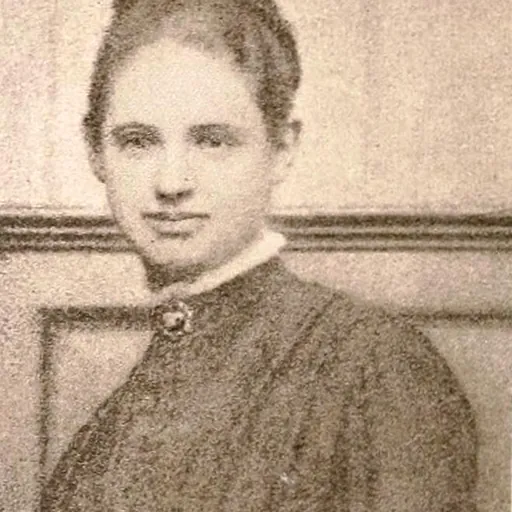
About Mary Elizabeth Coleridge
Lived 1861 – 1907 (aged 45). Mary Elizabeth Coleridge was a British poet, novelist and writer.
Mary Coleridge (23 September 1861 – 25 August 1907) was a British novelist and poet who also wrote essays and reviews. She wrote poetry under the pseudonym Anodos (a name taken from George MacDonald). Other influences on her were Richard Watson Dixon and Christina Rossetti. Robert Bridges, the Poet Laureate, described her poems as 'wondrously beautiful… but mystical rather than enigmatical'.
Biography Mary Elizabeth Coleridge was born in Hyde Park Square, London, the daughter of Arthur Duke Coleridge, who was a lawyer and influential amateur musician. With the singer Jenny Lind, her father was responsible for the formation of the London Bach Choir in 1875. Other family friends included Robert Browning, Alfred, Lord Tennyson, John Millais and Fanny Kemble. She was the great-grandniece of Samuel Taylor Coleridge and the great niece of Sara Coleridge, the author of Phantasmion.
Coleridge was educated at home, mostly by the poet and educationalist W. J. Cory, and began writing poetry as a child. She travelled widely throughout her life, although her home was in London, where she lived with her family. She taught at the London Working Women's College for twelve years from 1895 to 1907.
She completed five novels. Her first was The Seven Sleepers of Ephesus, published in February 1893 by Chatto & Windus. The story (which is unrelated to the Seven Sleepers of Ephesus legend) centres on a mysterious "Brotherhood" involved in the production of a play in a nineteenth-century German town. It received mixed reviews. The novel was credited only to "M. E. Coleridge", which led at least one newspaper to assume that the author was a man.
Edward Arnold published the other four novels. The best known is The King with Two Faces, which earned her £900 in royalties in 1897, running through six editions in its first year. The subject is the French Revolution and the assassination of Gustavus III of Sweden in 1792.
In 1954 interest was revived by the first comprehensive Collected Poems to be issued, edited by Rupert Hart-Davis and with an introduction by Theresa Whistler. More recently, her work has been further re-assessed and included in anthologies of fin de siècle Victorian women's poetry by Angela Leighton and Margaret Reynolds, and Isobel Armstrong and Joseph Bristow. Heather Braun contributed a substantial introduction to a reprint of her final published novel, The Lady on the Drawingroom Floor (with selected poetry and prose) in 2018.
Musical settings The relative simplicity of Mary Coleridge's lyrical poetry, combined with its touch of mysticism and strong imagery, proved congenial to composers. Both Hubert Parry and Charles Villiers Stanford were friends of Mary's father, and frequent visitors to the family home at 12, Cromwell Place, South Kensington. Parry set seven of her poems as songs for voice and piano in his English Lyrics, Ninth Set, published in 1909. In the opinion of Trevor Hold, "no-one set her more sympathetically than Parry". Stanford composed two sets of eight choral partsongs, Op. 119 and Op. 127 (both 1910). By far the best known of these (and of any Coleridge setting) is "The Blue Bird", from Mary's poem originally published in 1897 under the French title "L'Oiseau Bleu".
Other settings include several by John Ireland and Roger Quilter, three poems (including "Thy Hand in Mine") by Frank Bridge, and the Four Dramatic Songs, Op. 44 for solo voice and orchestra by Cyril Rootham (1913 - later also arranged for voice and piano). William Busch set "L'Oiseau Bleu" in a German translation as "Der blaue Vogel" (1944).
Published works
Collection of poems. Republished as
Collection of poems, including eleven repeated from Fancy's Following.
Collection of brief essays.
Posthumous, with an introduction by Henry Newbolt.
Posthumous study of the eponymous artist. The Collected Poems of Mary Coleridge, ed. Theresa Whistler. London: Rupert Hart-Davis, 1954 The Lady on the Drawingroom Floor with Selected Poetry and Prose, ed. Heather Braun. Vancouver: Fairleigh Dickinson University Press, 2018.
Don’t just read it —
keep it.
Full-length biographies made to live with: read them, listen on the way to work, watch them tonight.
- E-book
- Audio
- Video
Instant download · yours to keep · every purchase keeps this site free
Important facts
People in Mary Elizabeth Coleridge's life
Named in this biography and alive at the same time





Related people
Same field, nearest in time

Contemporaries
People whose lives overlapped Mary Elizabeth Coleridge's

Frequently asked questions
Who was Mary Elizabeth Coleridge?
Poet and a british writer (1861–1907)
When was Mary Elizabeth Coleridge born?
Mary Elizabeth Coleridge was born on 23 September 1861 in London.
When did Mary Elizabeth Coleridge die?
Mary Elizabeth Coleridge died on 25 August 1907 in Harrogate.
What was Mary Elizabeth Coleridge's occupation?
Mary Elizabeth Coleridge was a poet, novelist and writer.
What nationality was Mary Elizabeth Coleridge?
Mary Elizabeth Coleridge was British.
Sources & further reading
· Wikipedia: Mary Elizabeth Coleridge
Cite this page
APA: Biography.guide. (2026). Mary Elizabeth Coleridge. https://biography.guide/mary-elizabeth-coleridge/
MLA: "Mary Elizabeth Coleridge." Biography.guide, https://biography.guide/mary-elizabeth-coleridge/.
Chicago: "Mary Elizabeth Coleridge." Biography.guide. https://biography.guide/mary-elizabeth-coleridge/.
Data last updated: 2026-09-20 · Spot an error? Report a correction.
Portrait: Wikimedia Commons · author & licence
Page generated 2026-09-27 04:57 UTC