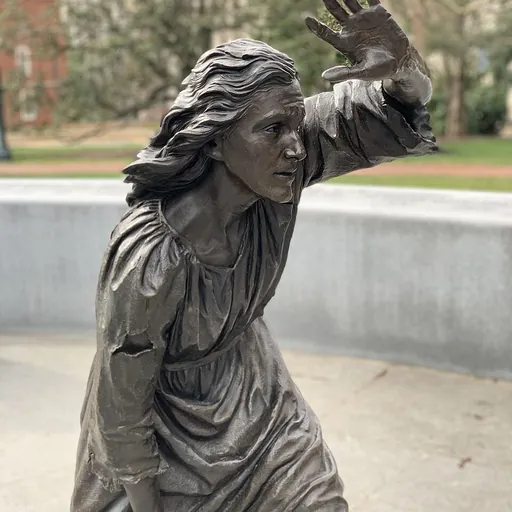
Mary Draper Ingles
American pioneer
About Mary Draper Ingles
Lived 1732 – 1815 (aged 82–83).
Mary Draper Ingles (1732 – February 1815), also known in records as Mary Inglis or Mary English, was an American pioneer and early settler of western Virginia. In the summer of 1755, she and her two young sons were among several captives taken by Shawnee after the Draper's Meadow Massacre during the French and Indian War. They were taken to Lower Shawneetown at the Ohio and Scioto rivers. Ingles escaped with another woman after two and a half months and trekked 500 to 600 miles, crossing numerous rivers, creeks, and the Appalachian Mountains to return home.
Two somewhat different accounts of Mary Draper Ingles' capture and escape, one written by her son John Ingles, and the other by Letitia Preston Floyd, an acquaintance, are the main sources from which the story is known.
The story became well known following the 1855 publication of William Henry Foote's account in Sketches of Virginia: Historical and Biographical, based on Mary's son's manuscript. It was further publicized in 1886 with the publication of an embellished version in John P. Hale's Trans-Allegheny pioneers: historical sketches of the first white settlements west of the Alleghenies.
Biography
Early life Log cabin next to the New River, near present-day Radford, Virginia, where Mary Draper Ingles and her husband William lived out their lives. Photo c.1890 Mary Draper Ingles was born in 1732 in Philadelphia, Pennsylvania to George and Elenor (Hardin) Draper, who had immigrated to America from County Donegal, Ireland in 1729. Between 1740 and 1744, the Draper family moved to the western frontier of Virginia, settling in Pattonsburg on the James River. According to John P. Hale, in 1744 George Draper went on an exploratory trip into what is now West Virginia, and never returned, although there is evidence that Draper was still alive as late as 1748. By 1746 his family had established Draper's Meadow, a pioneer settlement on the banks of Stroubles Creek near modern-day Blacksburg, Virginia.
In 1750, Mary married fellow settler William Ingles (1729–1782). They had two sons prior to Mary's captivity: Thomas Ingles, born in 1751, and George, in 1753.
Draper's Meadow massacre
On 30 July (or 8 July, according to John P. Hale An article in the Virginia Gazette published on 8 August 1755, announced Colonel James Patton's death at Draper's Meadow on "the last day of July." They took five captives, including Mary and her two sons, her sister-in-law Bettie Robertson Draper, and her neighbor Henry Lenard (or Leonard). Mary's husband was nearly killed but fled into the forest.
According to her son, Mary was not required to do this. Mary was separated from her sons, who were adopted by Shawnee families. According to John P. Hale, Mary's oldest son Thomas was taken to Detroit, her sister-in-law Bettie was taken to what is now Chillicothe, Ohio, and her youngest son George was taken to an unknown location and died soon afterward. An article in the New-York Mercury of 16 February 1756, describing Mary's capture and escape, mentions that while in Lower Shawneetown she saw "a considerable Number of English Prisoners, who have been taken Captives from the Frontiers of Virginia." although there is evidence to the contrary. and was kidnapped during an attack on a New River community on 3 July 1755. |group="Note" to escape with her. The next day (probably 19 October) they asked permission of the Native Americans to go into the forest to gather wild grapes, and set off, retracing the route their captors had followed after Mary was taken captive in July. They wore moccasins and carried only a tomahawk and a knife (both of which were eventually lost), and two blankets. As they were leaving the camp, they met three French traders from Detroit who were harvesting walnuts. Mary traded her old dull tomahawk for a new one. During their journey, they crossed at least 145 creeks and rivers—remarkable as neither woman could swim. On at least one occasion they "tied logs together with a grape-vine [and] made a raft" to cross a major river. on or about 1 December 1755, 42 days after leaving Big Bone Lick. Shortly afterward, a search party went back and found the old Dutch woman. Mary remained uneasy, however, and persuaded her husband to move again, this time to Robert Ewing's Fort near Montvale in Bedford County, Virginia. On the same day that they left, 25 June 1756, Fort Vause was attacked by French troops and a mixed force of 205 Shawnee, Ottawa and Miami Indians. Mary's brother-in-law John was killed, and her brother-in-law Matthew was captured.
The Ingles had four more children: Mary, Susanna (b. 1759), Rhoda (b. 1762), and John (1766–1836). and the associated Ingles Ferry Hill Tavern and blacksmith shop. She died there in 1815, aged 83.
A reconstruction of Mary Draper Ingles' home at Ingles Ferry, built on the foundations of her original home. Mary's son George probably died in Indian captivity, but Thomas Ingles, who was 4 when taken captive, was ransomed and returned to Virginia in 1768 at the age of 17; after 13 years with the Shawnee, he had become fully acculturated and spoke only Shawnee. He underwent several years of "rehabilitation" and education under Dr. Thomas Walker at Castle Hill, Virginia. He married Eleanore Grills in 1775 and settled in Burke's Garden, Virginia. In 1782, his wife and three children were kidnapped by Indians. Thomas came to rescue them and in the ensuing altercation, the two older children were killed. Eleanore was tomahawked but survived.
In 1761, Mary Ingles' brother John Draper attended a gathering of Cherokee chiefs at which a treaty to end the Anglo-Cherokee War was prepared. He found a man who knew of his wife, Bettie Robertson Draper, who had been taken captive in 1755. At that time, she was living at Chillicothe with the family of a widowed Cherokee chief. thumb A reconstruction of the Ingles Ferry Tavern near Radford, Virginia.
On 8 May 1779, Lord Henry Hamilton, a British prisoner of war, was being escorted under guard to Williamsburg and spent the night at the home of William and Mary Ingles. In his journal, Hamilton noted that the trauma of Mary's captivity and escape still affected her, 24 years later: 8th. In the Evening crossed over in a ferry the new river or great Canhawa, and were kindly and hospitably received at the house of Colonel Ingles-- here we rested for an entire day...Mrs. Ingles had in her early years been carryed off with another young Woman by the Savages, and tho carryed away into the Shawanes country had made her escape with her female friend, & wonderful to relate tho exposed to unspeakable hardships, & having nothing to subsist on but wild fruits, found her way back in safety, from a distance (if I remember right) of 200 miles-- however terror and distress had left so deep an impression on her mind that she appear'd absorbed in a deep melancholy, and left the management of household concerns, & the reception of Strangers to her lovely daughter.
Historical accounts of Mary Draper Ingles' journey
The only primary source of information about Mary Ingles' capture and escape is an article published in the New York Mercury on 16 February 1756 based on a report from "a Traveller who lately came from New River in Virginia," which contains a few details not found elsewhere. Her escape journey is also referred to briefly in two other Mercury articles, on 26 January and 1 March.
An important secondary source is the 1824 written account by Colonel John Ingles, son of Mary Ingles and William Ingles, born in 1766 after Mary's return. His account, The Story of Mary Draper Ingles and Son Thomas Ingles, written when he was 58, is based on stories he had heard from his parents. This is probably the most significant document describing Mary Ingles' capture and escape. is at the Albert and Shirley Small Special Collection in the University of Virginia library. It is very difficult to read, with little punctuation and poor spelling. It has been reproduced in an edition by Roberta Ingles Steele which retains the eccentricities of the author; copies are available at the Radford Public Library.|group="Note"
Letitia Preston Floyd
Another significant secondary source is an 1843 letter by Letitia Preston Floyd (1779–1852, wife of Virginia Governor John Floyd and daughter of Colonel William Preston, himself a survivor of the Draper's Meadow massacre) to her son Benjamin Rush Floyd. Letitia Preston Floyd did not know Mary Draper Ingles personally, although she claimed to have seen her once, in 1811 or 1812 at "a large Baptist Association." Glanville and Mays counter this opinion: "The overall accuracy of Mrs. Floyd’s 'My Dear Rush' letter is surprisingly good...She made minor errors in dates and places. However, it seems to us that Mrs. Floyd did remarkably well for a person aged 63 who was often writing of events about which she learned four or five decades earlier." one of Mary Ingles' great-grandsons, claimed to have interviewed Letitia Preston Floyd, and other people who knew Mary Ingles personally. His 1886 narrative contains numerous details not cited in any previous account.
Memorialization On October 14, 2019, the Virginia Women's Monument Commission dedicated seven statues, including one of Mary Draper Ingles. The other six statues are of Anne Burras Laydon, Cockacoeske, Elizabeth Keckly, Laura Copenhaver, Virginia Randolph, and Adele Clark. The monument is sited on Capitol Square grounds in Richmond, Virginia. left Plaque on the chimney stone memorial of Mary Draper Ingles in the West End Cemetery in Radford, VA. Radford University, located near Draper's Meadow, has residence halls named Draper Hall and Ingles Hall in honor of Mary Draper Ingles. A statue of Mary Ingles, identical to the one in front of the Boone County Public Library, was unveiled in the Radford Cultural Heritage Park near the Glencoe Museum in October, 2016.
A monument dedicated to Mary Draper Ingles is located in West End Cemetery, Radford, Virginia. It was built using stones from the chimney of a home where Ingles lived after her return in 1755. Mary Ingles Elementary School in Tad, West Virginia is named for her. An bronze statue depicting Mary Draper Ingles was installed outside the Boone County Public Library on route 18 in Burlington, Kentucky. Kentucky Route 8 in Campbell, Bracken, and Mason counties is officially named "Mary Ingles Highway." Ingles Ferry was listed on the National Register of Historic Places in 1969, and the Ingles Bottom Archeological Sites in 1978. The Virginia Tech library holds documents once owned by Mary Draper Ingles. The Mary Draper Ingles Bridge crosses the New River and is located in Summers County, West Virginia. Mary Draper Ingles Cultural Heritage Park, adjacent to the Radford Visitors' Center, includes a bronze statue cast from the same mold as the one at the Boone County Public Library in Burlington, Kentucky. The Mary Ingles Chapter of the National Society Daughters of the American Revolution is located in Fort Thomas, Kentucky.
Don’t just read it —
keep it.
Full-length biographies made to live with: read them, listen on the way to work, watch them tonight.
- E-book
- Audio
- Video
Instant download · yours to keep · every purchase keeps this site free
Important facts
People in Mary Draper Ingles's life
Named in this biography and alive at the same time




Contemporaries
People whose lives overlapped Mary Draper Ingles's






Frequently asked questions
Who was Mary Draper Ingles?
American pioneer
When was Mary Draper Ingles born?
Mary Draper Ingles was born in 1732 in Philadelphia.
When did Mary Draper Ingles die?
Mary Draper Ingles died on 1 February 1815 in Ingles Ferry.
Sources & further reading
· Wikipedia: Mary Draper Ingles
Cite this page
APA: Biography.guide. (2026). Mary Draper Ingles. https://biography.guide/mary-draper-ingles/
MLA: "Mary Draper Ingles." Biography.guide, https://biography.guide/mary-draper-ingles/.
Chicago: "Mary Draper Ingles." Biography.guide. https://biography.guide/mary-draper-ingles/.
Data last updated: 2026-09-24 · Spot an error? Report a correction.
Portrait: Wikimedia Commons · author & licence
Page generated 2026-09-27 05:09 UTC