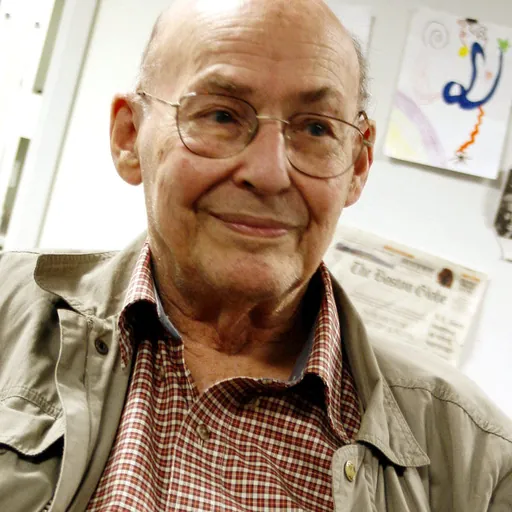
Marvin Minsky
American cognitive scientist
About Marvin Minsky
Lived 1927 – 2016 (aged 88). Marvin Minsky was an American mathematician, computer scientist, university teacher, artificial intelligence researcher, naturalist and docent, known for Artificial intelligence, Confocal microscope and Frame (artificial intelligence).
Marvin Lee Minsky (August 9, 1927 – January 24, 2016) Minsky, Claude Shannon, Nathaniel Rochester, and John McCarthy have been called the "fathers of AI" due to their participation in the Dartmouth workshop. At the time he was made emeritus, Minsky was the Toshiba Professor of Media Art & Sciences at MIT. the Golden Plate Award of the American Academy of Achievement in 1982, Minsky attended the Ethical Culture Fieldston School and the Bronx High School of Science.
Career Minsky began his academic career as a Junior Fellow of the Harvard Society of Fellows from 1954 to 1957. He joined the MIT faculty in 1958 and remained there until his death.
At the time of his death, Minsky was the Toshiba Professor of Media Arts and Sciences as well as professor of electrical engineering and computer science at MIT.
Contributions in computer science
Minsky's inventions include the first head-mounted graphical display (1963) and the confocal microscope (1957, a predecessor to today's widely used confocal laser scanning microscope). In 1951, Minsky built SNARC, which is often considered the first artificial neural network. In 1962, he worked on small universal Turing machines and published his well-known 7-state, 4-symbol machine.
Minsky and Papert's book Perceptrons attacked the work of Frank Rosenblatt on Perceptrons and became the foundational work in the analysis of artificial neural networks. The book is controversial, as some claim it greatly discouraged research on neural networks in the 1970s and contributed to the so-called "AI winter". Minsky also developed several other AI models. His paper "A Framework for Representing Knowledge" created a new paradigm in knowledge representation. Perceptrons is now viewed as of more historical than practical interest, but his theory of frames was in wide use as of 1975.
In the early 1970s, at the MIT Artificial Intelligence Lab, Minsky and Papert began to develop what came to be known as the Society of Mind theory. The theory describes intelligence as the possible product of the interaction of non-intelligent parts. Minsky said that ideas for the theory came from his work in trying to create a machine that uses a robotic arm, a videocamera, and a computer to build with children's blocks. In 1986, he published The Society of Mind, a comprehensive book on the theory that—unlike most of his previously published work—was written for the general public.
In 2006, Minsky published The Emotion Machine, a book that critiques many popular theories of how the human mind works, and suggests alternative theories, often replacing simple ideas with more complex ones.
Miscellaneous interests Minsky examined the possibility that extraterrestrial life may think like humans, thus permitting communication.
Minsky invented a "gravity machine" that rings a bell if the gravitational constant changes, a theoretical possibility not expected to occur in the foreseeable future. Arthur C. Clarke's novel of the same name explicitly mentions Minsky. In it, he achieves a crucial breakthrough in artificial intelligence in the then-future 1980s, paving the way for HAL 9000 in the early 21st century:
A useless box based on Minsky's design, at the moment when a device emerges from the box to switch it off. While working at Bell Labs in 1952, Minsky proposed a design for a useless machine he called the "ultimate machine". When switched on, a device emerges from it to switch it back off. Claude Shannon, Minsky's mentor at the time, built the first working prototype. After seeing it, Arthur C. Clarke said, "There is something unspeakably sinister about a machine that does nothing—absolutely nothing—except switch itself off". The design regained popularity online in the 2010s.
Published works 1967 – Computation: Finite and Infinite Machines, Prentice-Hall 1969 – Perceptrons: An Introduction to Computational Geometry, MIT Press 1986 – The Society of Mind 2006 – The Emotion Machine: Commonsense Thinking, Artificial Intelligence, and the Future of the Human Mind
Awards and recognition Minsky won the Turing Award, "computer science's highest prize", in 1969, the Japan Prize in 1990, the IJCAI Award for Research Excellence for 1991, and the Benjamin Franklin Medal from the Franklin Institute in 2001. In 2006, he was inducted as a Fellow of the Computer History Museum "for co-founding the field of artificial intelligence, creating early neural networks and robots, and developing theories of human and machine cognition." In 2011, Minsky was inducted into the IEEE Intelligent Systems' AI Hall of Fame for "significant contributions to the field of AI and intelligent systems". In 2014, from the past-present-future trio of Dan David Prizes, Minsky was awarded the "Future"-oriented prize, for "Artificial Intelligence, the Digital Mind". He also received the 2013 BBVA Foundation Frontiers of Knowledge Award in the Information and Communication Technologies category.
Minsky was elected to the U.S. National Academy of Sciences in 1973 Alcor Life Extension Foundation's Scientific Advisory Board;
Media appearances Machine Dreams (1988) Future Fantastic (1996)
Personal life
In 1952, Minsky married pediatrician Gloria Rudisch; together they had three children. Minsky was a talented improvisational pianist, and published musings on the relations between music and the mind.
Opinions Minsky was an atheist. He was a signatory to the Scientists' Open Letter on Cryonics.
He was a critic of the Loebner Prize for conversational robots, and argued that a fundamental difference between humans and machines is that while humans are machines, they are machines in which intelligence emerges from the interplay of the many unintelligent but semi-autonomous agents the brain comprises. He argued that "somewhere down the line, some computers will become more intelligent than most people", but that it was very hard to predict how fast progress would be. He cautioned that an artificial superintelligence designed to solve an innocuous mathematical problem might decide to assume control of Earth's resources to build supercomputers to help achieve its goal, but believed that such scenarios are "hard to take seriously" because he felt confident that AI would be well tested before being deployed.
Association with Jeffrey Epstein Minsky received a $100,000 research grant from Jeffrey Epstein in 2002, four years before Epstein's first arrest for sex offenses; it was the first from Epstein to MIT. Minsky received no further research grants from him.
Minsky organized two academic symposia on Epstein's private island Little Saint James, one in 2002 and another in 2011, after Epstein was a registered sex offender. Virginia Roberts Giuffre said Epstein sent her to have sex with Minsky; Minsky's widow, Gloria Rudisch, has denied this.
Death Minsky died in Boston, Massachusetts on January 24, 2016, aged 88. His family reported that he died of a cerebral hemorrhage. Alcor will neither confirm nor deny that Minsky was cryonically preserved.
Don’t just read it —
keep it.
Full-length biographies made to live with: read them, listen on the way to work, watch them tonight.
- E-book
- Audio
- Video
Instant download · yours to keep · every purchase keeps this site free
Important facts
more
Triadex Muse, Useless machinePeople in Marvin Minsky's life
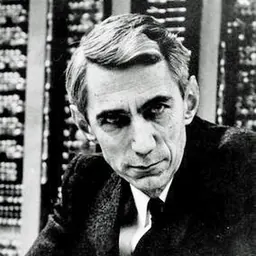
Named in this biography and alive at the same time






Related people
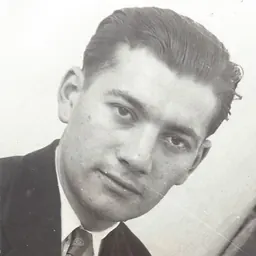
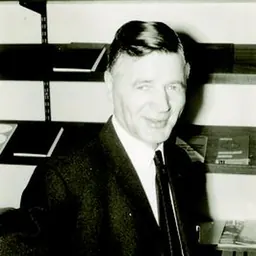
Same field, nearest in time

Contemporaries
People whose lives overlapped Marvin Minsky's


Frequently asked questions
Who was Marvin Minsky?
American cognitive scientist (1927-2016)
When was Marvin Minsky born?
Marvin Minsky was born on 9 August 1927 in New York City.
When did Marvin Minsky die?
Marvin Minsky died on 24 January 2016 in Boston.
What was Marvin Minsky's occupation?
Marvin Minsky was a mathematician, computer scientist, university teacher, artificial intelligence researcher, naturalist and docent.
What was Marvin Minsky known for?
Marvin Minsky was known for Artificial intelligence, Confocal microscope, Frame (artificial intelligence), Perceptrons (book), The Emotion Machine and The Society of Mind.
What nationality was Marvin Minsky?
Marvin Minsky was American.
Sources & further reading
Cite this page
APA: Biography.guide. (2026). Marvin Minsky. https://biography.guide/marvin-minsky/
MLA: "Marvin Minsky." Biography.guide, https://biography.guide/marvin-minsky/.
Chicago: "Marvin Minsky." Biography.guide. https://biography.guide/marvin-minsky/.
Data last updated: 2026-09-21 · Spot an error? Report a correction.
Portrait: Wikimedia Commons · author & licence
Page generated 2026-09-27 05:00 UTC