
About Martinus Rørbye
Lived 1803 – 1848 (aged 45). Martinus Rørbye was a Danish painter and graphic artist.
Martinus Christian Wesseltoft Rørbye (; 17 May 1803 – 29 August 1848) was a Danish painter, known both for genre works and landscapes. He was a central figure of the Golden Age of Danish painting during the first half of the 19th century.
The most traveled of the Danish Golden Age painters, he traveled both north to Norway and Sweden and south to Italy, Greece and Constantinople. He was also the first Danish painter to take to painting in Skagen at the northern top of Jutland, almost half a century before the thriving community of Skagen Painters formed and came to fame, through Michael Ancher, Anna Ancher and P.S. Krøyer.
Early life and education
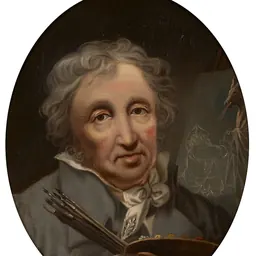
Martinus Rørbye was born in Drammen in Norway on 17 May 1803 to Danish parents Ferdinand Henrik Rørbye and his wife Frederikke Eleonore Catherine de Stockfleth. Martinus was not inclined to schooling, but in 1820 started his studies at the Royal Danish Academy of Fine Arts at 17 years of age. He studied under Christian August Lorentzen and Christoffer Wilhelm Eckersberg, a strong influence on a generation of artists during the Danish Golden Age. Rørbye was a favorite student of Eckersberg, and they formed a close association. He took to Eckersberg's careful attention to nature and his strivings to capture details realistically. He was also greatly influenced by Lorentzen's use of color.
He won the Academy's small silver medal in 1824, and the large silver medal in 1828. He competed for the gold medal and won a cash prize. In 1829 he won the small gold medal for his painting Christ healing the blind, which remains in the ownership of the Royal Danish Academy. He never won the large gold medal in spite of repeated attempts.
View from the Artist's Window, is a painting by a young Rørbye around 1825, heralding the many travels he would later make with its depiction of a caged bird in an open window, on the border between the safety of his parents' home and the wide, unknown world represented by a berthed ship.
Early career
Rørbye first exhibited his paintings at Charlottenborg in 1824 and would do so almost every year until 1848. His works were modestly priced, and he found sufficient buyers for his pieces. The majority of his works in the 1820s consisted of views from Copenhagen and the island of Zealand, although he also painted a number of portraits including one of Lorentzen, his painting instructor.
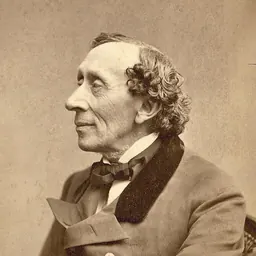
Twice, in 1830 and 1832, he traveled to Norway. On the first of these journeys he visited Jutland on the way, a rare destination for painters at that time. On 31 May 1830 he went to Århus on the paddle steamer Dania. Another passenger on the ship was Hans Christian Andersen and the two artists decided to travel together for a while. From Århus they went north, staying at the Rosenholm, Clausholm and Tjele estates. After that, Rørbye parted with Andersen, continuing to the remote and seldom-visited Thy province of north-western Jutland to visit relatives in Thisted. From his journals it can be concluded that he found the place deeply exotic, making detailed sketches and notes of everything from women's costumes and markets to the scenery. However, he found the landscape unsuitable for painting due to the lack of trees. On 7 July he left Thisted bound for Norway.
He married Rose Frederikke Schiøtt on 29 August 1839. His health was not good, however, and that same autumn he traveled again to Italy in the hope of renewing his strength. He painted "Torvet i Amalfi" ("The plaza in Amalfi") during this stay, and it was exhibited in 1842. He returned home in 1841.
He gave private painting lessons to Christen Dalsgaard, and in 1844 became professor at the Academy's school of modelling. His health deteriorated, and he died on 29 August 1848 in Copenhagen, leaving his young wife widowed and with several small children. She exhibited twelve of his paintings, mostly of Italian subjects, in 1849.
Works
He is remembered for his genre paintings, his landscapes and his architectural paintings, as well as for the many sketches he made during his numerous travels. He painted numerous scenes of life in Copenhagen, as well as large compositions showing Italian and Turkish landscapes and scenes of folk life. He painted few portraits.
He was one of the most traveled of the Golden Age painters, and distinguished his artistic production by his interpretations of lands rarely explored at that time for their artistic motifs, as well as for his anecdotal genre paintings depicting the Copenhagen of his day.
Discovering Skagen
Rørbye visited Skagen on three occasions, painting the local fishermen and the North Sea environs. The first time was in 1833, the year before he set out on his travels to the Mediterranean area and almost half a century before the community of Skagen Painters formed in the town and came to fame. He returned to Skagen towards the end of his life, in the summers of 1847 and 1848. His painting of Men of Skagen on a summer evening in fair weather was one of the last he completed. His works appear in a number of Danish art museums, including the Danish National Gallery (Statens Museum for Kunst), the Ny Carlsberg Glyptotek, and the Hirschsprung Collection.
Don’t just read it —
keep it.
Full-length biographies made to live with: read them, listen on the way to work, watch them tonight.
- E-book
- Audio
- Video
Instant download · yours to keep · every purchase keeps this site free
Important facts
more
Martinus Christian Wedseltoft Roerbye, Christian Martinus Wesiellorf Rorby, Martinus Christian Wedseltoft Rørbye, Martinus Christian Wesseltoft RörbyePeople in Martinus Rørbye's life
Named in this biography and alive at the same time

Related people
Same field, nearest in time

Contemporaries
People whose lives overlapped Martinus Rørbye's






Frequently asked questions
Who was Martinus Rørbye?
Danish artist (1803-1848)
When was Martinus Rørbye born?
Martinus Rørbye was born on 17 May 1803 in Drammen.
When did Martinus Rørbye die?
Martinus Rørbye died on 29 August 1848 in Copenhagen.
What was Martinus Rørbye's occupation?
Martinus Rørbye was a painter and graphic artist.
What nationality was Martinus Rørbye?
Martinus Rørbye was Danish.
Sources & further reading
Cite this page
APA: Biography.guide. (2026). Martinus Rørbye. https://biography.guide/martinus-rorbye/
MLA: "Martinus Rørbye." Biography.guide, https://biography.guide/martinus-rorbye/.
Chicago: "Martinus Rørbye." Biography.guide. https://biography.guide/martinus-rorbye/.
Data last updated: 2026-09-20 · Spot an error? Report a correction.
Page generated 2026-09-27 05:21 UTC