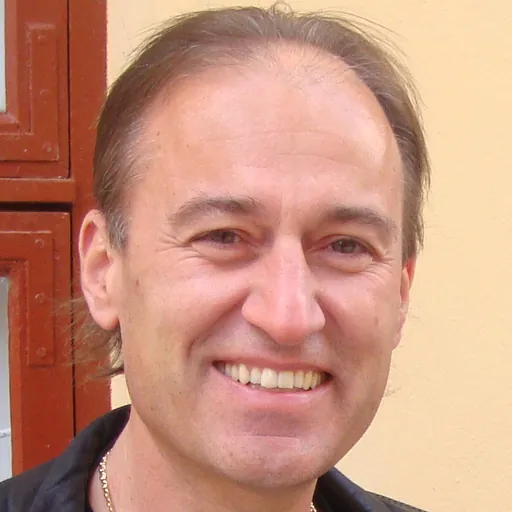
About Markus Gross
Born 1963. Markus Gross is a German university teacher and computer scientist.
Markus Gross (born June 14, 1963, Saarland, Germany) is a Professor of Computer science at the Swiss Federal Institute of Technology Zürich (ETH), head of its Computer Graphics Laboratory, and serves as Chief Scientist at The Walt Disney Studios as well as Director of DisneyResearchStudios. His research interests include physically based modeling, computer animation, immersive displays, and video technology. He has published more than 430 scientific papers on algorithms and methods in the field of computer graphics and computer vision, and holds more than 30 patents.
Early life and career
Markus Gross was born on June 14, 1963, in Neunkirchen, Saarland, a region historically influenced by both Germany and France during the first half of the 20th century. As an only child, he received significant attention from his parents, who balanced their day jobs with a passion for music, regularly performing with their own band. Consequently, Gross grew up immersed in popular and jazz music.
His fascination with animated films began after watching Disney’s The Jungle Book. He quickly developed a deep affection for animation and the Disney brand, becoming an avid collector of Disney comic books, which were widely popular in Europe. The character Gyro Gearloose, known for his inventive and eccentric nature, particularly resonated with him and inspired an early interest in electronics and engineering. Encouraged by this passion, he persuaded his parents to purchase a TI-59 programmable calculator, which sparked his interest in microcoding.
Around the age of 14, Gross encountered the Commodore PET computer at his local high school, prompting him to begin programming in BASIC and Pascal. Despite the limited graphical capabilities of early computers, he became fascinated by the potential to represent computational results visually in two and three dimensions. His interest deepened upon discovering pioneering animated clips created by Ed Catmull’s team at the New York Institute of Technology, which convinced him that his future lay in computer graphics.
Gross received a Master of Science in Electrical and Computer Engineering from Saarland University in 1986. He then continued his studies at Saarland University, earning a Ph.D. in Computer Graphics and Image Analysis in 1989 under the supervision of José Luis Encarnação, a leading authority in computer graphics in Europe.
From 1990 to 1994, he was a research scientist at the Computer Graphics Center of the Department of Computer Science of the Technical University of Darmstadt from where he received his habilitation in 1995.
Academic career
In 1994, Gross joined the faculty at ETH Zurich, as a professor of computer science and founded the Computer Graphics Laboratory. From 2004 to 2008 he served as a director of the Institute of Computational Sciences at ETH. He was promoted to full professor in 1997. IEEE Visualization, Eurographics, Pacific Graphics, and others. In 2005 he became the first European papers chair of ACM SIGGRAPH. He was the conference co-chair of the Eurographics 2021.
In addition, he has been the co-organizer of various international symposia. He has served on the editorial advisory boards of various journals and was associate editor of IEEE Computer Graphics & Applications.
During his tenure, Gross has co-authored more than 700 publications on topics including physically based modeling, immersive displays, video technology, image acquisition and generation, geometric modeling, computer animation, scientific visualization, and multimodal learning. As of June 2025, his current h-index is 117, and his i10-index is 469. He has coauthored 87 SIGGRAPH papers, ranking him among the top contributors in the field. Additionally, he has graduated more than 75 Ph.D. students.
His early research focused on wavelet-based volume rendering, surface meshing, and physically based medical simulations. His team developed finite element methods (FEM) for modeling soft tissue, deformation, collision, fracture, and fluids, as well as real-time 3D soft tissue cutting algorithms. His work on fluid simulations has been widely adopted in movies and video games, with his 2003 paper "Particle-based fluid simulation for interactive applications" being one of his highest-cited publications with over 2000 citations.
The Wavelet-Turbulence software, for which he received the “Tech-Oscar” from the Academy of Motion Picture Arts and Sciences, has become the standard procedure for animated smoke and explosions effects and employed in films such as “Avatar,” “Kung Fu Panda,” “Iron Man 3”, and “Man of Steel,” “Battleship” and others.
One of his major technical contributions is his work on point-based graphics, which enables the efficient computation of graphics pipeline processes using points rather than triangles, as in classical computer graphics. His papers “Surfels: Surface Elements as Rendering Primitives,” “Efficient Simplification of Point-Sampled Surfaces,” and “Surface Splatting” have collectively received over 4,100 citations.
Before joining Disney Research, Gross also worked on the theoretical modeling of dyslexia. He developed a statistical model and a multimodal recording system to facilitate language acquisition for people with dyslexia.
Disney Research
In 2008, Gross was recruited by Ed Catmull to help establish a corporate R&D organization at The Walt Disney Company. He was appointed Director of Disney Research Zurich, and later promoted to Vice President of Research in 2018. In 2022, he became the Chief Scientist of The Walt Disney Company.
His 2010 paper High-Quality Single-Shot Capture of Facial Geometry laid the foundation for the Disney Medusa Facial Capture system, which has been used in numerous films and contributed to his second Tech-Oscar award in 2019.
Entrepreneurship
Gross's research led to the establishment of 13 companies and the creation of software platforms which yielded several successful exits.
His work on physically-based modeling for facial surgery simulation (FACE Project) eventually led to the spin-off company Cyfex founded in 2000.
In 2002, he co-founded Novodex, a company focusing on middleware for physics modeling in computer games. The firm was chosen by Ageia as a software platform to support their upcoming PhysX PPU card, which became the basis of the PhysX SDK 2. x series. Aegia acquired Novodex in 2004, and Gross became the chair of the technical advisory committee. In 2008, Ageia was itself acquired by graphics technology manufacturer Nvidia.
Gross’ research on 3D video recording, compression, editing and visual effects led to the creation of the startup-company LiberoVision which in 2012 was acquired by Vizrt and rebranded “Viz Libero”. Major broadcast companies worldwide, including ESPN and BBC, have used its products.
His research on theoretical modeling of dyslexia resulted in the multimedia learning software Dybuster and the foundation of the company of the same name in 2007.
In 2018, he cofounded Animatico focusing on development of AI characters for next generation human-machine interaction. To mark the 100th Nobel Prize anniversary of Albert Einstein, who was an ETH Zurich alumni, Gross’s team and Animatico built a platform that allows for a conversation with a “digital Einstein”. In 2022, Animatico was acquired by Nvidia.
In 2018 Gross co-founded Arbrea Labs which develops augmented reality simulators for human bodies, and focuses on surgery pre-visualization.
Other companies he cofounded are Gimalon (2013), Perceptiko (2017), Propulsion Academy (2017), Nanocorp (2018), Percim (2018), Morgen (2020). Gross has also received multiple awards. The most recent is the Eurographics Gold Medal for his outstanding research contributions, for his contributions in bridging industry and academia, and for his leadership in the field at large. In 2013 he received the Karl Heinz Beckurts Prize for outstanding technological innovations with strong practical relevance. Also in 2013, Gross received the Konrad Zuse Medal of the German association of computer sciences (GI), the highest award for scientific achievements in computer sciences in Germany. From the Academy of Motion Picture Arts and Sciences Markus Gross received a “Tech-Oscar,” also known as the Technical Achievement Award together with Nils Thuerey, Theo Kim, and Doug James for the development of a procedure to simulate smoke and explosions more efficiently. Further, Gross received the Outstanding Technical Contributions Award EUROGRAPHICS in 2010 and the Swiss ICT Champions Award in 2011. 2024 Eurographics Gold Medal 2021 Steven Anson Coons Award for outstanding creative contributions to computer graphics 2021 ETH Dandelion Entrepreneurship Award 2019 Technical Achievement Award of the Academy of Motion Picture Arts and Sciences 2018 Distinguished Career Award, Eurographics 2015 IEEE Visualization Career Awar 2013 Karl Heinz Beckurts Prize for outstanding technological innovations with strong practical relevance 2013 Konrad Zuse Medal for achievements in computer sciences 2013 Technical Achievement Award of the Academy of Motion Picture Arts and Sciences 2012 Fellow of the Association for Computing Machinery (ACM) 2012 Fellow of the Berlin-Brandenburg Academy of Sciences and Humanities 2012 Fellow of the German Academy of Sciences Leopoldina 2011 Swiss ICT Award 2010 Outstanding Technical Contribution Award, Eurographics 2006 Fellow of the Eurographics Association
Most Relevant Papers According to Google Scholar, as of July 2025, his most cited papers are
"A benchmark dataset and evaluation methodology for video object segmentation". by F Perazzi, J Pont-Tuset, B McWilliams, L Van Gool, M Gross, A Sorkine-Hornung. Proceedings of the IEEE conference on computer vision and pattern recognition, 2016. (2491 cites) "Particle-based fluid simulation for interactive applications." by M Müller, D Charypar, M Gross. Proceedings of the 2003 ACM SIGGRAPH/Eurographics symposium on Computer animation. Eurographics Association, 2003. (2048 cites) "Efficient simplification of point-sampled surfaces." by M Pauly, M Gross, LP Kobbelt. Proceedings of the conference on Visualization'02. IEEE Computer Society, 2002. (1560 cites) "Surfels: Surface elements as rendering primitives". by H Pfister, M Zwicker, J Van Baar, M Gross. Proceedings of the 27th annual conference on Computer graphics and interactive techniques. ACM Press/Addison-Wesley Publishing Co., 2000. (1504 cites) "Towards better understanding of gradient-based attribution methods for deep neural networks". by M Ancona, E Ceolini, C Öztireli, M Gross. Proceedings of the International Conference on Learning Representations (ICLR), 2018. (1398 cites) "Surface splatting." M Zwicker, H Pfister, J Van Baar, M Gross. Proceedings of the 28th annual conference on Computer graphics and interactive techniques. ACM, 2001.(1091 cites) "Meshless deformations based on shape matching." M Müller, B Heidelberger, M Teschner, M Gross. ACM transactions on graphics (TOG). ACM, 2005. (867 cites)
Don’t just read it —
keep it.
Full-length biographies made to live with: read them, listen on the way to work, watch them tonight.
- E-book
- Audio
- Video
Instant download · yours to keep · every purchase keeps this site free
Important facts
People in Markus Gross's life
Named in this biography and alive at the same time




Related people
Same field, nearest in time




Contemporaries
People whose lives overlapped Markus Gross's



Frequently asked questions
Who is Markus Gross?
German computer scientist
When was Markus Gross born?
Markus Gross was born on 14 June 1963 in Saarland.
What is Markus Gross's occupation?
Markus Gross is a university teacher and computer scientist.
What nationality is Markus Gross?
Markus Gross is German.
Sources & further reading
Cite this page
APA: Biography.guide. (2026). Markus Gross. https://biography.guide/markus-gross/
MLA: "Markus Gross." Biography.guide, https://biography.guide/markus-gross/.
Chicago: "Markus Gross." Biography.guide. https://biography.guide/markus-gross/.
Data last updated: 2026-09-21 · Spot an error? Report a correction.
Portrait: Wikimedia Commons · author & licence
Page generated 2026-09-27 04:59 UTC