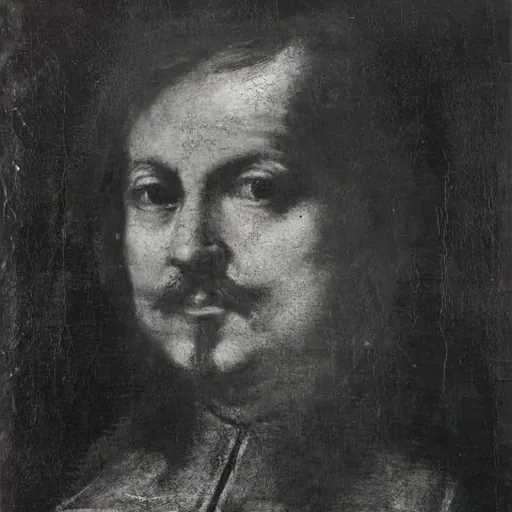
About Mario Balassi
Lived 1604 – 1667 (aged 62–63). Mario Balassi was a painter.
Mario Balassi (1604–1667) was an Italian painter of the Baroque period, active in Florence and Rome. Biography
He was born in Florence in 1604, and dedicated himself from a young age to artistic education, first as an apprentice to Jacopo Ligozzi, a Veronese artist active in Florence. When this master died, he passed to the school of Matteo Rosselli, where he remained until the age of 18 years. Finally he became a pupil of Domenico Passignano, and accompanied this master as his collaborator to Rome to work under the papacy of Pope Urban VIII. But in Rome he also worked on his own behalf, performing a Noli me Tangere for the church of San Caio (now destroyed) and produced a copy of Raphael's Transfiguration for Don Taddeo Barberini (now found in the church of the Cappuccini): the latter was praised by Passignano and Guido Reni, who said that "Mario had not copied it, but detached it from Raphael's painting".
When he lost a commission for a painting depicting the Crucifixion (at first commissioned to Balassi, but finally entrusted instead to Joachim von Sandrart), he left the patronage of the Piccolomini and embarked on the journey through Italy. He stayed in Venice for some time, where he derived, according to Baldinucci, significant enrichments to his artistic personality. Returning to his homeland, he executed a significant number of altar paintings for many churches in Florence, Prato, and Empoli.thumb
For example in Florence, he painted a St Francis of Assisi for the Compagnia delle Stimmate. He also painted a Noli me tangere (Touch Me Not) for the convent of the Maddalena. For the church of Sant'Agostino, Prato, he painted a picture of St Nicolas of Tolentino.
He died in Florence on 9 October 1667 and was buried in Santa Maria Novella.
His art is visibly influenced by the heterogeneous education of his youth, as well as by the multiple orientations of the contemporaries and the different environments in which the artist found himself. If in some works the traces of Passignano and of Ligozzi are clearly recognizable, in others they play elements extraneous to the Florentine environment, probably acquired during the Roman stay; while in some, as in the San Nicola da Tolentino of Prato, the "echoes of the Flemish-Caravaggio world" are evident. Among the stylistic components of the eclectic painter, however, is the derivation from the art of Matteo Rosselli.
Don’t just read it —
keep it.
Full-length biographies made to live with: read them, listen on the way to work, watch them tonight.
- E-book
- Audio
- Video
Instant download · yours to keep · every purchase keeps this site free
Important facts
People in Mario Balassi's life
Named in this biography and alive at the same time



Related people
Same field, nearest in time

Contemporaries
People whose lives overlapped Mario Balassi's





Frequently asked questions
Who was Mario Balassi?
Italian painter (1604-1667)
When was Mario Balassi born?
Mario Balassi was born in 1604 in Florence.
When did Mario Balassi die?
Mario Balassi died on 3 October 1667 in Florence.
What was Mario Balassi's occupation?
Mario Balassi was a painter.
Sources & further reading
Cite this page
APA: Biography.guide. (2026). Mario Balassi. https://biography.guide/mario-balassi/
MLA: "Mario Balassi." Biography.guide, https://biography.guide/mario-balassi/.
Chicago: "Mario Balassi." Biography.guide. https://biography.guide/mario-balassi/.
Data last updated: 2026-09-21 · Spot an error? Report a correction.
Portrait: Wikimedia Commons · author & licence
Page generated 2026-09-27 04:59 UTC