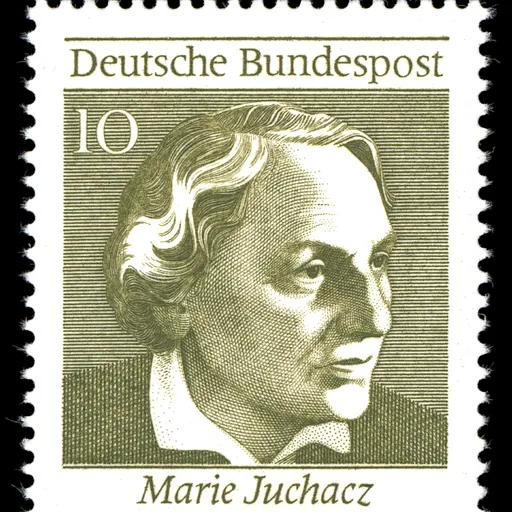
About Marie Juchacz
Lived 1879 – 1956 (aged 76). Marie Juchacz was a German politician, domestic worker, factory worker, licensed practical nurse, tailor and resistance fighter.
Marie Juchacz (; née Marie Gohlke; born Landsberg an der Warthe, 15 March 1879; died Düsseldorf, 28 January 1956)
She joined the Social Democratic Party (SPD) in 1908, more than ten years before women acquired the right to vote, and pursued a career that included politics, becoming, in 1919, the first female Reichstag member to address a German parliament.
Life and career
Early years Marie was the daughter of a carpenter called Theodor Gohlke and his wife Henriette. and she was obliged to leave school when aged 14. After finishing at the local school in Landsberg an der Warthe, Juchacz, whose beliefs were Protestant, began work in 1893, first as a maid, and then, briefly, in a factory that made curtains and fishing nets. Their daughter Lotte was born in the same year. and Elisabeth's children. The sisters set up house together in Berlin with their children, forming out of necessity what was seen as an unconventional family unit.
The war In November 1914 she gave a series of presentations to the "National Women's Association" (Nationale Frauengemeinschaft) entitled, "The Social obligations of Women in Wartime". In 1917 she returned to Berlin when she accepted Ebert's invitation to become the Women's Secretary in the Party's national leadership
Marie Juchacz addressing the national parliament (19 February 1919)
National Assembly member On 6 February 1919, Marie Juchacz and her sister were two of the 36 women elected to the Weimar National Assembly (which in June 1920 was superseded by the national Reichstag, to which Juchacz was also elected). On 19 February, exactly a month after the first national election in which women had been permitted to vote,
In the election of 6 June 1920 Juchacz (unlike her sister Elisabeth) retained , now representing the SPD for the Potsdam electoral district, and she remained a Reichstag member until 1933. The AWO was suppressed under the Nazis but resurrected in 1946, now independent of any political party, and is today an important element in Germany's decentralised welfare infrastructure, employing across the country 145,000 people plus around another 100,000 volunteers, and with approximately 400,000 members.
Despite her membership of the Reichstag, it was the AWO that was increasingly the focus of Juchacz's activities during the 1920s, as she found the party political mandate and functions less important than coordinating support for people needing help.
Marie Juchacz addressing the Reichstag (1932)
Exile On 30 January 1933 Adolf Hitler was appointed Reichs Chancellor. The AWO continued to function for a few more months, but after the Reichstag fire at the end of February and the Reichstag election of 5 March 1933, political parties found themselves banned, with the SPD, second only to the Nazi party in the March elections, prominent in the firing line.
In 1941 she fled again, on an emergency visa, to New York City, via Martinique.
Recognition Several cities have honoured Marie Juchacz by naming streets "Marie-Juchacz-Straße" or "Marie-Juchacz-Weg". In 2003, she was also honoured by Deutsche Post in its Women in German history series of postage stamps.
Since 1969 the AWO has issued, as its highest mark of honour and recognition, the . It is presented to AWO members who have demonstrated particular commitment to the AWO and stood up for its political interests.
Don’t just read it —
keep it.
Full-length biographies made to live with: read them, listen on the way to work, watch them tonight.
- E-book
- Audio
- Video
Instant download · yours to keep · every purchase keeps this site free
Important facts
Related people
Same field, nearest in time





Contemporaries
People whose lives overlapped Marie Juchacz's


Frequently asked questions
Who was Marie Juchacz?
German politician (1879-1956)
When was Marie Juchacz born?
Marie Juchacz was born on 15 March 1879 in Gorzów Wielkopolski.
When did Marie Juchacz die?
Marie Juchacz died on 28 January 1956 in Düsseldorf.
What was Marie Juchacz's occupation?
Marie Juchacz was a politician, domestic worker, factory worker, licensed practical nurse, tailor and resistance fighter.
What nationality was Marie Juchacz?
Marie Juchacz was German.
Sources & further reading
Cite this page
APA: Biography.guide. (2026). Marie Juchacz. https://biography.guide/marie-juchacz/
MLA: "Marie Juchacz." Biography.guide, https://biography.guide/marie-juchacz/.
Chicago: "Marie Juchacz." Biography.guide. https://biography.guide/marie-juchacz/.
Data last updated: 2026-09-22 · Spot an error? Report a correction.
Portrait: Wikimedia Commons · author & licence
Page generated 2026-09-27 05:03 UTC