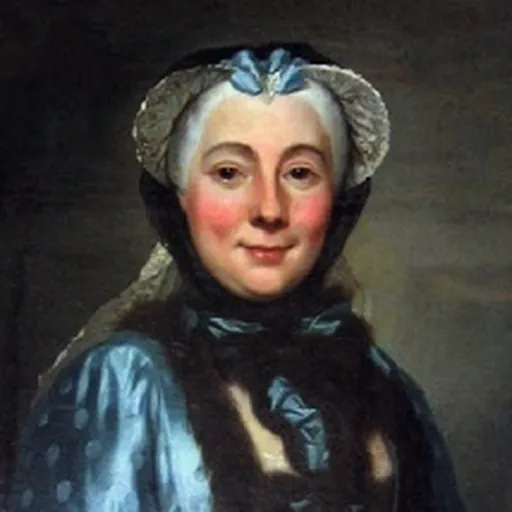
Marie-Geneviève-Charlotte Thiroux d'Arconville
French scientist
About Marie-Geneviève-Charlotte Thiroux d'Arconville
Lived 1720 – 1805 (aged 85). Marie-Geneviève-Charlotte Thiroux d'Arconville was a French chemist, translator, anatomist, writer, biologist and poet.
Marie Geneviève Charlotte Thiroux d'Arconville (née Darlus, also known as la présidente Thiroux d’Arconville and Geneviève Thiroux d'Arconville) (17 October 1720 – 23 December 1805), was a French novelist, translator and chemist who is known for her study on putrefaction. She discussed her study on putrefaction in her Essay on the History of Putrefaction in 1766.
Early life
Marie-Geneviève-Charlotte Thiroux d'Arconville was born Marie-Geneviève-Charlotte Darlus to Françoise Gaudicher and Guillaume Darlus on 17 October 1720. Her father was a tax farmer or farmer-general; they collected taxes for the state and usually kept some for themselves. Thiroux d'Arconville's mother died when she was four and her education was left in the hands of multiple governesses. As a young child, she enjoyed sculpture and art however when she learned to write at age eight, writing books became a new interest. She told friends later in life that she hardly had an idea without a pen in her hand.
Marriage and early adult life At fourteen years old, Thiroux d'Arconville requested to be married to Louis Lazare Thiroux d'Arconville, a tax farmer who later became a president in the Parliament of Paris, a regional justice court. Together the couple had three sons. As a married woman, Thiroux d'Arconville enjoyed theater and opera, similar to many wealthy women. She reportedly saw Voltaire's Mérope fifteen times in a row.
Women had long been a part of the literary community in France; critics thought this indicative of the advanced French society. Scholars viewed the idea of the "woman writer" as a sign of modernity and women in society were aware of the large body of work written by female scholars; in this sense, Thiroux d'Arconville was not an anomaly. However, because of her disfiguration, she chose to withdraw from the social space of the French salons, and establish herself in the research laboratory instead.
Career as a translator
Early translations Thiroux d'Arconville's desire for learning and her love for British culture inspired her to begin translating various English works, on a variety of subjects, to French. Translating works was not uncommon for women during this time period; it was a way for women to engage in scholarship. In her work Sur les femmes, she wrote about women "Do they show science or wit? If their works are bad, they are jeered at; if they are good, they are taken from them, and they are left only with ridicule for letting themselves be called authors".
Later translations Thiroux d'Arconville's next publications were Moral Thoughts and Reflections on Diverse Subjects in 1760, On Friendship in 1761, and On Passions in 1764. These works showed her interest in morality and emphasized the value of being virtuous and chaste. This reflects the mindset of the eighteenth century because having these qualities was very important especially in women. In both On Passions and On Friendships she discusses how friendship is important because it allows for reasonable and levelheaded thinking. However excessive passion can be dangerous for society, especially love and ambition. These works were also published anonymously.
Legacy Thiroux d'Arconville's life was common of many women of the time. She followed the rules of how a mother and wife should act in this time period and she embraced religion. She also shied way from social controversy, shown by her decision to maintain anonymity. Thiroux d'Arconville was also not thought to be a feminist; she thought women wasted their lives on material things and most of her close friends were men. Due to her decision to remain anonymous her name is still not well known. It is thought that her decision to remain anonymous was self-preservation; a way to keep her personal life as a mother and a wife distinct from her writings. According to scholars, Thiroux d'Arconville's body of work showcased her feelings on what it means to be a high status female author during the eighteenth century in France.
Works
Essays De l’Amitié, 1761, in-8°. (On Friendship) Traité des passions, 1764, in-8°. (Treatise on the Passions) Essai pour servir à l'histoire de la putréfaction, 1766, in-8°. (Essay on putrefaction) Histoire de mon enfance. Méditations sur les tombeaux. (Meditations on tombs) Mélanges de littérature, de morale et de physique, 1775. Pensées et réflexions morales sur divers sujets, 1760, 2nd end 1766, in-12. Sur moi. Traité d’ostéologie, in-fol.
Translations Avis d’un Père à sa Fille, 1756, in-12. Translated from the English of George Savile, 1st Marquess of Halifax. Leçons de chimie, 1759, in-4. Translation of Peter Shaw's Chemical Lectures (London: Longman, 2nd edn, 1755). Romans traduits de l'anglois, 1761. Includes excerpts translated from George Lyttelton's Letters from a Persian in England and Aphra Behn's Agnes de Castro. Mémoires de Mademoiselle de Falcourt. Amynthon et Thérèse Mélanges de Poésies Anglaises, traduits en français, 1764, in-12.
Don’t just read it —
keep it.
Full-length biographies made to live with: read them, listen on the way to work, watch them tonight.
- E-book
- Audio
- Video
Instant download · yours to keep · every purchase keeps this site free
Important facts
People in Marie-Geneviève-Charlotte Thiroux d'Arconville's life
Named in this biography and alive at the same time
Related people
Same field, nearest in time
Contemporaries
People whose lives overlapped Marie-Geneviève-Charlotte Thiroux d'Arconville's
Frequently asked questions
Who was Marie-Geneviève-Charlotte Thiroux d'Arconville?
French scientist
When was Marie-Geneviève-Charlotte Thiroux d'Arconville born?
Marie-Geneviève-Charlotte Thiroux d'Arconville was born on 17 October 1720 in Paris.
When did Marie-Geneviève-Charlotte Thiroux d'Arconville die?
Marie-Geneviève-Charlotte Thiroux d'Arconville died on 23 December 1805 in Paris.
What was Marie-Geneviève-Charlotte Thiroux d'Arconville's occupation?
Marie-Geneviève-Charlotte Thiroux d'Arconville was a chemist, translator, anatomist, writer, biologist and poet.
What nationality was Marie-Geneviève-Charlotte Thiroux d'Arconville?
Marie-Geneviève-Charlotte Thiroux d'Arconville was French.
Sources & further reading
· Wikipedia: Marie-Geneviève-Charlotte Thiroux d'Arconville
· DBpedia: Geneviève Thiroux d'Arconville
Cite this page
APA: Biography.guide. (2026). Marie-Geneviève-Charlotte Thiroux d'Arconville. https://biography.guide/marie-genevieve-charlotte-thiroux-d-arconville/
MLA: "Marie-Geneviève-Charlotte Thiroux d'Arconville." Biography.guide, https://biography.guide/marie-genevieve-charlotte-thiroux-d-arconville/.
Chicago: "Marie-Geneviève-Charlotte Thiroux d'Arconville." Biography.guide. https://biography.guide/marie-genevieve-charlotte-thiroux-d-arconville/.
Data last updated: 2026-09-25 · Spot an error? Report a correction.
Portrait: Wikimedia Commons · author & licence
Page generated 2026-10-04 10:21 UTC