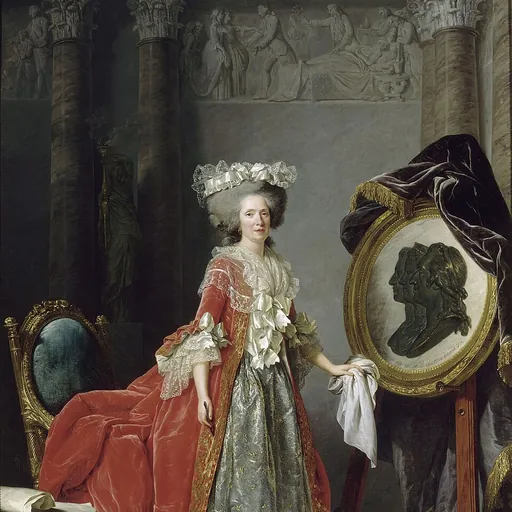
About Marie Adélaïde of France
Lived 1732 – 1800 (aged 67). Marie Adélaïde of France was a French aristocrat.
Adélaïde de France (Marie Adélaïde; 23 March 1732 - 27 February 1800) was a French princess, the sixth child and fourth daughter of King Louis XV and Queen Marie Leszczyńska.
As a legitimate daughter of the King, Adélaïde was a fille de France. She was referred to as Madame Quatrième ("Madame the Fourth") until the death of her older sister Marie Louise in 1733, and then as Madame Troisième ("Madame the Third"); as Madame Adélaïde from 1737 to 1755; as Madame from 1755 to 1759; and then as Madame Adélaïde again from 1759 until her death. Adélaïde and her sister Sophie possessed the Duchy of Louvois from 1777 until 1792. The duchy had been created for them by their nephew Louis XVI, in their own right. During the reign of her nephew Adélaïde led the extreme conservative faction at court and was strongly anti Marie Antoinette, whom Adélaïde reputedly called 'the Austrian' for the first time. During the French Revolution Adélaïde and her sister, Victoire fled France, settling in Rome. She studied Italian under Goldoni, and music under Beaumarchais. One of the reasons as to why the expense of her younger sisters at Versailles was regarded as too high, was that the royal children were allowed to participate in court life at a very young age. They were allowed to attend as well as arrange festivities already as children. Adélaïde and her sister Henriette, who never went to Fontevraud, accompanied their father to the opera in Paris at least since 1744 and hunted with him five days a week from the beginning of 1746.
Reign of Louis XV
In 1744, the King removed Henriette and Adelaide from the royal nursery into their household, known as the Household of the Mesdames aînées ('Elder Mesdames'). The sisters had two ladies-in-waiting (dame pour accompagner Mesdames). Two years later, they were given their own dame d'honneur, Marie-Angélique-Victoire de Bournonville, Duchesse de Duras. When the younger sisters arrived to court from Fontevrault in 1748–50, they were not inducted in to the Household of their elder sisters but formed the Household of the Mesdames cadettes ('Younger Mesdames'). After the death of Henriette in 1752, the Household of the Mesdames aînées was transformed into the Household of Madame Adélaïde, headed by Marie-Suzanne-Françoise de Creil, Duchesse de Beauvilliers, and she thus held a unique position as the only unmarried royal princess with her own separate household, while her younger sisters shared theirs.
When her younger sisters arrived back from Fontevraud in 1748–50, she became the head of the group of the four unmarried, younger sisters; the others were Madame Victoire, Madame Sophie, and Madame Louise. The King referred to them by nicknames: he called Madame Adélaïde ‘Loque’ (Tatters/Rag/Rags/Scraggy), Madame Victoire ‘Coche’ (Pig/Piggy/Sow), Madame Sophie, ‘Graille’ (Grub/Scrap/Carrion crow), and Madame Louise, ‘Chiffe’ (Shoddy silk/Rags).
Like their mother, the well loved Queen Marie Leszczyńska, Adélaïde and her siblings were actually very charitable as noted by Charles Philippe d'Albert, 4th Duke of Luynes in his memoirs and often gave money using their allowances in supporting workhouses for the poor as well as given alms to regions struck by calamity. She is described as an intelligent beauty; her appearance an ephemeral, "striking and disturbing beauty of the Bourbon type characterized by elegance", with "large dark eyes at once passionate and soft", and her personality as extremely haughty to her father's debauched circle of friends but was actually friendly towards the common people of France during public ceremonies in Paris as described by the Duke of Luynes, with a dominant and ambitious character with a strong will, who came to dominate her younger siblings: "Madame Adélaïde had more mind than Madame Victoire; but she was altogether deficient in that kindness which alone creates affection for the great, abrupt manners, a harsh voice, and a short way of speaking, rendering her more than imposing. She carried the idea of the prerogative of rank to a high pitch."
Madame Adélaïde, as well as her siblings, attempted without success to prevent their father's liaison with Madame de Pompadour, which began in 1745. In the early 1750s, when the health of Madame de Pompadour was deteriorating, Adélaïde, who was a good rider, became the favorite and close companion of her father, during which she often accompanied him during his riding and amused him with conversation. Their new close relationship, and Adelaïde's status as the most beautiful among her sisters, caused rumors that they had an incestuous relationship. A rumor also claimed that Adélaïde was the true mother of Louis de Narbonne (born 1755) by her father. Madame Adélaïde, who detested the idea of a new royal mistress, encouraged the solution of her father marrying again to prevent it. She reportedly preferred a queen who was young, beautiful and lacked ambition, as she could distract her father from state affairs, leaving them to Madame Adélaïde herself. She supported the Dowager Princesse de Lamballe as a suitable candidate for that purpose and was supported in this plan by the powerful Noailles family. Despite this, however, Madame Adélaïde had the time to intervene in the establishment of the new government: Louis XVI had been advised by his father to ask the advice of Adélaïde should he become king, and after his succession, he sent her a letter and asked her advice on whom he should entrust his kingdom, and she replied with a list of names of minister candidates to him suggested by his father. The Mesdames continued to be the confidants of Louis XVI, and they also maintained a good relationship with their niece, Princess Élisabeth of France, and often visited her in her retreat at . When Victoire de Rohan resigned as Governess of the Children of France, the King, who maintained a good relationship with his aunts, wished to give Madame Adélaïde the responsibility for the upbringing of his children, as she shared his views on religion, but this was rebuked by the Queen, who stated that she could not bear to give the position to someone who had made her first years in France so difficult.
Madame Adélaïde, reportedly, did not regard the convocation of the Estates General of 1789 as a prelude to a revolution, only as a grand state occasion. They left for Italy in a procession of wagons on 20 February 1791 with a large entourage.
Their departure was given attention in the press. The Chroniqle de Paris wrote: "Two Princesses, sedentary by condition, age, and taste, are suddenly possessed by a mania for travelling and running about the world. That is singular, but possible. They are going, so people say, to kiss the Pope's slipper. That is droll, but edifying. [...] The Ladies, and especially Madame Adélaïde, want to exercise the rights of man. That is natural. [...] "The fair travellers are followed by a train of eighty persons. That is fine. But they carry away twelve millions. That is very ugly. [...]", while the Sahhats Jacobites wrote: " The Ladies are going to Italy to try the power of their tears and their charms upon the princes of that country. Already the Grand Master of Malta has caused Madame Adélaïde to be informed that he will give her his heart and hand as soon as she has quitted France, and that she may count upon the assistance of three galleys and forty-eight cavaliers, young and old. Our Holy Father undertakes to marry Victoire and promises her his army of three hundred men to bring about a counter-revolution."
When news came that Louis XVI and his family had left Paris on the Flight to Varennes in June, a misunderstanding first caused the impression that the escape had succeeded; at this news, "the whole of Rome shouted with joy; the crowd massed itself under the windows of the princesses crying out: Long live the King!", When Naples was invaded by France in 1799, they left in a Russian frigate for Corfu, and finally settled in Trieste, where Victoire died of breast cancer. Adélaïde died one year later, on 27 February 1800 at the age of sixty-seven. Their bodies were returned to France by Louis XVIII at the time of the Bourbon Restoration and buried at the Basilica of Saint-Denis.
Gallery
Ancestry
Don’t just read it —
keep it.
Full-length biographies made to live with: read them, listen on the way to work, watch them tonight.
- E-book
- Audio
- Video
Instant download · yours to keep · every purchase keeps this site free
Important facts
People in Marie Adélaïde of France's life
Named in this biography and alive at the same time
Related people
Same field, nearest in time
Contemporaries
People whose lives overlapped Marie Adélaïde of France's





Frequently asked questions
Who was Marie Adélaïde of France?
French noblewoman (1732-1800)
When was Marie Adélaïde of France born?
Marie Adélaïde of France was born on 23 March 1732 in Versailles.
When did Marie Adélaïde of France die?
Marie Adélaïde of France died on 27 February 1800 in Trieste.
What was Marie Adélaïde of France's occupation?
Marie Adélaïde of France was an aristocrat.
What nationality was Marie Adélaïde of France?
Marie Adélaïde of France was French.
Sources & further reading
· Wikipedia: Marie Adélaïde of France
Cite this page
APA: Biography.guide. (2026). Marie Adélaïde of France. https://biography.guide/marie-adelaide-of-france/
MLA: "Marie Adélaïde of France." Biography.guide, https://biography.guide/marie-adelaide-of-france/.
Chicago: "Marie Adélaïde of France." Biography.guide. https://biography.guide/marie-adelaide-of-france/.
Data last updated: 2026-09-28 · Spot an error? Report a correction.
Portrait: Wikimedia Commons · author & licence
Page generated 2026-10-05 04:07 UTC