
Maria Luisa I, Duchess of Lucca
Spanish Royal
About Maria Luisa I, Duchess of Lucca
Lived 1782 – 1824 (aged 41). Maria Luisa I, Duchess of Lucca was a Spanish regent.
Maria Luisa of Spain (, 6 July 1782 – 13 March 1824) was a Spanish infanta, daughter of King Charles IV and Maria Luisa of Parma. In 1795, she married her first cousin Louis of Bourbon-Parma, heir apparent to the Duchy of Parma. She spent the first years of her married life at the Spanish court where their first child, Charles Louis, was born.
In 1801, the Treaty of Aranjuez made her husband King of Etruria, a kingdom created from the former Grand Duchy of Tuscany in exchange for the renunciation of the Duchy of Parma. They arrived in Florence, the capital of the new kingdom, in August 1801. During a brief visit to Spain in 1802, Maria Luisa gave birth to her second child. Her husband's reign in Etruria was marred by his ill health. He died in 1803 at the age of 30, following an epileptic crisis. Maria Luisa acted as regent for their son. During her government in Florence, she tried to gain the support of her subjects, but her administration of Etruria was cut short by Napoleon Bonaparte, who forced her to leave with her children in December 1807. As part of the Treaty of Fontainebleau, Napoleon incorporated Etruria to his domains.
After a futile interview with Napoleon in Milan, Maria Luisa looked for refuge in exile with her family in Spain. The Spanish court was deeply divided and a month after her arrival the country was thrown into unrest when a popular uprising, known as the Mutiny of Aranjuez, forced Maria Luisa's father to abdicate in favor of her brother Ferdinand VII. Napoleon invited father and son to Bayonne, France, with the excuse of acting as a mediator, but gave the kingdom to his brother Joseph. Napoleon called the remaining members of the Spanish royal family to France and at their departure on 2 May 1808, the citizens of Madrid rose up against the French occupation. In France, Maria Luisa was reunited in exile with her parents. She was the only member of the Spanish royal family to oppose Napoleon directly. After her secret plan to escape was discovered, Maria Luisa was separated from her son and placed with her daughter as prisoners in a Roman convent.
Maria Luisa, mostly known as the Queen of Etruria during her lifetime, regained her freedom in 1814 at the fall of Napoleon. In the following years, she continued to live in Rome, hoping to recover her father-in-law's former domains. To put forward her case, she wrote a book of memoirs, but was disappointed when the Congress of Vienna (1814–15) compensated her not with Parma, but with the smaller Duchy of Lucca, which had been created specifically for her family in place of the ancient Republic of Lucca. As a consolation, she was allowed to retain the honours of a queen. Initially stubbornly opposed to accepting this accord, Maria Luisa only took the government of Lucca in December 1817, after her family had been granted the right of reversion to the Duchy of Parma upon the death of the incumbent Duchess, the former Empress of the French, Marie Louise of Austria.
As the reigning duchess of Lucca, she disregarded the constitution imposed by the Congress of Vienna. While spending time in her palace in Rome, she died of cancer at the age of 41.
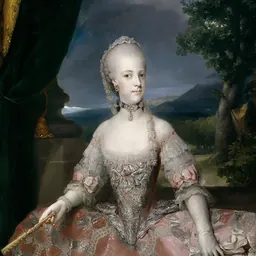
Infanta of Spain Thirteen-year-old Maria Luisa, portrait by Agustín Esteve, 1795. Born at the Royal Palace of La Granja de San Ildefonso, Segovia, Spain, Maria Luisa was the third surviving daughter of King Charles IV of Spain and Maria Luisa of Parma, granddaughter of Louis XV and the popular Queen Marie Leszczyńska. She was given the names Maria Luisa Josefina Antonieta, after an older sister, Maria Luisa Carlota, who had died just four days before Maria Luisa's birth on 2 July, and her mother.
In 1795, Maria Luisa's first cousin, Louis of Bourbon-Parma, It was anticipated that he would marry the Infanta Maria Amalia, Charles IV's eldest unmarried daughter. She was fifteen years old at the time and of a timid and melancholic nature, but was not very beautiful. All four daughters of Charles IV were short and not particularly beautiful, but Maria Luisa was clever, lively and amusing. She had dark curly hair, brown eyes and a Grecian nose. Her face was expressive and her character lively, and she was generous, kindhearted, devout and more attractive than her sisters. Both infantas were favorably impressed by the Prince of Parma, a tall and handsome young man, and when he ultimately chose the younger sister, Queen Maria Luisa readily agreed to the change of bride.
Marriage The family of Charles IV by Francisco de Goya. Maria Luisa is beside her husband with her son in her arms on the right hand side of the painting. Louis was created Infante of Spain and married Maria Luisa on 25 August 1795 at the Royal Palace of La Granja. The young couple remained in Spain during the early years of their marriage, which were to be the happiest period of their lives. In early 1796, the couple traveled through Castile, Extramadura all the way to Portugal. Her first son, Charles Louis, was born in Madrid on 22 December 1799.
Queen of Etruria
Maria Luisa's life was deeply marked by Napoleon Bonaparte's actions. Napoleon was interested in having Spain as an ally against the United Kingdom. In the summer of 1800, he sent his brother Lucien to the Spanish court with the proposal that would result in the Treaty of Aranjuez. Napoleon, who had conquered Italy, proposed to compensate the House of Bourbon-Parma for their loss of the Duchy of Parma and Piacenza by creating the new Kingdom of Etruria for Louis, heir of Parma. The new kingdom was created out of the Grand Duchy of Tuscany.
To make way for the Bourbons, Ferdinand III, Grand Duke of Tuscany was ousted and compensated with Salzburg. Maria Luisa, who had never lived away from her own family and was totally inexperienced in political affairs, opposed the plan. One of Napoleon's conditions was that the young couple had to go to Paris and there receive from him the investiture of their new sovereignty, before taking possession of Etruria. Maria Luisa was reluctant to make a trip to France, where only seven years earlier her relatives Louis XVI and Marie Antoinette had been executed. However, pressed also by her family, she did as she was told. On 21 April 1801 the couple and their son left Madrid, crossed the border in Bayonne and traveled incognito to France under the name of Counts of Livorno.
In the recollections of Napoleon's valet, Maria Luisa left a more favorable impression than her husband: "The Queen of Etruria was, in the opinion of the First Consul, more sagacious and prudent than her husband.. [she] dressed herself in the morning for the whole day, and walked in the gardens, her head adorned with flowers or a diadem, and wearing a dress, the train of which swept up the sand of the walk: often also carrying in her arms one of her children.., by night the toilet of her Majesty was somewhat disarranged. She was far from pretty, and her manner were not suited to her rank. But, which fully atoned for all of this, she was good-tempered, much loved by those in her service, and scrupulous in fulfilling the duties of wife and mother. In consequence, the First Consul, who made a great point of domestic virtue, professed for her the highest esteem."
On 30 June, after staying in Paris for three weeks, Maria Luisa and her husband, headed south toward Parma. In Piacenza they were greeted by Louis' parents, together they went to Parma and Maria Luisa met her husband's two unmarried sisters. They found Louis already speaking Italian with a foreign accent while Maria Luisa's Italian was often mixed with Spanish words. After three weeks in Parma they entered Etruria. On 12 August they arrived at Florence. The French general Joachim Murat had been sent to Florence to prepare the Pitti Palace for them. But the King and Queen of Etruria did not have an auspicious start in their new life. Maria Luisa suffered a miscarriage, while her frail husband's health deteriorated further, fits of epilepsy becoming more frequent. The Pitti Palace, the residence of the King and Queen, was the former house of the Medici dukes. The palace had been practically abandoned after the death of the last Medici and the ousted Grand Duke Ferdinand had taken most of its valuables with him. Short of money, Maria Luisa and her husband were forced to furnish the Pitti Palace borrowing furniture from the local nobility.
Maria Luisa and Louis were both full of good intentions but they were received with hostility by the population and the nobility that missed the popular Grand Duke and saw them as just mere tools in the hands of the French. With Etruria's financial and economic difficulties, Louis' health failing and Maria Luisa in an early state of pregnancy, going abroad was clearly not expedient, but under the pressure of her father and wanted to see her family, they started the journey to her native country.
Louis felt very ill before boarding the ship, waiting for his full recovery delayed their plans for a month. Once at sea, they were caught in a storm for three days.
Back in Etruria, the illness of her husband was carefully concealed from the population, as Maria Luisa alone was seen in public functions and entertaining at court. For this she was accused of overpowering her husband and being merry in his absence. Louis died on 27 May 1803, aged 30, as a consequence of an epileptic crisis.
Regent of Etruria Coins of King Charles Louis and Queen Maria Luisa: 10 lires (1803). Grief-stricken by the death of her husband, she developed a nervous illness. She had to act as a regent for her son Charles Louis, the new King of Etruria. Only twenty years old when she was widowed, plans for a new wedding were considered: France and Spain wanted to marry her to her first cousin, Infante Pedro Carlos of Spain and Portugal, but the marriage never materialized.
During her four-year regency, Maria Luisa took on the government of Etruria with the help of her ministers Count Fossombroni and Jean Garbiel Eynard (1775-1863). With them, Maria Luisa reorganized the tax system, created taxable manufactures like tobacco and porcelain companies and increased the size of the army.
Though Maria Luisa by then had become fond of Florence, Napoleon had other plans for Italy and Spain: I am afraid the Queen is too young and her minister too old to govern the Kingdom of Etruria, he said. She was accused of not enforcing the English blockade in Etruria. Increasing Maria Luisa's isolation, Napoleon replaced the French ambassador to Etruria, the Marchaise de Beauharnais, with the less congenial, Count Hector d'Aubusson de la Feuillade, the Empress Joséphine's chamberlain. Her father answered her pleas with discouragement: she yielded and hastily left the kingdom, returning to her family in Spain, leaving Florence on 10 December 1807 with her children, their future uncertain. He promised her, as compensation for the loss of Etruria, the throne of a Kingdom of Northern Lusitania (in the North of Portugal), he intended to create after the Franco-Spanish conquest of Portugal. This was part of the Treaty of Fontainebleau between France and Spain (October 1807) that also had incorporated Etruria to Napoleons' domains.
Ferdinand had been pardoned but with the family's prestige shaken, Napoleon took this opportunity to invade Spain. With the excuse of sending reinforcements to Lisbon, French troops had entered Spain in December. Not completely blind to Napoleon's real intentions, the Spanish royal family had secretly planned their escape to New Spain, but their plans were cut short. At this point Maria Luisa arrived in Aranjuez on 19 February 1808. Members of popular classes, soldiers and peasants assaulted Godoy's residence, captured him, and made King Charles depose the prime minister. Two days later, the court forced Charles IV to abdicate and yield the throne to his son, now Ferdinand VII. The abdication of Charles IV in favor of Ferdinand VII was enthusiastically acclaimed by the people.
Maria Luisa, who at the time had been in Spain for barely a month, took her father's side against the party of her brother. She acted as intermediate between the deposed Charles IV and the French general Murat, who on 23 March entered Madrid. Napoleon, capitalizing on the rivalry between father and son, invited both to Bayonne, France, ostensibly to act as a mediator. Both kings, afraid of the French power, thought it appropriate to accept the invitation and separately left for France. Maria Luisa was just recovering from measles at the time of the Mutiny of Aranjuez, and was not fit to travel. Her son was also sick and she stayed behind with her children, her uncle Antonio and her younger brother Francisco de Paula. However, Napoleon insisted on all relatives of the King to leave Spain and called them to France. At their departure on 2 May 1808, citizens of Madrid rose up in rebellion against the French occupation, but the revolt was crushed by Murat. She was considered in Spain as a foreign princess aiming at gaining a throne for her son. Arriving at Bayonne, Maria Luisa was greeted by her father with the words "My daughter, our family has forever ceased to reign". Napoleon had forced both Charles IV and Ferdinand VII to renounce the throne of Spain and in exchange for their renunciation of all claims, were promised a large pension and residence in Compiègne and Château de Chambord. After this, Napoleon gave Spain to his brother Joseph Bonaparte and forced the royal family into exile in Fontainebleau. Maria Luisa requested a separate residence and moved with her children to a house in Passy, but was soon moved to Compiègne on 18 June. She was plagued by frequent sickness and shortage of money and, not owning any horses, was forced to walk wherever she needed to go. When at last Napoleon sent 12,000 francs as the promised compensation, the expenses of her trip to France were discounted.
She planned to escape to England, but her letters were intercepted and her two accomplices executed. Maria Luisa was arrested on 26 July and condemned to be imprisoned in a convent in Rome, while her nine-year-old son was to remain in the care of his grandfather Charles IV. Maria Luisa's pension was reduced to 2500 francs; all her jewels and valuables were taken away. She was imprisoned in the convent of Santi Domenico e Sisto, near the Quirinal Hill on 14 August 1811 with her daughter and a maid.
On 18 March 1812, Maria Luisa and her children were stripped of their rights to the Spanish crown by the Cortes of Cádizwhich served as a parliamentary Regency after Ferdinand VII was deposedbecause she was under Napoleon's control. Her rights were not restored until 1820. The former Queen of Etruria wrote in her Memoirs:
On 19 June 1812, she was allowed to see her family. In an emotional meeting, Maria Luisa threw herself into her mother's arms, kissed her son with frenzy and her father hugged them all in a general embrace. After this, Maria Luisa was allowed to see her parents and her son once a month but only for twenty minutes and under surveillance. Only the fall of Napoleon opened the gates of her prison. On 14 January 1814, after more than four years of captivity, she was freed when the troops of Joachim Murat entered Rome.
Congress of Vienna Maria Luisa, Queen of Etruria with her two children Charles Louis and Luisa Carlota. Portrait by José Aparicio e Inglada, 1815. Maria Luisa moved with her children and her parents to the Barberini Palace. She hoped for the restorations of her son's estates and as the Congress of Vienna (1814–15) assembled to reorder the European map, she quickly wrote and published the Memoirs of the Queen of Etruria, originally written in Italian but translated to different languages, to put forward her case. When Napoleon returned from his exile at Elba, Maria Luisa and her parents fled Rome, moving from one city to another in Italy. The Countess de Boigne met her in Genoa and found her untidy and vulgar. When Napoleon was defeated at Waterloo, they returned to Rome.
At the Congress of Vienna, Maria Luisa's interests were represented by the Spanish emissary Marquis of Labrador, an incompetent man, who did not successfully advance his country's or Maria Luisa's diplomatic goals. The Austrian Chancellor Metternich had decided not to restore Parma to the House of Bourbon, but to give it to Napoleon's wife, Marie Louise of Austria. Maria Luisa pleaded her cause to her brother Ferdinand VII of Spain, Pope Pius VII, and Tsar Alexander I of Russia. Ultimately, the Congress decided to compensate Maria Luisa and her son with the smaller Duchy of Lucca, which was established in place of the ancient Republic of Lucca not restored by the Congress. She was to retain the honors of a queen as she had before in Etruria. During this time, she lived with her children in a Roman palace. Family relationships became strained: her parents and her brother Ferdinand VII wanted to marry Maria Luisa's daughter, Maria Luisa Carlota, then fourteen years old, to Francisco de Paula, Maria Luisa's youngest brother. She opposed this plan, considering her brother (eight years older than her young daughter) to be too reckless. She also rejected a proposed plan for her own son to marry Maria Christina of the Two Sicilies, a daughter of her sister Maria Isabel.
Seeking independence from her family, Maria Luisa accepted the solution offered by the in 1817: upon the death of Marie Louise of Austria, the Duchy of Parma would revert "to H.M. the Infanta of Spain Maria Luisa, to the Infante D. Charles Louis her son and his direct male descendants", while the Duchy of Lucca would simultaneously revert to the Grand Duchy of Tuscany with some territorial adjustments in favor of the Duchy of Modena and Reggio. Maria Luisa became Duchess of Lucca in her own right (suo jure) and was granted the rank and privileges of a queen. Her son, Charles Louis, would succeed her only upon her death and would meantime be styled the Prince of Lucca. Then the Spanish minister in Turin, took possession of Lucca until Maria Luisa arrived on 7 December 1817.
Duchess of Lucca Statue of Maria Luisa at Piazza Napoleone in Lucca by Lorenzo Bartolini. When Maria Luisa arrived in Lucca, she was already thirty-five years old. Ten years of endless struggles had taken their toll: she was prematurely aged and had gained a lot of weight. Nevertheless, she set her sights on a new marriage. She first addressed Ferdinand III, Grand Duke of Tuscany, who was a widower, and also her first cousin, possibly with the idea of securing her position in Lucca and gaining a foothold in Florence. After this failed, she tried Archduke Ferdinand of Austria-Este but this failed as well. After the assassination of Charles Ferdinand, Duke of Berry, in 1820, there were plans to marry her to his father, the future King Charles X of France.
Maria Luisa's firm intention was to obliterate every trace of the government of Elisa Bonaparte, who had ruled Lucca from 1805 to 1814 and who nominally succeeded Maria Luisa in Tuscany in 1808. To this end, she completely contravened the provision contained in Article 101 of the Final Act of the Congress of Vienna, that the Duchy should retain "a form of government founded upon the principles of that which [the Principality of Lucca had] received in 1805".
As duchess, she promoted public works and culture in the spirit of enlightenment and during her government the sciences flourished. Between 1817 and 1820, she ordered the complete renewal of the inner decorations of the Palazzo Ducale, completely redecorating the building into its present form, making the Palazzo one of the finest in Italy. Maria Luisa, a religious woman, favored the clergy. In her small state, seventeen new convents were founded in the six years of her reign. Among the projects she accomplished were the building of a new aqueduct and the development of Viareggio, the port of the duchy.
Politically, Maria Luisa governed Lucca in an absolutist fashion, though her government was not very reactionary and oppressive. When the Spanish liberals imposed a constitution on her brother, King Ferdinand VII, she opened up to the idea of accepting a constitution, but the resurgence of Spanish absolutism in 1823 ended her intentions. In 1820, she arranged the wedding of her twenty-year-old son with Princess Maria Teresa of Savoy, one of the twin daughters of King Victor Emmanuel I of Sardinia. The relationship with her son had turned sour and later he complained that his mother had "ruined him physically, morally and financially".
Death
Throughout these years, she spent the summers in Lucca and the winters in Rome. She went to Rome on 25 October 1823 to her Palace in Piazza Venezia, already feeling ill. On 22 February 1824, she signed her will and died of cancer on 13 March in Rome. By resolution of the Municipality of Lucca in 1823, a monument depicting Maria Luisa, the work of the sculptor Lorenzo Bartolini, was later erected in the main square in front of the Ducal Palace. This monument still stands today in the .
In accordance with the stipulations of the aforementioned 1817 Treaty of Paris, upon her death, she was succeeded by her son Charles Louis.
Children Maria Luisa was survived by her two children: Charles Louis Ferdinand (22 December 1799 – 16 April 1883) married Maria Teresa of Savoy Princess of Savoy, daughter of King Victor Emmanuel I of Sardinia and Maria Theresa of Austria-Este. Luisa Carlota (Barcelona, 2 October 1802 – Rome, 18 March 1857) married Prince Maximilian of Saxony, widower of her aunt Carolina of Parma, as his second wife. Although the marriage was childless, she was the stepmother of Maximilian and Caroline's children, including the future kings Frederick Augustus II and John I of Saxony, and Maria Josepha Amalia of Saxony, Queen of Spain.
Ancestors
Don’t just read it —
keep it.
Full-length biographies made to live with: read them, listen on the way to work, watch them tonight.
- E-book
- Audio
- Video
Instant download · yours to keep · every purchase keeps this site free
Important facts
Family & relationships
People in Maria Luisa I, Duchess of Lucca's life
Named in this biography and alive at the same time


Related people
Same field, nearest in time

Contemporaries
People whose lives overlapped Maria Luisa I, Duchess of Lucca's



Frequently asked questions
Who was Maria Luisa I, Duchess of Lucca?
Spanish Royal
When was Maria Luisa I, Duchess of Lucca born?
Maria Luisa I, Duchess of Lucca was born on 6 July 1782 in Real Sitio de San Ildefonso.
When did Maria Luisa I, Duchess of Lucca die?
Maria Luisa I, Duchess of Lucca died on 13 March 1824 in Rome.
What was Maria Luisa I, Duchess of Lucca's occupation?
Maria Luisa I, Duchess of Lucca was a regent.
What nationality was Maria Luisa I, Duchess of Lucca?
Maria Luisa I, Duchess of Lucca was Spanish.
Sources & further reading
· Wikipedia: Maria Luisa I, Duchess of Lucca
· DBpedia: Maria Luisa, Duchess of Lucca
Cite this page
APA: Biography.guide. (2026). Maria Luisa I, Duchess of Lucca. https://biography.guide/maria-luisa-i-duchess-of-lucca/
MLA: "Maria Luisa I, Duchess of Lucca." Biography.guide, https://biography.guide/maria-luisa-i-duchess-of-lucca/.
Chicago: "Maria Luisa I, Duchess of Lucca." Biography.guide. https://biography.guide/maria-luisa-i-duchess-of-lucca/.
Data last updated: 2026-09-20 · Spot an error? Report a correction.
Page generated 2026-09-27 05:22 UTC