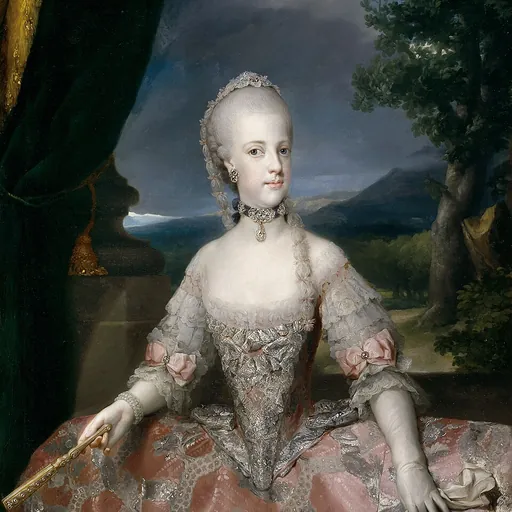
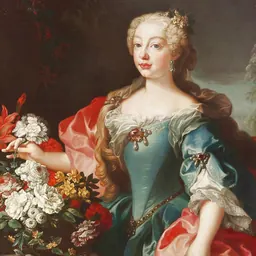
Maria Carolina of Austria
Queen of Naples and Sicily from 1768 to 1814
About Maria Carolina of Austria
Lived 1752 – 1814 (aged 62). Maria Carolina of Austria was an Austrian regent.
Maria Carolina of Austria (Maria Carolina Louise Josepha Johanna Antonia; 13 August 1752 – 8 September 1814) was Queen of Naples and Sicily as the wife of King Ferdinand IV and III, who later became King of the Two Sicilies. As de facto ruler of her husband's kingdoms, Maria Carolina oversaw the promulgation of many reforms, including the revocation of the ban on Freemasonry, the enlargement of the navy under her favourite, Sir John Acton, and the expulsion of Spanish influence. She was a proponent of enlightened absolutism until the advent of the French Revolution, when, in order to prevent its ideas gaining currency, she made Naples a police state.
Born an archduchess of Austria, the thirteenth child of Empress Maria Theresa and Holy Roman Emperor Francis I, Maria Carolina married Ferdinand as part of an Austrian alliance with Spain, of which Ferdinand's father was king. Following the birth of a male heir in 1775, Maria Carolina was admitted to the Privy Council. She dominated the Council until 1812, when she was sent back to Vienna. Like her mother, Maria Carolina arranged politically advantageous marriages for her children. Maria Carolina promoted Naples as a centre of the arts, patronising painters Jacob Philipp Hackert and Angelica Kauffman, and academics Gaetano Filangieri, Domenico Cirillo and Giuseppe Maria Galanti.
Maria Carolina, abhorring how the French treated their queen, her sister Marie Antoinette, allied Naples with Britain and Austria during the Napoleonic and French Revolutionary Wars. As a result of a failed Neapolitan invasion of French-occupied Rome, she fled to Sicily with her husband in December 1798. One month later, the Parthenopean Republic was declared, which repudiated Bourbon rule in Naples for six months. Deposed as Queen of Naples for a second time by French forces, in 1806, Maria Carolina died in Vienna in 1814, a year before her husband's restoration to Naples.
Maria Carolina was the last surviving child of Maria Theresa. She was also the last queen of Naples and Sicily before the unification of the two into the Kingdom of the Two Sicilies.
Early life alt=A young blue-eyed girl wears a blue rococo bodice with frilled sleeves while holding a portrait of her father. Born on 13 August 1752 at the Schönbrunn Palace in Vienna, Maria Carolina Louise Josepha Johanna Antonia was the thirteenth and sixth surviving child of Maria Theresa, Queen of Hungary and Bohemia and ruler of the Habsburg dominions, and Francis I, Holy Roman Emperor. She was a namesake of her elder sisters – Maria Carolina, who died two weeks after her first birthday, and Maria Carolina, who died several hours after being baptised – but she was known as Charlotte by her family. Her godparents were King Louis XV of France and his wife, Maria Leszczyńska. Maria Carolina was the daughter who resembled her mother most, inheriting her strong-willed and dominant personality.
Maria Carolina formed a very close bond with her youngest sister, Maria Antonia. In August 1767 Maria Theresa separated the two girls, hitherto raised together under the auspices of Countess Marie von Brandis, because of their bad behaviour. Soon after in October of the same year, Maria Carolina's sister Maria Josepha, destined to marry Ferdinand IV of Naples as part of an alliance with Spain, died during a smallpox epidemic before she could leave for Naples to marry him. Just five years earlier, Maria Josepha's older sister, Maria Johanna was previously engaged to the young king, but she too had died from smallpox. Anxious to save the Austro-Spanish alliance, Charles III of Spain, father of Ferdinand IV, requested one of Maria Josepha's sisters as a replacement. The empress offered the court of Madrid, negotiating on behalf of that of Naples, Maria Amalia or Maria Carolina. Because Maria Amalia was five years older than his son, Charles III opted for the latter. Nine months later, on 7 April 1768, Maria Carolina married Ferdinand IV of Naples by proxy, her brother Ferdinand representing the bride-groom.
Early reign The fifteen-year-old Queen of Naples journeyed at leisure from Vienna to Naples, making stops at Mantua, Bologna, Florence, and Rome on the way. She entered the Kingdom of Naples on 12 May 1768, disembarking at Terracina, where she took leave of her native attendants. To the Countess of Lerchenfeld, she wrote, "I love him only out of duty..."
Maria Carolina's dislike of her husband, however, did not get in the way of her bearing children, as her most important wifely duty was to perpetuate the dynasty. In total, Maria Carolina bore Ferdinand eighteen children within twenty-one years, from 1772 to 1793. Seven of these children survived into adulthood including his successor, Francis I, the last Holy Roman Empress, a Grand Duchess of Tuscany, the last Queen of the French, and a Princess of Asturias.
alt=An elderly brown-eyed man wears a powdered periwig and a red sash, with, over this, the cross of the Constantinian Order of Saint George.
Fall of Tanucci Ferdinand, having received a lacklustre education from the Prince of San Nicandro, lacked the ability to rule, relying completely on his father Charles III of Spain's counsel, communicated by Bernardo Tanucci. Pursuant to Empress Maria Theresa's instructions, Maria Carolina gained Ferdinand's trust by feigning interest in his favourite activity—hunting. Until then, Maria Carolina presided over the rejuvenation of Neapolitan court life, largely neglected since the advent of her husband's regency. Academics Gaetano Filangieri, Domenico Cirillo, and Giuseppe Maria Galanti frequented her salon, among others.
Tanucci's fall from grace came about over an argument with Maria Carolina regarding Freemasonry, of which she was an adherent. Resigned to the queen's wishes, Ferdinand dismissed Tanucci in October 1776, causing a rift with his father. The appointment of Tanucci's successor, the Marquis of Sambuca, Maria Carolina's powerless puppet, represented the end of Spanish influence in Naples, hitherto virtually a province of that country. Maria Carolina proceeded to alienate large swaths of the nobility by replacing the influence of Spain with that of Austria. Her unpopularity among the nobility was increased by her attempts to curb their prerogative. Acting on her brother the Holy Roman Emperor Joseph II's advice, Maria Carolina and Acton revamped the Neapolitan navy, then neglected, opening 4 marine colleges and commissioning 150 ships of various sizes. The merchant navy, too, was augmented by trade pacts with Russia and Genoa. Maria Carolina once again replied using a letter written by the king, expounding to Charles III that Acton, the son of a French woman, was not English and that he was appointed before Spanish hostilities with Britain broke out. Acton and Maria Carolina were seen to have become so close by 1782 that, according to the Sardinian ambassador in Naples, people falsely believed they were lovers. That the rumour was untrue was not known to the king, who tried several times to "surprise you together" and threatened to kill them both in a rage. In response, Maria Carolina set spies on her husband, but a reconciliation was soon achieved. Maria Carolina patronised German-Swiss artists, foremostly Angelica Kauffman, who famously painted the queen's family in an informal garden setting in 1783, and gave her daughters lessons in drawing. Maria Carolina showered Kauffman with gifts, but she preferred the artistic circles in Rome to Naples. The queen's patronage was not restricted to portrait painters: she allotted landscape painter Jacob Philipp Hackert a wing of the palace at Francavilla. On recommendation from Hackert, the king and queen restored the statues of Palazzo Farnese and brought them to Naples. In 1784, the queen established the philanthropic San Leucio colony, a village with its own unique laws and customs whose sole object was to weave silk. She also commissioned ornamental snuff boxes and jewellery from goldsmiths.
In 1788, with the death of King Charles III, Neapolitan-Spanish relations improved. The new king, Charles IV, was eager to be on good terms with his brother, the King of Naples, sending the Spanish fleet to salute to him. To consolidate their reconciliation, Charles IV proposed that his daughter marry the king and queen's eldest son, the Duke of Calabria. The death of the queen's nephew Crown Prince Francis of Austria's wife, Duchess Elisabeth of Württemberg, afforded her an opportunity to fulfil her marital ambitions. Her daughters Maria Theresa and Luisa married Crown Prince Francis and Ferdinand III, Grand Duke of Tuscany, respectively, during the Neapolitan royal family's visit to Vienna in 1790.
End of enlightened absolutism Marie Antoinette, Queen of France, here depicted by Jean-Baptiste Gautier Dagoty, was Maria Carolina's favourite sister. It was as a response to her treatment by the French that Maria Carolina allied Naples with Britain during the French Revolutionary Wars alt=A woman with a pouf wears a voluminous blue dress with a train of fleur-de-lis. Maria Carolina was anxious to improve Neapolitan-Papal relations, which had deteriorated owing to arguments with Pope Pius VI over ecclesiastical laws and the investiture and choice of bishops. Therefore, Maria Carolina arranged a meeting with the pope. The pope agreed to cede to the king the right of appointing bishops to vacant sees. On leaving, Maria Carolina was presented with the Golden Rose, a great mark of Papal favour. Alarmed by developments in France, especially in regards to her favourite sister, Marie Antoinette,#tag:ref|In Rome, Maria Carolina met the Mesdames de France, the last two surviving daughters of King Louis XV, who had sought refuge from the turmoil engulfing France there. From them, Maria Carolina learned of her sister's maltreatment at the hands of the French. She rejected the French Revolution and was determined to prevent its ideology gaining prevalence in Naples. She did this by sub-dividing Naples into twelve police wards, controlled by government-appointed commissioners, replacing the popularly elected alderman system. The effectiveness of the wards was increased by the creation of a secret police force, which had in its pay spies of every class.
In an attempt to please Great Britain, with a military alliance in mind, the queen deigned to meet the wife of the English ambassador, Emma Hamilton, in audience, despite the fact that the British Queen, Charlotte of Mecklenburg-Strelitz, had not yet received her. a French puppet state.
Escape and creation of the Parthenopean Republic When the Kingdom of Naples and Sicily joined the Second Coalition, Napoleon found a reason to act. The French General Jean-Étienne Championnet succeeded rapidly, and in January 1799 he occupied Naples and forced the royal family to escape to Sicily. In the Sicilian exile Maria Carolina continued her politics towards Naples.
On 24 January 1799, the Parthenopean Republic was proclaimed in Naples by the French troops led by General Championnet. The chosen name (after Parthenope, an ancient Greek colony which existed on the site of the future city of Naples) was an attempt by the French to obtain the support of the Neapolitan people. During the republican period, a government was installed with Ercole D'Agnese as elected President, press freedom was proclaimed, and future reforms were prepared. However, after only 6 months, the young republic ended when the Sanfedisti, the army led by Cardinal Fabrizio Ruffo, attacked and invaded Naples (21 June 1799). The collapse of the republic was largely due to the English fleet, which had supplied the royal army with weapons. Again, it was Admiral Nelson who successfully defeated the French in the middle of 1799 from Naples and Sicily securing the throne for the Royal couple.
In June 1800, Maria Carolina traveled with her three unmarried daughters, her younger son Leopoldo, and accompanied by William and Emma Hamilton and Nelson over Livorno, Florence, Trieste, and Laibach to Vienna, where she arrived two months later. Maria Carolina stayed two years in her homeland, where she arranged advantageous marriages for her children. In the family circle, she spent most time with her favorite grandchild, Archduchess Marie Louise of Austria, who later became the wife of her arch-enemy Napoleon.
Exile and death
After her stay in Vienna, Maria Carolina returned to Naples on 17 August 1802. It is said that Napoleon claimed that the queen was the only man in the Kingdom of Naples. The European states were concerned by Napoleon's growing power, which reached its peak with his Imperial coronation on 18 May 1804. By 1805 Italy was again the center of interest of the new Emperor, whose crown bore the inscription Rex totius Italiae. From then on, events came quickly and Maria Carolina was surprised by the news of the defeat of Austria in the Battle of Austerlitz (2 December 1805).
Napoleon then did not hesitate to conquer Naples and installed first his brother Joseph Bonaparte, and four years later his brother-in-law Joachim Murat, on the throne of Naples. The royal family was forced to flee to Sicily in February 1806. In their exile, the refugees relied on the help of Great Britain, but after the death of Admiral Nelson in the Battle of Trafalgar (21 October 1805), the British developed more and more aversion to Maria Carolina. Finally in 1813, her husband essentially (but not officially) abdicated and appointed their son Francis regent. This deprived her of any political influence, and the queen was forced to leave Sicily and return to Vienna.
During her trip, she received the news of Napoleon's defeat at the Battle of Leipzig on 19 October 1813. After a long journey through Constantinople, Odessa, Lviv, and Budapest, Maria Carolina finally arrived in Vienna in January 1814, where she began negotiations with Prince Metternich and her nephew, Emperor Francis I of Austria, for the restoration of her husband and herself to the Neapolitan throne. However, this never happened: Maria Carolina died on 8 September as a consequence of a stroke, without seeing the final defeat of Napoleon and the restoration of her husband by the Congress of Vienna. Her maid found the queen lying dead on the floor among scattered letters. Maria Carolina was the last surviving child of Empress Maria Theresa.
Maria Carolina was buried in the Imperial Crypt in Vienna. Her parents and most of her siblings are also buried there.
Issue Several of Maria Carolina’s young children succumbed to smallpox. In the end, Maria Carolina outlived all but four of her many offspring.
Ancestry
In popular culture Maria Carolina has occasionally been portrayed on film. Examples include Norma Drury in That Hamilton Woman (1941) and Gabriella Pession in Ferdinando and Carolina (1999).
Don’t just read it —
keep it.
Full-length biographies made to live with: read them, listen on the way to work, watch them tonight.
- E-book
- Audio
- Video
Instant download · yours to keep · every purchase keeps this site free
Important facts
more
Queen of Naples Maria Carolina, Maria Carolina d'Austria, Archduchess Maria Karolina Luise Josepha Johanna Antonia, Maria Karolina von Österreich, S.M. la Reine de Naples, Maria CarolinaPeople in Maria Carolina of Austria's life
Named in this biography and alive at the same time

Related people
Same field, nearest in time




Contemporaries
People whose lives overlapped Maria Carolina of Austria's






Frequently asked questions
Who was Maria Carolina of Austria?
Queen of Naples and Sicily from 1768 to 1814 (1752–1814)
When was Maria Carolina of Austria born?
Maria Carolina of Austria was born on 13 August 1752 in Vienna.
When did Maria Carolina of Austria die?
Maria Carolina of Austria died on 8 September 1814 in Hetzendorf.
What was Maria Carolina of Austria's occupation?
Maria Carolina of Austria was a regent.
What nationality was Maria Carolina of Austria?
Maria Carolina of Austria was Austrian.
Sources & further reading
· Wikipedia: Maria Carolina of Austria
· DBpedia: Maria Carolina of Austria
Cite this page
APA: Biography.guide. (2026). Maria Carolina of Austria. https://biography.guide/maria-carolina-of-austria/
MLA: "Maria Carolina of Austria." Biography.guide, https://biography.guide/maria-carolina-of-austria/.
Chicago: "Maria Carolina of Austria." Biography.guide. https://biography.guide/maria-carolina-of-austria/.
Data last updated: 2026-09-21 · Spot an error? Report a correction.
Portrait: Wikimedia Commons · author & licence
Page generated 2026-09-27 04:59 UTC