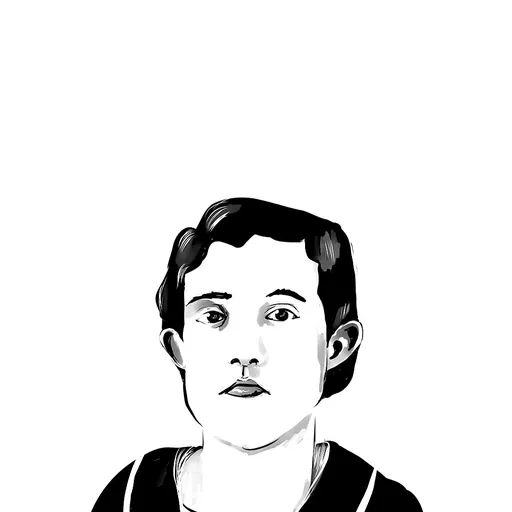
About María "La Jabalina"
Lived 1917 – 1942 (aged 25). María "La Jabalina" was a Spanish laborer, nurse and anarchist.
María Pérez Lacruz (1917–1942), also known by her nickname La Jabalina, was a Spanish militiawoman. Originally from the province of Teruel, she moved to the Valencian city of Sagunt at an early age. There she became involved in the Libertarian Youth and, following the outbreak of the Spanish Civil War, she joined the Iron Column as a military nurse. After being wounded in action, she was transferred to the , and went to work in an armaments factory after she had recovered. With the Nationalist victory in the civil war, she was arrested, charged with rebellion and imprisoned. She gave birth during her imprisonment and her child was abducted by the Francoist dictatorship. A court martial sentenced her to death and she was executed by firing squad; she became the last woman to be executed by the dictatorship. Since the passage of the Historical Memory Law in 2007, her life has been covered in various artistic mediums.
Biography María Pérez Lacruz was born in the Aragonese city of Teruel, on 3 May 1917, to Manuel Pérez and Isabel Lacruz. She was nicknamed , due to her family's origins in the small village of Jabaloyas. In 1923, her family moved to the Valencian city of Sagunt to look for work. Pérez Lacruz and her siblings were forced to work from a young age to support their family. Pérez Lacruz herself worked as a housecleaner. Following the proclamation of the Second Spanish Republic, in 1934, Pérez Lacruz joined the Libertarian Youth. When the Spanish Civil War broke out in July 1936, she went to Sarrión and joined the Iron Column, an anarchist militia. She worked as a military nurse on the Teruel front, where she opened a field hospital for the militia column. During an offensive against Teruel, on 23 August 1936, she was wounded by a bullet to her leg and transferred to the . After she was discharged on 24 December 1936, she returned to Sagunt and worked at an armaments factory.
After Sagunt fell to the Nationalists in the final offensive of the Spanish Civil War, on 23 April 1939, Pérez Lacruz was arrested by the Civil Guard. The police interrogated her and shaved her hair off, before releasing her. On 31 May, a military tribunal presented the charges against her, accusing her of rebellion and of living a libertine lifestyle, and of having attacked a prison in Castelló. She was also accused of having killed a number of guards, priests and a legislator, as well as two engineers, and a Bolivian consul (despite no Bolivian consulate existing in Valencia at the time). The Provincial Hospital verified that she had been recovering from her war wounds at the time of the alleged crimes, but this evidence was disregarded by the tribunal. Pérez Lacruz refused to sign the declaration against her and argued that the charges were based on lies; she was immediately imprisoned.
Her health deteriorated in prison, threatening her pregnancy, and on 4 November 1939, she was transferred to the Provincial Hospital. After she gave birth on 9 January 1940, her child was immediately taken away from her and she never saw them again. Valencian historian Ricard Vinyes estimated that the Francoist dictatorship abducted up to 30,000 children from imprisoned women. The parent's custody of them forcibly removed, the children were then placed them in orphanages and then re-educated them according to the values of the regime. On 18 January 1940, Pérez Lacruz was transferred to the women's prison in the . Two years later, she was transferred to the provincial women's prison. During her years in prison, she was regularly beaten and tortured, but she never gave up any information to her captors other than that she had been the lover of someone named "Paco el Francés".
On 28 July 1942, a court martial sentenced Pérez Lacruz to capital punishment for rebelling against the National Movement. On 8 August 1942, Pérez Lacruz and six other prisoners were executed by firing squad in the cemetery of Paterna. She was the last woman to be executed by the dictatorship. As of 2020, the fate of her abducted child has not yet been discovered; if alive, they would be in their 80s and would likely be entirely unaware of their true origins. Pérez Lacruz's life has been the focus of a biography by Manuel Girona published in 2007, a novel by Rosana Corral-Márquez published in 2013, and interpreted as a stage play in 2019. As part of a historical memory initiative by the Sagunt city council, in 2022, Cristina Durán and published a graphic novel about her life.
Don’t just read it —
keep it.
Full-length biographies made to live with: read them, listen on the way to work, watch them tonight.
- E-book
- Audio
- Video
Instant download · yours to keep · every purchase keeps this site free
Important facts
Related people
Same field, nearest in time



Contemporaries
People whose lives overlapped María "La Jabalina"'s



Frequently asked questions
Who was María "La Jabalina"?
Spanish anarchist militant (1917-1942)
When was María "La Jabalina" born?
María "La Jabalina" was born on 3 May 1917 in Teruel.
When did María "La Jabalina" die?
María "La Jabalina" died on 9 August 1942 in Paterna.
What was María "La Jabalina"'s occupation?
María "La Jabalina" was a laborer, nurse and anarchist.
What nationality was María "La Jabalina"?
María "La Jabalina" was Spanish.
Sources & further reading
· Wikipedia: María "La Jabalina"
Cite this page
APA: Biography.guide. (2026). María "La Jabalina". https://biography.guide/maria-la-jabalina/
MLA: "María "La Jabalina"." Biography.guide, https://biography.guide/maria-la-jabalina/.
Chicago: "María "La Jabalina"." Biography.guide. https://biography.guide/maria-la-jabalina/.
Data last updated: 2026-09-20 · Spot an error? Report a correction.
Portrait: Wikimedia Commons · author & licence
Page generated 2026-09-27 04:58 UTC