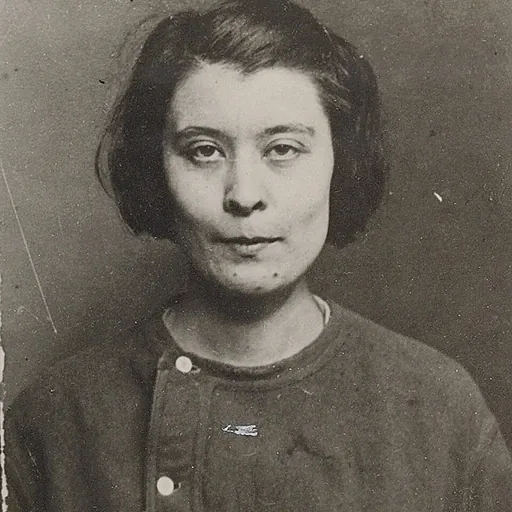
About Germaine Berton
Lived 1902 – 1942 (aged 40). Germaine Berton was a French laborer, trade unionist and anarchist.
Germaine Berton (7 June 1902, in Puteaux – 6 July 1942, in Paris) was a French anarchist and trade unionist. She is known for the murder of Marius Plateau, an editor for the Action Française journal and a leader in the royalist organisation Camelots du Roi, in January 1923. Germaine Berton was defended by Henry Torrès during her trial and surrealists have used her mugshot in a number of art pieces. Despite confessing, Berton was acquitted on 24 December 1923.
Berton stopped engaging with anarchist organizations following a subsequent arrest in 1924. In 1925, Berton married Paul Burger, a painter before leaving him in 1935 for René Coillot, a printer. She died in 1942 due to an intentional overdose.
Childhood Germaine Jeanne Yvonne Berton was born in Puteaux on 7 June 1902, to a working class family. Her father was a mechanic, Republican, Freemason, follower of Jean Jaurès and an anticlerical activist. Her mother was a congregational teacher. Through her father, Germaine met Jean Jaurès as a child. Germaine had a good relationship with her father but a difficult relationship with her mother.
Mugshots of Berton in 1921. On 20 November 1921, Berton went to the Pré-Saint-Gervais police station to report her identity papers as stolen. The police had initially stated the papers were previously brought to the station and were waiting for her to collect but were found to be missing when she arrived. Following this, Berton slapped the police commissioner's secretary and subsequently was sentenced to 3 months in prison and a 25 franc fine. When police arrived, Berton declared she was avenging the assassination of Jean Jaurès, Miguel Almereyda's mysterious death, and France's occupation of the Ruhr. She attempted suicide to escape prosecution but was unsuccessful. Berton was imprisoned for 11 months in Saint-Lazare prison before her trial. During her stay, Berton told the nun present, Sister Marie-Claudia, about her personal doubts about her own faith. Berton wrote: Berton was defended by Henry Torrès who argued that Berton should receive the same treatment as Raoul Villain, the man who assassinated Jean Jaurès and was acquitted four years earlier. Torres stated "Acquit her for all that she represents of abandonment of herself and misery, acquit her as you acquitted Villain. Peace for all. She must go and join Villain in oblivion and peace”. During the trial, the anarchist newspaper Le Libertaire organized a campaign in support of Germaine, calling her "the heroic Germaine Berton" in their 210th issue. The anarchist Séverine attended the trial.
Action Française called the assassination a “German-Bolshevist” plot. Historian Fanny Bugnon has stated the royalists attempted to use the fact Germaine Berton was a young woman to give credence to the conspiracy that "agents of Germany, the Soviets and the International Finance” manipulated Berton to silence their organization. This was followed with a call to mobilize. The Camelots du roi vandalized the printing press of the L'Œuvre newspaper on the evening of Plateau's death and thousands marched during Plateau's funeral. Historical analysis has found that Marius Plateau was proponent of structure in his party and Action Française became more radical in its beliefs following his death.
Despite having claimed responsibility for the killing, Berton was acquitted on 24 December 1923. On 22 May 1924, she was arrested following a number of fights that were attributed to her lectures in Bordeaux, resulting in a 100 franc fine and 4 months in prison at Fort du Hâ. During her detention, Germaine went on hunger strike for eight days before being taken to Saint-André Hospital on 30 May, ending her strike on 31 May. Berton was found to be suffering from a mental disorder while in the hospital, attempting suicide multiple times. The newspaper Le Libertaire stated her mental state was due to the death of Philippe Daudet. Following her release, Berton no longer engaged in militant activities and abandoned anarchism all together. Her death came four days after the death of Léon Daudet.
Legacy in Surrealism In 1923, during Berton's trial, Louis Aragon wrote an article supporting her. Aragon wrote an individual can “use terrorist means, in particular murder, to safeguard, at the risk of losing everything, what seems to her— rightly or wrongly — precious beyond anything in the world” Aragon would publish a 29 portrait piece in La Révolution surréaliste. Berton, or the idea of Berton, became more famous as a muse to many Surrealists. André Breton believed that she was the first surrealist anti-heroine and the incarnation of love and revolution.
Her mugshot was published in the surrealist magazine La Révolution surréaliste in December 1924. It is surrounded by the male surrealists, including Louis Aragon and André Breton, and other "inspirational figures" (Sigmund Freud, Pablo Picasso). The quote at the bottom comes from Charles Baudelaire and reads: "The woman is the being who casts the greatest shadow or the greatest light in our dreams."
Gallery
Don’t just read it —
keep it.
Full-length biographies made to live with: read them, listen on the way to work, watch them tonight.
- E-book
- Audio
- Video
Instant download · yours to keep · every purchase keeps this site free
Important facts
People in Germaine Berton's life
Named in this biography and alive at the same time




Related people
Same field, nearest in time


Contemporaries
People whose lives overlapped Germaine Berton's



Frequently asked questions
Who was Germaine Berton?
French anarchist
When was Germaine Berton born?
Germaine Berton was born on 7 June 1902 in Puteaux.
When did Germaine Berton die?
Germaine Berton died on 4 July 1942 in 15th arrondissement of Paris.
What was Germaine Berton's occupation?
Germaine Berton was a laborer, trade unionist and anarchist.
What nationality was Germaine Berton?
Germaine Berton was French.
Sources & further reading
Cite this page
APA: Biography.guide. (2026). Germaine Berton. https://biography.guide/germaine-berton/
MLA: "Germaine Berton." Biography.guide, https://biography.guide/germaine-berton/.
Chicago: "Germaine Berton." Biography.guide. https://biography.guide/germaine-berton/.
Data last updated: 2026-09-23 · Spot an error? Report a correction.
Portrait: Wikimedia Commons · author & licence
Page generated 2026-09-27 05:06 UTC