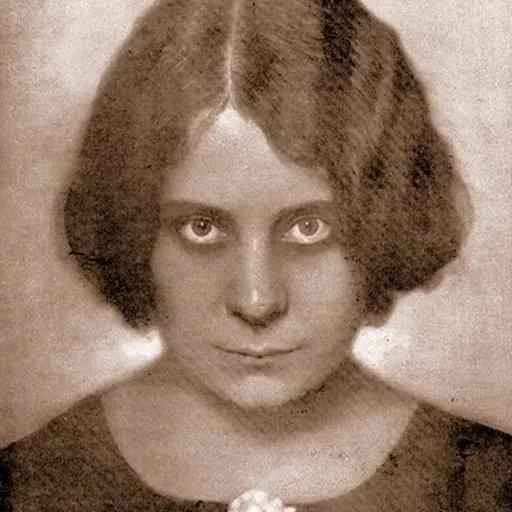
About Margit Kaffka
Lived 1880 – 1918 (aged 38). Margit Kaffka was a Hungarian poet, writer, women's rights activist and novelist.
Margit Kaffka (10 June 1880 – 1 December 1918) was a Hungarian writer and poet.
Called a "great, great writer" by Endre Ady, she was one of the most important female Hungarian authors, and an important member of the Nyugat generation. Her writing was inspired by József Kiss, , and the writers' group of the periodical .
Personal life
Margit Kaffka was born on 10 June 1880 in Nagykároly (today Carei, Romania) into a family of minor Hungarian nobility (see her family's genealogy in Records of the Tötösy de Zepetnek Family). Her father was a public prosecutor, but died early and the family lived under reduced circumstances. She received a scholarship to study at the Sisters of Mercy teacher's training college in Szatmár and in return she taught for one year in Miskolc. She studied in Budapest, receiving a teacher's diploma from the Erzsébet Girls' School. She returned to Miskolc, where she taught literature and economics in a private girls' school, beloved by students. This is the period when her first writings, poems, and novels appeared. She subsequently became a full-time contributor to Nyugat, the most important periodical of the era.
She married , a forestry officer, on 17 February 1905. In 1907 her husband moved to the Ministry of Agriculture, enabling Kaffka to move away from Miskolc, a town she did not like. However, their marriage became stressed after a few years, and ended in a divorce. Kaffka worked as a teacher in Budapest between 1910 and 1915. During this time, she published her best known work, Színek és évek (1912) (Colors and Years). She married for the second time in 1914 to Ervin Bauer, the younger brother of Béla Balázs. At the beginning of the First World War she left her teaching job to focus full-time on her literary work. She died in the 1918 flu pandemic along with her young son.
Literature
Her works dealt mostly with two main themes: the fall of the gentry, and the physical and spiritual hardships of the independent women in the start of the 20th century. She often wrote about her personal memories of great national crises, the glaring oppositions of the anachronistic society in Hungary.
Her literary career can be divided into three chapters, from 1901 to the start of Nyugat in 1908, the second ending in the start of the war in 1918, and the third marked by the hard years after the war ending in her death.
The year 1912 marked the release of her first, and most important novel, Színek és Évek (Colours and Years) dealing with the fate of the gentry class and women. Her second most famous work is Hangyaboly (The Ant Heap) collecting her memories from the years at the Sisters of Mercy; it was published in 1917.
Major works
Versek (1903) Levelek a zárdából (diary novel, 1904) A gondolkodók és egyéb elbeszélések (narratives, 1906) Csendes válságok (narratives, 1909) Képzelet-királyfiak (meseregény, 1909) Csendes válságok (narratives, 1910) Csonka regény és novellák (narratives, 1911) Tallózó évek (poems, 1911) Utolszor a lyrán (poems, 1912) Süppedő talajon (narratives, 1912) Színek és évek (Colours and Years) (novel, 1912) Mária évei (novel, 1913) Szent Ildefonso bálja (narratives, 1914) Két nyár (novel, 1916) Állomások (novel, 1917) Hangyaboly (The Ant Heap) (novel, 1917) Kis emberek barátocskáim (collection of early works, 1918) Az élet útján (poems, 1918) A révnél (narratives, 1918)
Don’t just read it —
keep it.
Full-length biographies made to live with: read them, listen on the way to work, watch them tonight.
- E-book
- Audio
- Video
Instant download · yours to keep · every purchase keeps this site free
Important facts
Family & relationships
People in Margit Kaffka's life
Named in this biography and alive at the same time

Related people
Same field, nearest in time

Contemporaries
People whose lives overlapped Margit Kaffka's






Frequently asked questions
Who was Margit Kaffka?
Hungarian writer (1880-1918)
When was Margit Kaffka born?
Margit Kaffka was born on 10 June 1880 in Carei.
When did Margit Kaffka die?
Margit Kaffka died on 1 December 1918 in Budapest.
What was Margit Kaffka's occupation?
Margit Kaffka was a poet, writer, women's rights activist and novelist.
What nationality was Margit Kaffka?
Margit Kaffka was Hungarian.
Sources & further reading
Cite this page
APA: Biography.guide. (2026). Margit Kaffka. https://biography.guide/margit-kaffka/
MLA: "Margit Kaffka." Biography.guide, https://biography.guide/margit-kaffka/.
Chicago: "Margit Kaffka." Biography.guide. https://biography.guide/margit-kaffka/.
Data last updated: 2026-09-22 · Spot an error? Report a correction.
Portrait: Wikimedia Commons · author & licence
Page generated 2026-09-27 05:02 UTC