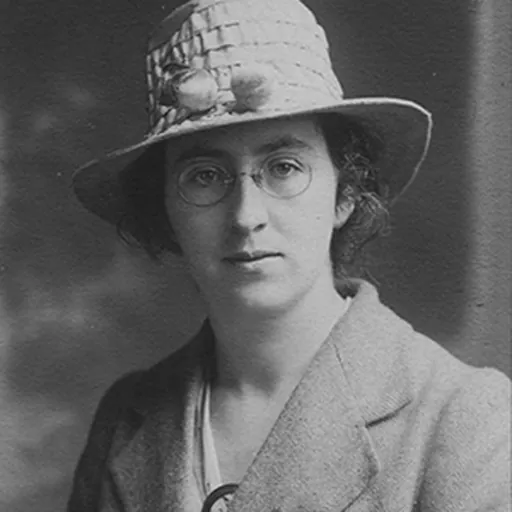
About Margaret Skinnider
Lived 1892 – 1971 (aged 79). Margaret Skinnider was an Irish teacher, autobiographer, suffragist, sniper, revolutionary and feminist.
Margaret Frances Skinnider (28 May 1892 – 10 October 1971) was a revolutionary and feminist born in Coatbridge, Scotland. She fought during the 1916 Easter Rising in Dublin as a sniper, among other roles, and was the only woman wounded in the action. As a scout, she was praised for her bravery. Sadhbh Walshe in The New York Times refers to her as "the schoolteacher turned sniper".
Early life Margaret Frances Skinnider was born in 1892 to Irish parents in the Lanarkshire town of Coatbridge. She trained as a mathematics teacher and joined Cumann na mBan in Glasgow. She was also involved in the women's suffrage movement, including a protest at Perth Prison. Ironically, she had learned to shoot in a rifle club which had originally been set up so that women could help in defence of the British Empire.
During her trips to Ireland, Skinnider came under the influence of Constance Markievicz and became active in smuggling detonators and bomb-making equipment into Dublin (in her hat) in preparation for the 1916 Easter Rising. Along with Madeleine ffrench-Mullen, she spent time in the hills around Dublin testing dynamite.
When Skinnider was shown "the poorest part of Dublin" by Markievicz, she wrote, "I do not believe there is a worse place in the world." The street was "a hollow full of sewage and refuse", and the building "as full of holes as if it had been under shellfire".
Easter Rising
Although a member of Cumann na mBan, Skinnider was attached to the Irish Citizen Army during the Rising. Operating variously as a scout, message runner (often dressed as a boy ) and sniper, Skinnider took part in action against the British Army at the Garrison at the College of Surgeons and St. Stephen's Green under the Command of General Michael Mallin and Markievicz. Beneath her were 4 men under her command. Skinnider was reportedly an excellent markswoman.
She was seriously wounded when she was shot three times attempting to burn down houses on Harcourt Street to try to cut off the retreat of British soldiers who had planted a machine-gun post on the roof of the University Church.
Nora Connolly O'Brien describes Skinnider's leading role in this action:
In her autobiography, Doing my bit for Ireland Skinnider herself vividly describes her role as a sniper at St. Stephen's Green in the Easter Rising:
In terms of her role as a woman taking part in military action Skinnider comments:
The president of Sinn Féin, Gerry Adams, quoted Skinnider's words in his 2006 address to the Sinn Féin Ard Feis.
Skinnider was seriously injured during the Easter Rising, being shot three times, with one of the bullets missing her spine just a quarter of an inch. One of the people fighting alongside her, 17-year-old Fred Ryan, was killed. Lying in the street, she was carried by fellow rebels to the College of Surgeons. She remained there until the order to surrender came, after which she was transferred to St Vincent's Hospital on the other side of the Green. For the next two weeks Skinnider suffered terribly; the bullets she had been shot with were dumdum bullets, which expand after entering the body. Her wounds were treated with corrosive sublimate, but too much was used and as a result they removed all the skin on her back and her side. On top of this she had to fight off a fever and pneumonia. Skinnider also wrote and published her autobiography in New York – Doing my Bit for Ireland. Skinnider later returned to Ireland and took up a teaching post in Dublin in 1917. During the Irish War of Independence, she was arrested and imprisoned. In the Irish Civil War, she participated in the Battle of the Four Courts where she served as a courier to the anti-treaty commanders. Following the death of Harry Boland she later became the Paymaster General of the Irish Republican Army until she was arrested on Saint Stephen's Day 1922 and held at North Dublin Union on charges of processing a revolver and ammunition. There she became Director of Training for the prisoners.
In 1925, Skinnider applied for a wounded pension based on her involvement in the Easter Rising. However, she was turned on the grounds of being a woman (although the fact she had fought on the anti-treaty side in the Civil war was also held against her). She would not receive her pension until 1938, after Eamon De Valera and Fianna Fáil came to power and forced the state to be more amicable to pension requests from those who had fought on the anti-treaty side.
Later life
After her release from prison, she worked as a teacher at Kings Inn Street Sisters of Charity Primary School in Dublin until her retirement in 1961. She was a member of the Irish National Teachers' Organisation (INTO) throughout her teaching career, and became its president in 1956. She also actively fought for the rights of women, with the marriage bar being a particular target of her campaigning.
In 1960, she was made chairperson of the Women's Advisory Committee of the Irish Congress of Trade Unions (ICTU) and from 1961 till 1963 she served on its executive council.
Personal life Mary McAuliffe, a historian who has written a biography of Skinnider after researching her life, believes Skinnider was a lesbian. Her partner was Nora O’Keeffe whom she met in 1917 while in New York as the two of them had been sent by Eamon De Valera to collect funds for the nationalist cause. By 1919 the two were living together as a couple, remaining together living in Dublin until O’Keeffe's death in 1962. Skinnider was amongst a number of lesbian women who participated in Easter 1916, as she would have fought alongside Kathleen Lynn, Madeleine ffrench-Mullen, Julia Grenan and Elizabeth O'Farrell. These women were featured, along with Eva Gore-Booth and others, in a 2023 TG4 documentary about "the radical queer women at the very heart of the Irish Revolution": (Radical Hearts).
She spent her last years in Glenageary, County Dublin. She died on 10 October 1971 and was buried next to Markievicz in Glasnevin Cemetery, Dublin. Skinnider was only the third woman to have been buried in the "Republican plot" area of Glasnevin, Markievicz being the first and James Connolly's wife Lillie being the second.
Don’t just read it —
keep it.
Full-length biographies made to live with: read them, listen on the way to work, watch them tonight.
- E-book
- Audio
- Video
Instant download · yours to keep · every purchase keeps this site free
Important facts
People in Margaret Skinnider's life
Named in this biography and alive at the same time





Related people
Same field, nearest in time

Contemporaries
People whose lives overlapped Margaret Skinnider's




Frequently asked questions
Who was Margaret Skinnider?
Irish republican activist
When was Margaret Skinnider born?
Margaret Skinnider was born on 28 May 1892 in Coatbridge.
When did Margaret Skinnider die?
Margaret Skinnider died on 10 October 1971 in Dublin.
What was Margaret Skinnider's occupation?
Margaret Skinnider was a teacher, autobiographer, suffragist, sniper, revolutionary and feminist.
What nationality was Margaret Skinnider?
Margaret Skinnider was Irish.
Sources & further reading
· Wikipedia: Margaret Skinnider
Cite this page
APA: Biography.guide. (2026). Margaret Skinnider. https://biography.guide/margaret-skinnider/
MLA: "Margaret Skinnider." Biography.guide, https://biography.guide/margaret-skinnider/.
Chicago: "Margaret Skinnider." Biography.guide. https://biography.guide/margaret-skinnider/.
Data last updated: 2026-09-20 · Spot an error? Report a correction.
Portrait: Wikimedia Commons · author & licence
Page generated 2026-09-27 04:58 UTC