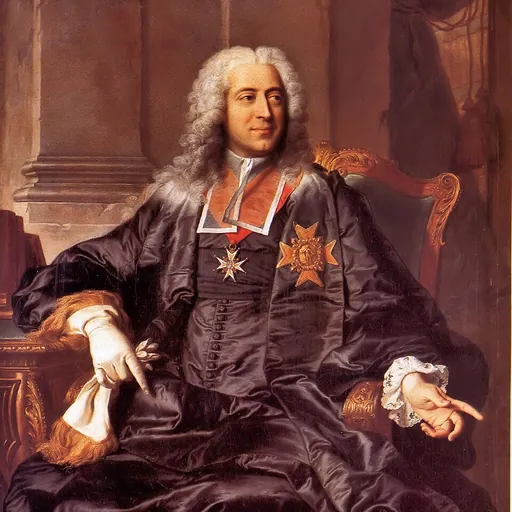
About Marc Pierre de Voyer de Paulmy d'Argenson
Lived 1696 – 1764 (aged 68). Marc Pierre de Voyer de Paulmy d'Argenson was a French politician, aristocrat, writer and minister.
Marc-Pierre de Voyer de Paulmy, comte d'Argenson (16 August 1696 22 August 1764) was a French politician.
Biography D'Argenson, a younger son of Marc-René de Voyer de Paulmy d'Argenson (1652–1721), was born on 16 August 1696. Following the family tradition he studied law and was councillor at the parlement of Paris. He succeeded his father as lieutenant-general of police in Paris, but held the post only five months (26 January to 30 June 1720). He then received the office of intendant of Tours, and resumed the lieutenancy of police in 1722.
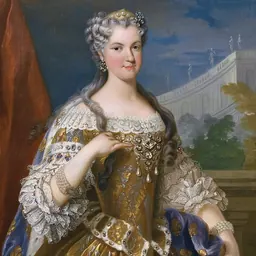
On 2 January 1724 d'Argenson was appointed councillor of state. He gained the confidence of the regent Philippe, Duke of Orleans, administering his fortune and living with his son until 1737. During this period he opened his salon to the philosophers Chaulieu, the Marquis of la Fare and Voltaire, and collaborated in the legislative labours of the chancellor d'Aguesseau. He was also a close friend and confidant of the French Queen Marie Leszczyńska.
In March 1737 d'Argenson was appointed director of the censorship of books, in which post he showed sufficiently liberal views to gain the approval of writers—a rare thing in the reign of Louis XV. He only retained this post for a year. He became president of the grand council (November 1738), intendant of the généralité of Paris (August 1740), was admitted to the king's council (August 1742).
In January 1743 d'Argenson was appointed secretary of state for war in succession to Baron de Breteuil. As minister for war he had a heavy task; the French armies engaged in the War of the Austrian Succession were disorganized, and the retreat from Prague had produced a disastrous effect. After consulting with Marshal Saxe, he began the reform of the new armies. To assist recruiting, he revived the old institution of local militias, which, however, did not come up to his expectation. In the spring of 1744 three armies were able to resume the offensive in the Netherlands, Germany and Italy, and in the following year France won the Battle of Fontenoy, at which d'Argenson was present.
As part of a project to rationalise and standardise the military, he set up a new military engineering school in 1744, the École royale du génie at Charleville-Mézières, which still exists today. After the 1748 Treaty of Aix-la-Chapelle, other significant reforms included standardising the artillery, grouping Grenadiers into separate regiments, and setting up an officer training school, the École Militaire. thumb Marc-Pierre de Voyer de Paulmy d'ArgensonAn edict of 1 November 1751 granted patents of nobility to all who had the rank of general officer. In addition to his duties as minister of war he had the supervision of the printing, postal administration and general administration of Paris. He was responsible for the arrangement of the promenade of the Champs Élysées and for the plan of the present Place de la Concorde. He was exceedingly popular, and, although the court favourites hated him, he had the support of the king. Nevertheless, after the attempt of Robert-François Damiens to assassinate King Louis XV, Louis abandoned d'Argenson to the machinations of the court favourites and dismissed both him and his colleague, the Comte d'Arnouville (February 1757).
D'Argenson was exiled to his château and estate at Les Ormes near Saumur, but he had previously found posts for his brother, René Louis, Marquis d'Argenson, as minister of foreign affairs, for his son Marc René as master of the horse, and for his nephew Marc Antoine René as commissary of war. From the time of his exile he lived in the society of savants and philosophers. He had been elected member of the Académie des Inscriptions in 1749. Diderot and d’Alembert dedicated the Encyclopédie to him, and Voltaire, Charles-Jean-François Hénault, and Jean-François Marmontel openly visited him in his exile. After the death of Madame de Pompadour he obtained permission to return to Paris, and died 22 August 1764, a few days after his return.
Don’t just read it —
keep it.
Full-length biographies made to live with: read them, listen on the way to work, watch them tonight.
- E-book
- Audio
- Video
Instant download · yours to keep · every purchase keeps this site free
Important facts
People in Marc Pierre de Voyer de Paulmy d'Argenson's life
Named in this biography and alive at the same time
Related people
Same field, nearest in time

Contemporaries
People whose lives overlapped Marc Pierre de Voyer de Paulmy d'Argenson's

Frequently asked questions
Who was Marc Pierre de Voyer de Paulmy d'Argenson?
French politician (1696-1764)
When was Marc Pierre de Voyer de Paulmy d'Argenson born?
Marc Pierre de Voyer de Paulmy d'Argenson was born on 16 August 1696 in Paris.
When did Marc Pierre de Voyer de Paulmy d'Argenson die?
Marc Pierre de Voyer de Paulmy d'Argenson died on 22 August 1764 in Paris.
What was Marc Pierre de Voyer de Paulmy d'Argenson's occupation?
Marc Pierre de Voyer de Paulmy d'Argenson was a politician, aristocrat, writer and minister.
What nationality was Marc Pierre de Voyer de Paulmy d'Argenson?
Marc Pierre de Voyer de Paulmy d'Argenson was French.
Sources & further reading
· Wikipedia: Marc Pierre de Voyer de Paulmy d'Argenson
· DBpedia: Marc Pierre de Voyer de Paulmy, Count of Argenson
Cite this page
APA: Biography.guide. (2026). Marc Pierre de Voyer de Paulmy d'Argenson. https://biography.guide/marc-pierre-de-voyer-de-paulmy-d-argenson/
MLA: "Marc Pierre de Voyer de Paulmy d'Argenson." Biography.guide, https://biography.guide/marc-pierre-de-voyer-de-paulmy-d-argenson/.
Chicago: "Marc Pierre de Voyer de Paulmy d'Argenson." Biography.guide. https://biography.guide/marc-pierre-de-voyer-de-paulmy-d-argenson/.
Data last updated: 2026-09-26 · Spot an error? Report a correction.
Portrait: Wikimedia Commons · author & licence
Page generated 2026-10-04 10:35 UTC