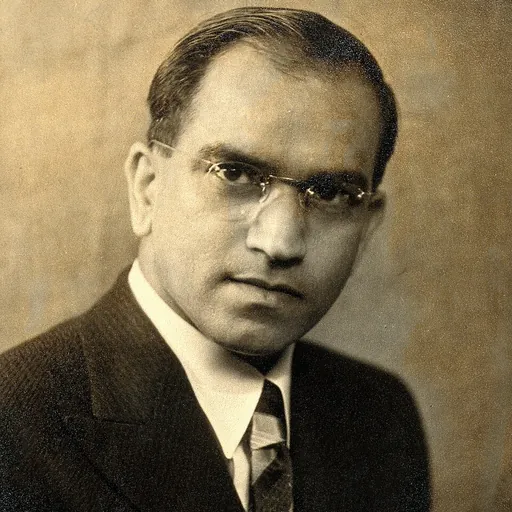
Mandayam Osuri Tirunarayana Iyengar
Indian medical entomologist
About Mandayam Osuri Tirunarayana Iyengar
Lived 1895 – 1972 (aged 77). Mandayam Osuri Tirunarayana Iyengar was an Indian entomologist, malariologist and medical entomologist.
Mandayam Osuri Tirunarayana Iyengar (6 February 1895 – 16 September 1972) was an Indian medical entomologist who worked on management of filaria and malaria vectors. He was employed as an entomologist in the Department of Malaria Research, Bengal. The mermithid parasite Romanomermis iyengari and the mosquito species Culex iyengari are named after him.
Life and work Iyengar was born in a prominent Madras family, his father M.O. Alasingrachariar was a senior judge in the Madras High Court, and an older brother was the botanist M.O.P. Iyengar. After studying at the Hindu High School and graduating from the Presidency College, Madras he joined as an entomologist in-charge in the Bengal Malaria Research laboratory in Calcutta from 1918. He also taught medical parasitology and entomology for public health students. He served as a professor of medical entomology at the School of Tropical Medicine in Calcutta between 1922 and 1923. He also maintained an interest in botany, especially in association with aquatic habitats where he was studying mosquitoes, and described the floral biology of Monochoria and published with his brother on Characium (algae) associated with the larvae of Anopheles in 1932. He worked under the aegis of the Rockefeller Foundation for the Travancore State between 1931 and 1934 studying filariasis on which he served as a consultant for the World Health Organization working in many parts of the world including Afghanistan, the Maldives, New Guinea, Samoa, and Thailand. He collaborated with other malariologists around the world including P.A. Buxton, Wilhelm Schüffner, Henri Galliard, N.H. Swellengrebel and P.G. Shute. He surveyed natural control measures of mosquito larvae and identified fungi in the Coelomomyces group and a mermithid with potential for use in control. A mermithid, named after him as Romanomermis iyengari has found continued use in the management of anophelines around the world. Other findings of his included the observation that microfilaria that had been injested with blood by mosquitoes, entered the haemocoel not from the stomach wall as had been earlier thought but through the wall of the proventriculus. Iyengar also published a couple of notes in entomology that were not in his professional line of work. These include notes on adult coprid beetles emerging from human intestines with faeces. The Dr M.O.T. Iyengar Memorial Award was instituted in 1983 by his wife Mrs Rukmani Iyengar.
Publications Swellengrebel with Iyengar (right-most in white) at Calcutta, c. 1924 A complete list of publications is provided in Iyengar & Gandhi (2009). Some major publications include:
On the biology of the flowers of Monochoria. J. Indian Bot. Soc, 170-173, April 1923 The anopheline fauna of a swamp in Bangalore. Indian J. Med. Res.,13:697-702,1926 Infestation of the human intestines by coprid beetles. Indian Med. Gaz., 63, 365-369, 1928. The larva of Anopheles turkhudi. Indian J. Med. Res., 17:1189-1192, 1930 Filariasis in North Travancore. Indian J. Med. Res., 20, 671-672, 1933 Rat-flea survey in Peermade District, Travancore. Indian J. Med. Res., 21:723-730,1934 The identification of common rat-fleas of India. Indian J. Med. Res., 22:675-686,1935 Public health aspects of filariasis in India. Indian Med. Gaz, 72:300-307, 1937. Naturalistic control of the breeding of Anopheles sundaicus by means of Eichomia cover. J. Malar. Inst. India, 6:309-310,1946. Mosquitoes of the Maldive Islands. Bull. Ent. Res., 46:1-10, 1955. (with M.A.U. Menon). Infection experiments with a fungus (Coelomomyces) which kills malarial mosquitoes. Science, 158, 526, 1967. (with J.N. Couch and C.J. Umphlett) Developmental Stages Of Filariae In Mosquitoes. 5th. Pacif. Comm. Tech. Pap., No. 104, 11 pages, 1957
Don’t just read it —
keep it.
Full-length biographies made to live with: read them, listen on the way to work, watch them tonight.
- E-book
- Audio
- Video
Instant download · yours to keep · every purchase keeps this site free
Important facts
People in Mandayam Osuri Tirunarayana Iyengar's life
Named in this biography and alive at the same time

Related people
Same field, nearest in time



Contemporaries
People whose lives overlapped Mandayam Osuri Tirunarayana Iyengar's


Frequently asked questions
Who was Mandayam Osuri Tirunarayana Iyengar?
Indian medical entomologist
When was Mandayam Osuri Tirunarayana Iyengar born?
Mandayam Osuri Tirunarayana Iyengar was born on 6 February 1895.
When did Mandayam Osuri Tirunarayana Iyengar die?
Mandayam Osuri Tirunarayana Iyengar died on 16 September 1972.
What was Mandayam Osuri Tirunarayana Iyengar's occupation?
Mandayam Osuri Tirunarayana Iyengar was an entomologist, malariologist and medical entomologist.
What nationality was Mandayam Osuri Tirunarayana Iyengar?
Mandayam Osuri Tirunarayana Iyengar was Indian.
Sources & further reading
· Wikipedia: Mandayam Osuri Tirunarayana Iyengar
Cite this page
APA: Biography.guide. (2026). Mandayam Osuri Tirunarayana Iyengar. https://biography.guide/mandayam-osuri-tirunarayana-iyengar/
MLA: "Mandayam Osuri Tirunarayana Iyengar." Biography.guide, https://biography.guide/mandayam-osuri-tirunarayana-iyengar/.
Chicago: "Mandayam Osuri Tirunarayana Iyengar." Biography.guide. https://biography.guide/mandayam-osuri-tirunarayana-iyengar/.
Data last updated: 2026-09-20 · Spot an error? Report a correction.
Portrait: Wikimedia Commons · author & licence
Page generated 2026-09-27 04:57 UTC