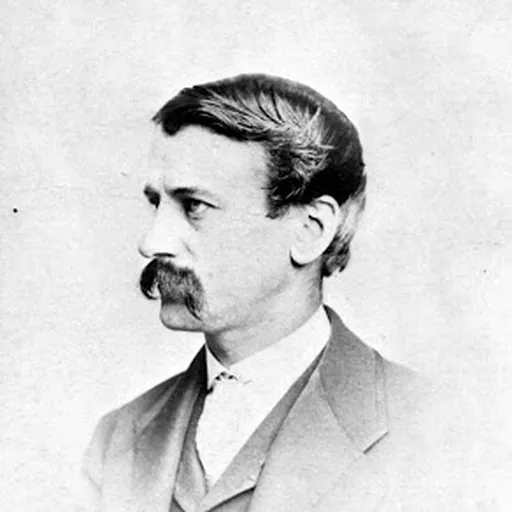
About Maitland Armstrong
Lived 1836 – 1918 (aged 82). Maitland Armstrong was an American painter, diplomat, lawyer, art collector, glass painter and glass artist.
David Maitland Armstrong (April 15, 1836 May 26, 1918) was Charge d'Affaires to the Papal States (1869), American Consul in Rome (186971), and Consul General in Rome (187173). He was also an important stained-glass artist and a painter.
Early life
Armstrong was born in Newburgh, New York in 1836 and educated at Trinity College, Hartford, Connecticut from 1854. He was the youngest of four sons of Edward Armstrong (1800–1840), a prominent local farmer, and his wife, Sarah Hartley Ward (1801–1853) of Charleston, South Carolina. Edward Armstrong added to the land already acquired by his father, until eventually he owned farms extending along a nearly two mile frontage of the Hudson River, and built a substantial house, the Edward Armstrong Mansion, now demolished, but with its huge Ionic columns on display in the grounds of the Storm King Art Center.
His grandfather was Colonel William Armstrong, who came from Scotland with the British Army during the American Revolution. His grandfather was present at the Battle of Yorktown, as was his wife's grandfather, Colonel Nicholas Fish, but he was on the winning side. In his memoirs, Maitland wonders if they ever met.
His brothers were William Henry, Gouverneur, and John Armstrong. William Henry Armstrong (and his family) lived at Gomez Mill House from 1835 to 1904, the earliest surviving Jewish residence in the US, and now a museum, with several of Maitland Armstrong's artworks on display.
In the autumn of 1858, Maitland Armstrong sailed to Italy, arriving just before the new year, where he spent months touring the country and making illustrations of the scenery and ancient monuments. At this time, former U.S. President Ulysses S. Grant was on a long world tour, and Armstrong met him several times socially and to show him around the Exposition. Armstrong was awarded the Légion d'honneur for his work on the Exposition.
Painting Armstrong's paintings were mainly of landscapes and picturesque country scenes.
Stained glass
From the 1880s, Armstrong worked with his friends Louis C. Tiffany and John La Farge. In 1887 he formed his own firm, Maitland Armstrong and Co., of New York. joined him in the business and she became an important stained-glass artist in her own right. Works created included important installations at the Appellate Court Building in New York, Vanderbilt's All Souls Church in Biltmore Village (Asheville, NC), and the Church of the Ascension in New York, where he was a parishioner.
Armstrong was one of the foremost exponents of American-style opalescent stained glass during the American Renaissance or Gilded Age.
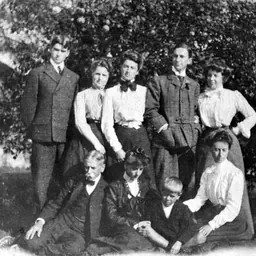
Family The Armstrong family c. 1910s. Front row, left to right: D. Maitland, Helen Maitland, Hamilton Fish, and Margaret Neilson Armstrong. Standing, left to right: Noel, Helena, Marion, Edward Maitland, Maud Gwendolyn King (Edward's wife). Armstrong married Helen Neilson, a descendant of Peter Stuyvesant and a niece of Hamilton Fish. They had seven children, six of whom survived to adulthood. Helen Maitland Armstrong (1869–1948) followed in her father's footsteps in the family business. Her sister Margaret Neilson Armstrong (1867–1944) became a noted book designer and later novelist and biographer, while their brother Hamilton (Ham) Fish Armstrong, was editor of the influential U.S. foreign policy journal Foreign Affairs from 1928 to 1972. The other children were Marion Howard Armstrong (1880-1957), who married Alfred Edey, Noel Maitland Armstrong (1882-1938), and Edward Maitland Armstrong (1874-1915).
He died at his home at 58 West Tenth Street, New York, which is now sometimes known as the D. Maitland Armstrong House. Armstrong purchased number 58 in 1890 and refurbished it, adding decorative flourishes in leaded stained glass and wrought iron. The Tenth Street Studio Building (now demolished), was built at number 51 in 1858 for artists, and became the centre of artistic life in New York for the rest of that century. The New York Times notes that "For some people, West 10th Street between Fifth and Sixth Avenues is the most beautiful block in New York City."
Don’t just read it —
keep it.
Full-length biographies made to live with: read them, listen on the way to work, watch them tonight.
- E-book
- Audio
- Video
Instant download · yours to keep · every purchase keeps this site free
Important facts
People in Maitland Armstrong's life
Named in this biography and alive at the same time




Related people
Same field, nearest in time



Contemporaries
People whose lives overlapped Maitland Armstrong's




Frequently asked questions
Who was Maitland Armstrong?
American lawyer and artist (1836–1918)
When was Maitland Armstrong born?
Maitland Armstrong was born on 15 April 1836 in Newburgh.
When did Maitland Armstrong die?
Maitland Armstrong died on 26 May 1918 in Manhattan.
What was Maitland Armstrong's occupation?
Maitland Armstrong was a painter, diplomat, lawyer, art collector, glass painter and glass artist.
What nationality was Maitland Armstrong?
Maitland Armstrong was American.
Sources & further reading
· Wikipedia: Maitland Armstrong
Cite this page
APA: Biography.guide. (2026). Maitland Armstrong. https://biography.guide/maitland-armstrong/
MLA: "Maitland Armstrong." Biography.guide, https://biography.guide/maitland-armstrong/.
Chicago: "Maitland Armstrong." Biography.guide. https://biography.guide/maitland-armstrong/.
Data last updated: 2026-09-23 · Spot an error? Report a correction.
Portrait: Wikimedia Commons · author & licence
Page generated 2026-09-27 05:06 UTC