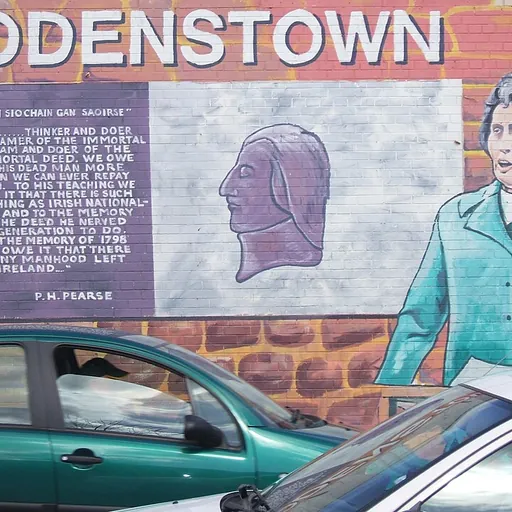
About Máire Drumm
Lived 1919 – 1976 (aged 56). Máire Drumm was a British politician, known for Republican Movement (Ireland).
Máire Drumm (22 October 1919 – 28 October 1976) was the vice-president of Sinn Féin and a commander in Cumann na mBan. She was assassinated by Ulster loyalists while recovering from an eye operation in Belfast's Mater Hospital.
Early life Máire McAteer was born in Newry, County Down, to a staunchly Irish republican McAteer family, where she became the eldest of four siblings. Drumm's mother, Margaret McAteer (née Brown), had been active in the War of Independence and the Civil War. Drumm grew up in the village of Killeen, County Armagh, right on the border with County Louth. She played camogie for Killeen. The family moved to Dublin in 1940 and soon afterwards Drumm joined Sinn Féin. The family moved again to Liverpool and it was there Drumm joined the Gaelic League. The family returned to Northern Ireland in 1943 and Drumm took up work as a grocer's assistant in Belfast. It was at this point Drumm became an active participant in the Republican movement, taking a particular interest in the welfare of Republican prisoners. It was through this interest she met Jimmy Drumm, a long time Irish Republican who was interned in a Belfast prison, whom she married upon his release in 1947. Starting in the 1930s, Jimmy Drumm spent 13 years in prison for Republican activity including internment on the prison ship HMS Al Rawdah. At least nine of those years of imprisonment were served with no charge ever being filed. Her husband's imprisonment left Máire to do most of the raising of their four children. Despite her family circumstances, Drumm remained an active social figure. She became involved in the National Graves Association, an organisation dedicated to the maintenance of the gravesites and shrines to deceased Republicans. She was also involved in the Gaelic Athletic Association, working to promote the sport of Camogie.
Political life The onset of the Troubles in Northern Ireland severely ratcheted up the sectarian tensions in the region and forced dramatic responses from Republicans. Both the Irish Republican Army and Sinn Féin split into two parallel camps, the Official IRA and its political counterpart Official Sinn Féin, and the Provisional IRA and its political partner Provisional Sinn Féin. Drumm sided with the provisionals and was subsequently made a high-ranking member of that faction: She served on Ard Comhairle (supreme council) of Provisional Sinn Féin, later become a vice-president of the party. As the violence grew and many people became displaced by the Troubles, Drumm worked to rehouse those people in new areas.
As Vice-president of Sinn Féin, she often acted as a spokeswoman for the party in the media and was known for her abrasive rhetoric. She openly called for Catholics in Northern Ireland to join the IRA, and she was unafraid to threaten the Northern Irish and British governments with civil unrest as a result of their decisions. This culminated with her arrest for "seditious speech" in July 1971 when she told an audience in Belfast "You should not shout “Up the IRA”, you should join the IRA."
In August of 1976, she was once again imprisoned following a speech, this time at a rally in Dunville Park, West Belfast where she suggested the city would be destroyed "stone by stone" by Republicans unless republican prisoners were given Special Category Status. In the immediate aftermath, many questioned why her location had been so well publicised as well as criticising the lack of security around the hospital that allowed for her assassins to so easily enter her ward. Some Unionists suggested that Drumm was a victim of the violent rhetoric which she had sown, and was thus undone by her own hand. Ian Paisley described her as the "personification" of the Provisionals, meaning "sinister, bitter and violent".
Quotes Drumm's speeches and quotations can be found on murals across Northern Ireland. These include:
"The only people worthy of freedom are those who are prepared to go out and fight for it every day, and die if necessary". "We must take no steps backward, our steps must be onward, for if we don't, the martyrs that died for you, for me, for this country will haunt us forever".
Don’t just read it —
keep it.
Full-length biographies made to live with: read them, listen on the way to work, watch them tonight.
- E-book
- Audio
- Video
Instant download · yours to keep · every purchase keeps this site free
Important facts
People in Máire Drumm's life
Named in this biography and alive at the same time

Related people
Same field, nearest in time






Contemporaries
People whose lives overlapped Máire Drumm's


Frequently asked questions
Who was Máire Drumm?
Northern Irish politician (1919-1976)
When was Máire Drumm born?
Máire Drumm was born on 22 November 1919 in Newry.
When did Máire Drumm die?
Máire Drumm died on 28 October 1976 in Belfast.
What was Máire Drumm's occupation?
Máire Drumm was a politician.
What was Máire Drumm known for?
Máire Drumm was known for Republican Movement (Ireland).
What nationality was Máire Drumm?
Máire Drumm was British.
Sources & further reading
Cite this page
APA: Biography.guide. (2026). Máire Drumm. https://biography.guide/maire-drumm/
MLA: "Máire Drumm." Biography.guide, https://biography.guide/maire-drumm/.
Chicago: "Máire Drumm." Biography.guide. https://biography.guide/maire-drumm/.
Data last updated: 2026-09-23 · Spot an error? Report a correction.
Portrait: Wikimedia Commons · author & licence
Page generated 2026-09-27 05:06 UTC