
About Macario Peralta, Jr.
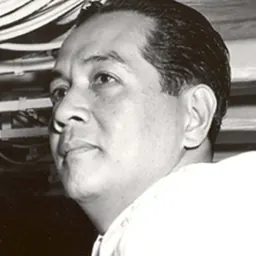
Lived 1913 – 1965 (aged 52). Macario Peralta, Jr. was a Filipino politician, minister, military leader and lawyer.
Macario Peralta Peralta Jr. (July 30, 1913 – January 7, 1975) was a Filipino soldier, lawyer, senator and Secretary of National Defense.
Early life Peralta was born in Manila on July 30, 1913, of Ilocano-Pangasinan descent to Macario Maravilla Peralta Sr. and Concepcion Roldan Peralta from Mangatarem, Pangasinan, he grew up in Moncada, Tarlac. Peralta finished his Bachelor of Laws degree at the University of the Philippines Manila, graduating cum laude, in 1936. He passed the bar the same year, obtaining second place to Diosdado Macapagal.
Career
Army Officer
Peralta joined the Philippine Army in 1936 as a reserve officer and was later commissioned in the regular force as second Lieutenant. His first assignment was in Cebu as Commandant of the Visayan Institute ROTC cadets, later at the Adamson University in Manila. He attended the Philippine Army Infantry School in 1940, finishing at the top of his class.
War found him back in the Visayas as Chief of Operations of the 61st Division, then being mobilized in Iloilo. After the surrender of the USAFFE troops to the Japanese, Peralta, then a Colonel, organized and led the guerrillas in Panay, Romblon, Palawan, Marinduque and portions of Masbate and Mindoro, all in or bordering the Western Visayas. Col. Peralta's guerrilla forces controlled much of Panay when the Americans returned on March 18, 1945. Plaque commemorating the landing of American liberation forces in Sawang, Romblon during World War II, and honoring Colonel Macario Peralta, Jr. and forces under his command. In this resistance campaign against the Japanese, Peralta displayed his exemplary leadership, competence and gallantry in action. For this he was awarded the Distinguished Service Star. The United States government conferred on him the Distinguished Service Cross and the Silver Star. The Distinguished Service Cross was presented to him on Panay, soon after liberation, as can be seen in this video on YouTube of the Panay landing taken by the Army Pictorial Service.
Returning to military control in 1945, he was subsequently sent to the Command and General Staff College at Fort Leavenworth, Kansas, in the United States for advanced studies. He came home with a special commendation from the commandant of the school for his "brilliant and unexcelled scholastic record". Late in 1945, he was promoted to Brigadier General, and was designated Deputy Chief of Staff of the Philippine Army.
He resigned from the Army in 1946 and was appointed by President Manuel Roxas as Chairman of the Philippine Veterans Board, a position he served until 1949. With the Magsaysay Mission to the United States which he helped organize, he was able to obtain substantial benefits for the disabled veterans. Again, he was awarded the Distinguished Service Star by the Philippine government for this mission.
Political career At 36, he ran for the Philippine Senate and was elected in 1949 under the Liberal Party. Among his achievements at the Senate were the expose of the Tambobong-Buenavista estate deal; procurement of supplies and equipment for the Filipino troops in Korea, so called Philippine Expeditionary Forces to Korea (PEFTOK); legislation giving veterans priority in employment and others. In 1955, he was elected as one of the outstanding senators when his Senate term ended, Peralta returned to law practice.
Cabinet official It was President Macapagal who persuaded him to handle the defense portfolio, a position he had twice refused after the "exemplary devotion to duty and for being the most valuable cabinet member" in the first year of the Macapagal administration. The President also appointed him head of the Philippine Virginia Tobacco Administration (PVTA).
He was awarded by the Confederation of Filipino Veterans (CONVETS) for distinguished service to Filipino veterans. He was a recipient of the Gold Cross Medal for gallantry in action in Panay.
Personal life and death Peralta was married to Natividad Kasilag of Batangas with whom he had three children - Macario III, Cecilia, and Engelbert.
He died on December 30, 1965, and is buried at the Balantang Memorial Cemetery National Shrine in Jaro, Iloilo City.
Don’t just read it —
keep it.
Full-length biographies made to live with: read them, listen on the way to work, watch them tonight.
- E-book
- Audio
- Video
Instant download · yours to keep · every purchase keeps this site free
Important facts
People in Macario Peralta, Jr.'s life
Named in this biography and alive at the same time


Related people
Same field, nearest in time






Contemporaries
People whose lives overlapped Macario Peralta, Jr.'s



Frequently asked questions
Who was Macario Peralta, Jr.?
Filipino politician (1913–1975)
When was Macario Peralta, Jr. born?
Macario Peralta, Jr. was born on 30 July 1913 in Manila.
When did Macario Peralta, Jr. die?
Macario Peralta, Jr. died on 30 December 1965.
What was Macario Peralta, Jr.'s occupation?
Macario Peralta, Jr. was a politician, minister, military leader and lawyer.
What nationality was Macario Peralta, Jr.?
Macario Peralta, Jr. was Filipino.
Sources & further reading
· Wikipedia: Macario Peralta, Jr.
· DBpedia: Macario Peralta Jr.
Cite this page
APA: Biography.guide. (2026). Macario Peralta, Jr.. https://biography.guide/macario-peralta-jr/
MLA: "Macario Peralta, Jr.." Biography.guide, https://biography.guide/macario-peralta-jr/.
Chicago: "Macario Peralta, Jr.." Biography.guide. https://biography.guide/macario-peralta-jr/.
Data last updated: 2026-09-20 · Spot an error? Report a correction.
Page generated 2026-09-27 05:22 UTC