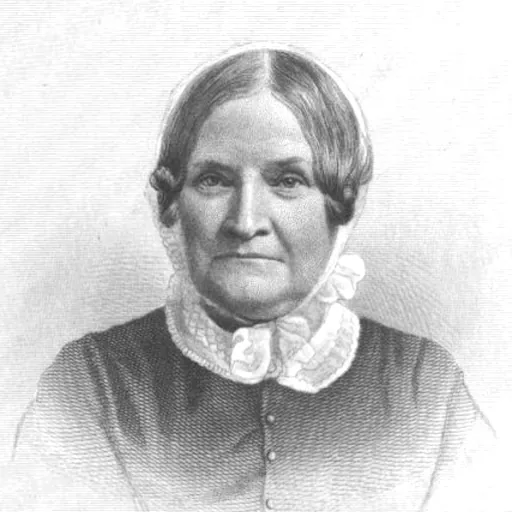
Lydia Maria Child
American abolitionist, author and women's rights activist
About Lydia Maria Child
Lived 1802 – 1880 (aged 78). Lydia Maria Child was an American novelist, poet, journalist, writer, geologist and philosopher.
Lydia Maria Child ( Francis; February 11, 1802 – October 20, 1880) was an American abolitionist, feminist, Native American rights activist, novelist, journalist, and opponent of American expansionism. Her journals, both fiction and domestic manuals, reached wide audiences from the 1820s through the 1850s. At times she shocked her audience as she tried to take on issues of both male dominance and white supremacy in some of her stories.
Despite these challenges, Child may be most remembered for her poem "Over the River and Through the Wood". Her grandparents' house, which she wrote about visiting, was restored by Tufts University in 1976 and stands near the Mystic River on South Street, in Medford, Massachusetts.
Early life and education Lydia Maria Francis was born in Medford, Massachusetts, on February 11, 1802, to Susannah (née Rand) and Convers Francis. Her older brother, Convers Francis, was educated at Harvard College and Seminary, and became a Unitarian minister. Francis received her education at a local dame school and later at a women's seminary. Upon the death of her mother, she went to live with her older sister in Maine, where she studied to be a teacher. During this time, her brother Convers, by then a Unitarian minister, saw to his younger sister's education in literary masters such as Homer and Milton. In her early 20s, Francis lived with her brother and met many of the top writers and thinkers of the day through him. She also converted to Unitarianism. After publishing other works voicing her opposition to slavery, much of her audience turned against her, especially in the South. The Juvenile Miscellany closed down after book sales and subscriptions dropped. Child wrote that her book had been "written for the poor ... those who can afford to be epicures will find the best of information in the Seventy-five Receipts" by Eliza Leslie.
Child changed the title to The American Frugal Housewife in 1832 to end the confusion with the British author Susannah Carter's The Frugal Housewife first published in 1765, and then printed in America from 1772. Child wrote that Carter's book was not suited "to the wants of this country".
Abolitionism and women's rights movements
In 1831, William Lloyd Garrison began publication of his influential abolitionist newspaper, The Liberator. Lydia Child and her husband read it from the beginning and began to identify themselves with the anti-slavery cause. Personal contact with Garrison was another factor. In this book, she wrote that "the intellectual inferiority of the negroes is a common, though most absurd apology, for personal prejudice."
While she was editor of the National Anti-Slavery Standard, Child wrote a weekly column for the paper called "Letters from New-York", which she later compiled and published in book form. Child's management as editor and the popularity of her "Letters from New-York" column both helped to establish the National Anti-Slavery Standard as one of the most popular abolitionist newspapers in the US. She edited the Standard until 1843, when her husband took her place as editor-in-chief. She acted as his assistant until May 1844. During their stay in New York, the Childs were close friends of Isaac T. Hopper, a Quaker abolitionist and prison reformer. After leaving New York, the Childs settled in Wayland, Massachusetts, where they spent the rest of their lives.
Eventually Child left the National Anti-Slavery Standard, because she refused to promote violence as an acceptable weapon for battling slavery.
She did continue to write for many newspapers and periodicals during the 1840s, and she promoted greater equality for women. However, because of her negative experience with the AASS, she never worked again in organized movements or societies for women's rights or suffrage. In 1844, Child published the poem "The New-England Boy's Song about Thanksgiving Day" in Flowers for Children, Volume 2, that became famous as the song "Over the River and Through the Wood".
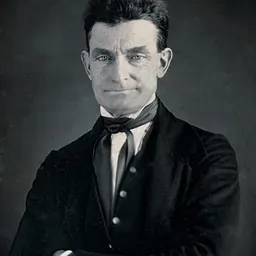
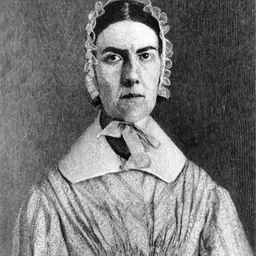
In the 1850s, Child responded to the near-fatal beating on the Senate floor of her good friend Charles Sumner, an abolitionist Senator from Massachusetts, by a South Carolina congressman, by writing her poem entitled "The Kansas Emigrants". The outbreak of violence in Kansas between anti- and pro-slavery settlers, prior to voting on whether the territory should be admitted as a free or slave state, resulted in Child changing her opinion about the use of violence. Along with Angelina Grimké Weld, another proponent for peace, she acknowledged the need for the use of violence to protect anti-slavery emigrants in Kansas. Child also sympathized with the radical abolitionist John Brown. While she did not condone his violence, she deeply admired his courage and conviction in the raid on Harper's Ferry. She wrote to Virginia Governor Henry A. Wise asking for permission to travel to Charles Town to nurse Brown, but although Wise had no objection, Brown did not accept her offer.
In 1860, Child was invited to write a preface to Harriet Jacobs's slave narrative, Incidents in the Life of a Slave Girl. She met Jacobs and not only agreed to write the preface but also became the editor of the book.
Native American rights work
Child published her first novel, the historical romance Hobomok, A Tale of Early Times, anonymously under the gender-neutral pseudonym "an American". The plot centers on the interracial marriage between a white woman and a Native American man, who have a son together. The heroine later remarries, reintegrating herself and her child into Puritan society. The issue of miscegenation caused a scandal in the literary community and the book was not a critical success.
During the 1860s, Child wrote pamphlets on Native American rights. The most prominent, An Appeal for the Indians (1868), called upon government officials, as well as religious leaders, to bring justice to American Indians. Her presentation sparked Peter Cooper's interest in Indian issues. It contributed to the founding of the U.S. Board of Indian Commissioners and the subsequent Peace Policy in the administration of Ulysses S. Grant.
Freethought beliefs Born to a strict Calvinist father, Child slept with a bible under her pillow when she was young. However, although she joined the Unitarians in 1820, as an adult she was not active in that, or any other, church. In 1855 she published the 3-volume "The Progress of Religious Ideas Through Successive Ages", within which she rejected traditional theology, dogma, and doctrines and repudiated the concept of revelation and creeds as the basis for moral action, arguing instead "It is impossible to exaggerate the evil work that theology has done in the world" and, in commenting on the efforts of theologians, "What a blooming paradise would the whole earth be if the same amount of intellect, labor, and zeal had been expended on science, agriculture, and the arts!"
Child's An Appeal in Favor of that Class of Americans Called Africans pushed for emancipation by highlighting the life of an enslaved Muslim man named Ben Solomon. In underscoring Ben Solomon's excellence and intelligence as an Arabic teacher and a man of Muslim faith, Child not only drove racial acceptance but religious acceptance as well.
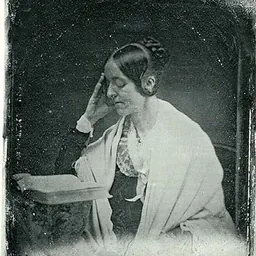
Personal life Lydia Francis taught school until 1828, when she married Boston lawyer David Lee Child. His political activism and involvement in reform introduced her to the social reforms of Indian rights and Garrisonian abolitionism. She was a long-time friend of activist Margaret Fuller and frequent participant in Fuller's "conversations" held at Elizabeth Palmer Peabody's North Street bookstore in Boston.
Child died in Wayland, Massachusetts, aged 78, on October 20, 1880, at her home at 91 Old Sudbury Road. She was buried at North Cemetery in Wayland. At her funeral, abolitionist Wendell Phillips shared the opinion of many within the abolition movement who knew her, "We felt that neither fame, nor gain, nor danger, nor calumny had any weight with her." The Liberty ship Lydia M. Child, named after Child, was launched on January 31, 1943, and saw service during World War II. Child was inducted into the National Women's Hall of Fame in 2007. In 2007, Child was inducted into the National Abolition Hall of Fame, in Peterboro, New York.
Writings
Hobomok, A Tale of Early Times. 1824 Evenings in New England: Intended for Juvenile Amusement and Instruction. 1824 The Rebels; or, Boston Before the Revolution (1825). 1850 ed. The Juvenile Miscellany, a children's periodical (editor, 1826–1834)
The Frugal Housewife: Dedicated to Those Who are Not Ashamed of Economy, a book of kitchen, economy and directions (1829; 33rd edition 1855) 1832 The Mother's Book (1831), an early American instructional book on child rearing, republished in England and Germany A collection of verses The American Frugal Housewife: Dedicated to those who are not ashamed of Economy (1832) 1841
The Ladies' Family Library, a series of biographies (5 vols., 1832–1835)
The Girl's Own Book, new ed. by Mrs. R. Valentine. London: William Tegg, 1863 An Appeal in Favor of that Class of Americans Called Africans 1833
(two volumes). A romance of Greece set in the days of Pericles
Includes stories such as The Quadroons A short story Letters from New-York, written for the National Anti-Slavery Standard while Child was the editor (2 vols., 1841–1843) "The New-England Boy's Song about Thanksgiving Day" (1844), later known by its opening line, "Over the River and Through the Wood". A poem originally published in Flowers for Children, vol. 2. Text of poem "Hilda Silfverling: A Fantasy". 1845 Flowers for Children (3 vols., 1844–1846)
The Progress of Religious Ideas, Through Successive Ages, an ambitious work, showing great diligence, but containing much that is inaccurate (3 vols., New York, 1855)
A Few Scenes from a True History. 1858.
A novel promoting interracial marriage
A volume of her letters, with an introduction by John G. Whittier and an appendix by Wendell Phillips, was published after her death (Boston: Houghton, Mifflin, 1882) Lydia Maria Child: Selected Letters, 1817-1880 (Meltzer, Milton, and Holland, Patricia G., eds.). Amherst, MA: University of Massachusetts Press, 1982 Masur, Louis P., ed. "Lydia Maria Child (1802-1880)," in "... the real war will never get in the books": Selections from Writers During the Civil War, New York and Oxford: Oxford University Press, 1993, pp. 39–55. Contains twelve letters from Childs about slavery, written from 1861 to 1865, and the chapter "Advice from an Old Friend" (to the freed slaves) from Childs' The Freedmen's Book.
Don’t just read it —
keep it.
Full-length biographies made to live with: read them, listen on the way to work, watch them tonight.
- E-book
- Audio
- Video
Instant download · yours to keep · every purchase keeps this site free
Important facts
Family & relationships
People in Lydia Maria Child's life
Named in this biography and alive at the same time


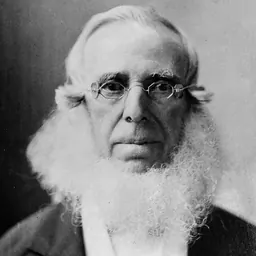
Related people
Same field, nearest in time
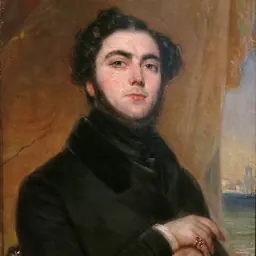
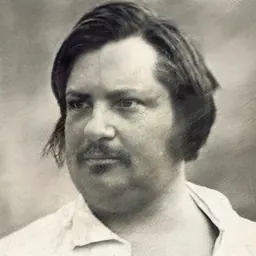
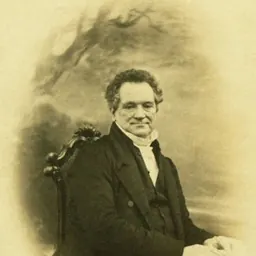


Contemporaries
People whose lives overlapped Lydia Maria Child's






Frequently asked questions
Who was Lydia Maria Child?
American abolitionist, author and women's rights activist (1802-1880)
When was Lydia Maria Child born?
Lydia Maria Child was born on 11 February 1802 in Medford.
When did Lydia Maria Child die?
Lydia Maria Child died on 20 October 1880 in Wayland.
What was Lydia Maria Child's occupation?
Lydia Maria Child was a novelist, poet, journalist, writer, geologist and philosopher.
What nationality was Lydia Maria Child?
Lydia Maria Child was American.
Sources & further reading
· Wikipedia: Lydia Maria Child
Cite this page
APA: Biography.guide. (2026). Lydia Maria Child. https://biography.guide/lydia-maria-child/
MLA: "Lydia Maria Child." Biography.guide, https://biography.guide/lydia-maria-child/.
Chicago: "Lydia Maria Child." Biography.guide. https://biography.guide/lydia-maria-child/.
Data last updated: 2026-09-23 · Spot an error? Report a correction.
Portrait: Wikimedia Commons · author & licence
Page generated 2026-09-27 05:05 UTC