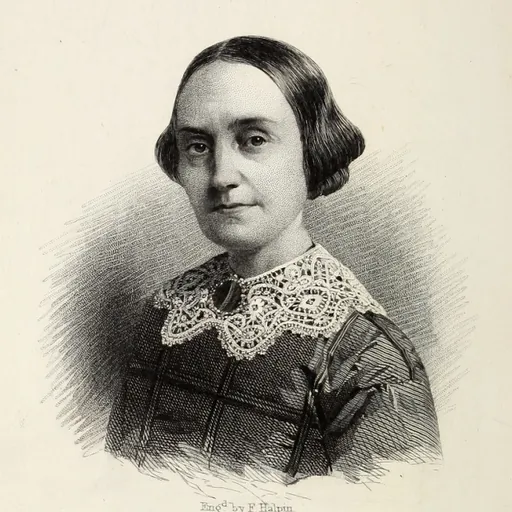
About Lydia Baxter
Lived 1809 – 1874 (aged 64). Lydia Baxter was an American writer, composer and hymnwriter.
Lydia Baxter (, Odell; September 2, 1809 – January 23, 1874) was an American poet and hymnwriter. She is chiefly remembered as the author of "The Gate Ajar for Me" and other Sunday school hymns, which became widely known and very popular. This song in particular, and some events associated with it, influenced Ira D. Sankey, American gospel singer and composer, to write his first hymn.
Early life and education Lydia Odell was born at Petersburgh, New York, September 2, 1809. She had at least one sibling, a sister, Mary. She was educated in the district school of Petersburgh.
Career She became a Christian while very young, studying under the Rev. Eber Tucker, a Baptist home missionary. She soon spread her influence in her native town, by the fact that her conversion, in connection with that of her younger sister, led to the organization of a Baptist church in that place. There, she became a successful Sunday school teacher.
After her marriage to Col. John C. Baxter (1807-1877), the rest of her life was spent in New York City. Principally through her influence, her husband became a Christian a few years after their marriage. Her affiliation was with the Baptist Church.
For many years, Baxter contributed one or more hymns to the anniversary collections of the New York and Baptist Sunday school Unions, in May, which were generally sung in the various churches. Most of the published collections of Sunday school hymns of the day contained liberal selections written by Baxter. Many of her hymns had a worldwide circulation. One, entitled "The Gates Ajar", after becoming popular in the United States and England, was sung throughout Scotland, too.
Personal life For nearly thirty years, Baxter's disability kept her bed-ridden much of the time, often the victim of excruciating pain. She died in New York City, January 23, 1874.
"The Gate Ajar for Me"
Baxter wrote the lyrics for "The Gate Ajar for Me" about three years before her death in New York City in 1874. It was set to music by S. J. Vai.
"There is a gate that stands ajar, And through its portals gleaming."
This hymn was often used in religious meetings in Great Britain, 1873–74. It was sung at the watch-night service in 1873, the night before New Year's, in the Free Assembly Hall of Edinburgh. A young woman who was present —Maggie Lindsay, of Aberdeen, Scotland— was much impressed by the hymn, and those seated by her side heard her exclaim, "O, heavenly Father, is it true that the gate is standing ajar for me? If it is so, I will go in." That night, she became a Christian disciple. The next day, she called on her pastor, the Rev. J. H. Wilson, minister of the Barclay Church, and told him of her decision. He was greatly pleased, and advised her to tell her school mates of her experience. This she did, and succeeded in converting several of them. Scarcely a month later, on January 28, 1874, Maggie took a train bound for her home, but she never reached it. The train in which she was riding collided with mineral wagon at Manuel Junction. A number of passengers were killed, and Maggie was found in the wreckage. In one of her hands was a copy of Ira D. Sankey's Sacred Songs and Solos, opened at Maggie's favorite hymn, "There is a gate that stands ajar", the page of which was stained with her blood. She was carried into a cottage near the station, where she lingered a few days before her death, frequently heard singing on the couch the chorus of the hymn so dear to her, "For me, for me! was left ajar for me!". In commemoration of this event, which touched Sankey so deeply, he wrote his first hymn, "Home at last", which he also set to music.
Selected works
Her best known hymns are: One by one we cross the river, 1866 Take the name of Jesus with you, 1870 The Master is coming, 1870 There is a gate that stands ajar, 1872 In the fadeless spring-time, 1872 Cast thy net again, my brother, 1873 Go, work in my vineyard, 1873 I'm weary, I'm fainting, my day's work is done, 1873 I'm kneeling, Lord, at mercy's gate, 1879
Don’t just read it —
keep it.
Full-length biographies made to live with: read them, listen on the way to work, watch them tonight.
- E-book
- Audio
- Video
Instant download · yours to keep · every purchase keeps this site free
Important facts
Related people
Same field, nearest in time


Contemporaries
People whose lives overlapped Lydia Baxter's




Frequently asked questions
Who was Lydia Baxter?
American poet, hymnwriter (1809-1874)
When was Lydia Baxter born?
Lydia Baxter was born on 2 September 1809 in Petersburgh.
When did Lydia Baxter die?
Lydia Baxter died on 23 January 1874 in New York City.
What was Lydia Baxter's occupation?
Lydia Baxter was a writer, composer and hymnwriter.
What nationality was Lydia Baxter?
Lydia Baxter was American.
Sources & further reading
Cite this page
APA: Biography.guide. (2026). Lydia Baxter. https://biography.guide/lydia-baxter/
MLA: "Lydia Baxter." Biography.guide, https://biography.guide/lydia-baxter/.
Chicago: "Lydia Baxter." Biography.guide. https://biography.guide/lydia-baxter/.
Data last updated: 2026-09-21 · Spot an error? Report a correction.
Portrait: Wikimedia Commons · author & licence
Page generated 2026-09-27 04:59 UTC