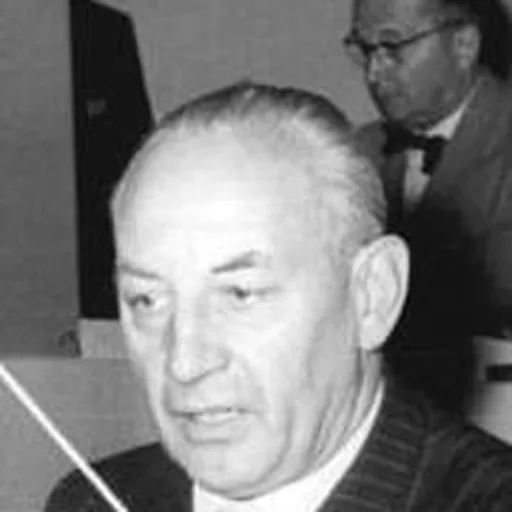
About Luitpold Steidle
Lived 1898 – 1984 (aged 86). Luitpold Steidle was a German politician, resistance fighter, soldier and farmer.
Luitpold Steidle (12 March 1898, in Ulm – 27 July 1984, in Weimar) was a German army officer and an East German politician. During his political career he belonged to the CDU.
He was described by Der Spiegel in 1947 as a "refreshingly open-minded man with a narrow distinctive face, in his late 40s".
Life In 1898 Luitpold Steidle was born into a Catholic family in Ulm, in the Kingdom of Württemberg, which less than thirty years earlier had been incorporated into the German Empire. His father was a senior military judge. However, he then switched to a more hands-on training. He learned farming at Hohenpolding and at Grasselfing (Olching), both located a short distance to the west of Munich. One precondition for the BDO's objective to have become a realistic proposition would have been the successful removal from power of Adolf Hitler. This did not happen for another two years. In the meanwhile, as the BDO's Vice-president (and one of its most persuasive speakers) Luitpold Steidle was sentenced to death to the Provisional People's Chamber (Volkskammer). He remained a member of the (after 1950 no longer "provisional") (Volkskammer) till 1971. He held office from 1949 till 1950 as Minister for Work and Health, and from 1950 till 1958 as Minister for Health. He also provided advice on the creation of the National People's Army (NVA / Nationale Volksarmee), established in 1956 (following a period during which the wartime allies, including the Soviet Union, had agreed that permitting Germany an army was inappropriate).
From 1960 till his retirement in 1969 Luitpold Steidle was mayor of Weimar, where afterwards he continued to live.
Awards Luitpold Steidle received the usual awards conferred on politicians by states with that use Honours Systems. He was also, in 1956, made an Honorary Senator of Greifswald University and, in 1972, an Honorary Member of the Presidential Council of the Kulturbund (Culture League).
Publications Das Nationalkomitee Freies Deutschland, Burgscheidungen 1960 Das Große Bündnis, Burgscheidungen 1963 Entscheidung an der Wolga, Berlin 1969 Dokumente Familienarchiv, Bayreuth, 2010
Don’t just read it —
keep it.
Full-length biographies made to live with: read them, listen on the way to work, watch them tonight.
- E-book
- Audio
- Video
Instant download · yours to keep · every purchase keeps this site free
Important facts
Related people
Same field, nearest in time






Contemporaries
People whose lives overlapped Luitpold Steidle's




Frequently asked questions
Who was Luitpold Steidle?
German politician (1898-1984)
When was Luitpold Steidle born?
Luitpold Steidle was born on 12 March 1898 in Ulm.
When did Luitpold Steidle die?
Luitpold Steidle died on 27 July 1984 in Weimar.
What was Luitpold Steidle's occupation?
Luitpold Steidle was a politician, resistance fighter, soldier and farmer.
What nationality was Luitpold Steidle?
Luitpold Steidle was German.
Sources & further reading
Cite this page
APA: Biography.guide. (2026). Luitpold Steidle. https://biography.guide/luitpold-steidle/
MLA: "Luitpold Steidle." Biography.guide, https://biography.guide/luitpold-steidle/.
Chicago: "Luitpold Steidle." Biography.guide. https://biography.guide/luitpold-steidle/.
Data last updated: 2026-09-24 · Spot an error? Report a correction.
Portrait: Wikimedia Commons · author & licence
Page generated 2026-09-27 05:09 UTC