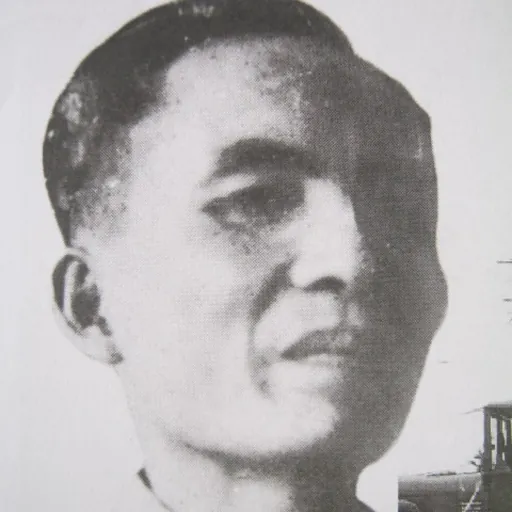
About Luis Taruc
Lived 1913 – 2005 (aged 91). Luis Taruc was a Filipino politician and partisan.
Luis Mangalus Taruc (; June 21, 1913 – May 4, 2005) was a Filipino political figure and rebel during the agrarian unrest of the 1930s until the end of the Cold War. He was the leader of the Hukbalahap group (from Hukbong Bayan Laban sa Hapon) between 1942 and 1950.
Early life and career Luis Mangalus Taruc was born of peasant stock in the barrio of Santa Monica, township of San Luis, Pampanga on 21 June 1913. studying medicine and law, but no longer able to afford the expenses, He was influenced by Pedro Abad Santos, a Marxist, whom Luis regarded as a true socialist.
He led a large people's army against the Japanese invaders, and their "puppet constabulary", as Supremo Luis Taruc,
Taruc went underground in late 1946, following failed negotiations with President Roxas, and the Huks soon numbered 10,000 armed fighters. effectively ending the Huk rebellion. On 15 June 1954, Luis met with President Magsaysay and Gen. Eulogio Balao at Camp Murphy, where Luis agreed to a trial. After his release, he continued to work for agrarian reforms. His struggle on behalf of the poor farmers persuaded local and national leaders to strengthen the legal rights of farm workers and led to a more equitable distribution of farm land. In his later years Taruc claimed to have never been a real communist, but rather always advocated Christian democratic socialism; he supported land reform strengthening the rights of local, small farmers over corporations and hereditary feudal elite.
Legacy Luis M. Taruc Freedom Park in San Luis, Pampanga in Barangay San Sebastian, beside Barangay Santa Cruz Poblacion along the Baliuag-Candaba-San Luis Provincial Road
Taruc dictated Born of the People (1953) to American communist and ghost writer William Pomeroy. Luis Taruc used Alipato, meaning "spark that spreads a fire", as his pseudonym. "Born of the People" was Nelson Mandela's reference on peasant resistance and guerrilla warfare when he was the commander in chief of the uMkhonto we Sizwe (Spear of the Nation).
While in New Bilibid Prison, Taruc composed He Who Rides the Tiger (1967). In 2003, he explained to historian Keith Thor Carlson that he attributed the revolution's failure to the dogmatism of members of the politburo's Russian-trained elite, in particular José and Jesus Lava, an accusation that runs contrary to the views of the Lavas and William Pomeroy who countered that Taruc suffered from a cult of personality.
Several Huk veterans organizations dispute the credit heaped on Taruc for organizing the Hukbalahap during World War II. They contend that Taruc only joined the movement when several prominent Huk leaders were captured and executed by the Japanese, and that there were several Huk brigades operating in concert, under Castro Alejandrino, Eusebio Aquino, and Mariano Franco among others.
Don’t just read it —
keep it.
Full-length biographies made to live with: read them, listen on the way to work, watch them tonight.
- E-book
- Audio
- Video
Instant download · yours to keep · every purchase keeps this site free
Important facts
People in Luis Taruc's life
Named in this biography and alive at the same time





Related people
Same field, nearest in time




Contemporaries
People whose lives overlapped Luis Taruc's


Frequently asked questions
Who was Luis Taruc?
Philippine Marxist politician (1913–2005)
When was Luis Taruc born?
Luis Taruc was born on 21 June 1913 in San Luis.
When did Luis Taruc die?
Luis Taruc died on 4 May 2005 in Quezon City.
What was Luis Taruc's occupation?
Luis Taruc was a politician and partisan.
What nationality was Luis Taruc?
Luis Taruc was Filipino.
Sources & further reading
Cite this page
APA: Biography.guide. (2026). Luis Taruc. https://biography.guide/luis-taruc/
MLA: "Luis Taruc." Biography.guide, https://biography.guide/luis-taruc/.
Chicago: "Luis Taruc." Biography.guide. https://biography.guide/luis-taruc/.
Data last updated: 2026-09-22 · Spot an error? Report a correction.
Portrait: Wikimedia Commons · author & licence
Page generated 2026-09-27 05:04 UTC