
About Lucile Blanch
Lived 1895 – 1981 (aged 85). Lucile Blanch was an American painter and artist.
Lucile Esma Lundquist Blanch (December 31, 1895 – October 31, 1981) was an American artist, and art educator. She was noted for the murals she created for the U.S. Treasury Department's Section of Fine Arts during the Great Depression. She was awarded a Guggenheim Fellow in 1933.
Early life and education Lucile Lundquist Blanch was born as Lucile Esma Lundquist in 1895 in Hawley, Minnesota to Charles E. and May E. Lundquist.
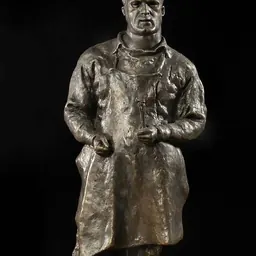
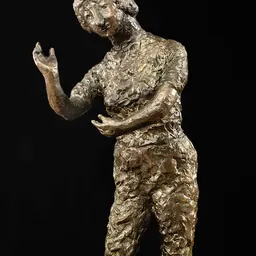
Raised in rural northern Minnesota, Blanch enjoyed gardening as a child. Her mother, a gifted musician, insisted on young Blanch starting strict piano lessons at age 7, though Blanch would eventually protest her lessons at 12 years old. She was only one of ten students in the country to be awarded full tuition to the Art Students League that year. She was friends with Eugenie Gershoy, who sculpted her at work.
She and Arnold Blanch married on November 23, 1920 in New York and traveled to France to continue their art studies. sharing the same studio building and telephone in San Francisco when Arnold was appointed a teaching position and Rivera was commissioned to paint two murals in the city.
Career
After moving to Woodstock, New York, Blanch began exhibiting work in local group shows as well as with the New York Society of Women Artists and the Whitney Studio Club. As she and husband Arnold were building their reputation as Woodstock artists, they supported themselves by selling tapestries they wove, as well as running a small cafeteria. They eventually would become key figures in the revitalization of the Woodstock art colony.
After Blanch received the Guggenheim Fellowship in 1933, her art was featured in a number of important venues, including the Whitney Museum of American Art. From 1932 to 1943, the Metropolitan Museum of Modern Art, the Museum of Modern Art, the Whitney Museum, and the Corcoran Gallery in Washington D.C. purchased her works for their collections. in 1939, was in an annual contemporary American watercolor show there. Later in 1939, Blanch participated in an exhibition by the American Society of Painters, Sculptors, and Gravers. The exhibition began May 16, 1939 and continued until June 10 that same year.
In 1938, Blanch worked with artist Philip Evergood and George Picken in administrating the WPA Project in New York.
A retrospective of Blanch's long career was held at the Woodstock Artists Association in the fall of 1978, when the artist was 83 years old. The exhibition was reviewed by the Woodstock Times ' Dennis Drogseth, as having "admirable successes...mixed with not so admirable failures--but that these inconsistencies are a part of the creative effort." Almost 850 artists were commissioned to paint 1371 murals, most of which were installed in post offices. 162 of the artists were women. The murals were funded as a part of the cost of the construction of new post offices, with 1% of the cost set aside for artistic enhancements. In the town of Appalachia, Virginia, she painted the mural Appalachia in 1940. The tempera mural, Rural Mississippi from Early Days to Present was completed in 1941 for the Tylertown, Mississippi post office. In addition, she painted murals for the post offices in Flemingsburg, Kentucky, and Sparta, Georgia. The Flemingsburg mural was completed in 1943, titled Crossing to the Battle of Blue Licks, and the Sparta post office project consisted of three panels depicting an antebellum plantation house, the granite quarry near Sparta, and local Hancock County scenery.
Death She died on October 31, 1981, in Kingston, New York and is buried in the Woodstock Artists' Cemetery in Woodstock, New York.
Style Blanch began her career focusing on realist subjects, but her art became increasingly abstract.
Awards
In 1931, Blanch was awarded Medal of First Award for Graphic Arts at San Francisco Art Association's annual exhibit. In 1933, Blanch was given a fellowship by the John Simon Guggenheim Memorial Foundation to enable creative work in painting abroad for one year. The average monetary value of the fellowships given that year were $2,500 each. In 1934, received a prize for her work at the Wanamaker Regional Exhibition in New York.
Gallery
Don’t just read it —
keep it.
Full-length biographies made to live with: read them, listen on the way to work, watch them tonight.
- E-book
- Audio
- Video
Instant download · yours to keep · every purchase keeps this site free
Important facts
People in Lucile Blanch's life
Named in this biography and alive at the same time



Related people
Same field, nearest in time


Contemporaries
People whose lives overlapped Lucile Blanch's
Frequently asked questions
Who was Lucile Blanch?
American artist (1895-1981)
When was Lucile Blanch born?
Lucile Blanch was born on 31 December 1895 in Hawley.
When did Lucile Blanch die?
Lucile Blanch died on 31 October 1981 in Kingston.
What was Lucile Blanch's occupation?
Lucile Blanch was a painter and artist.
What nationality was Lucile Blanch?
Lucile Blanch was American.
Sources & further reading
Cite this page
APA: Biography.guide. (2026). Lucile Blanch. https://biography.guide/lucile-blanch/
MLA: "Lucile Blanch." Biography.guide, https://biography.guide/lucile-blanch/.
Chicago: "Lucile Blanch." Biography.guide. https://biography.guide/lucile-blanch/.
Data last updated: 2026-09-20 · Spot an error? Report a correction.
Page generated 2026-09-27 05:33 UTC