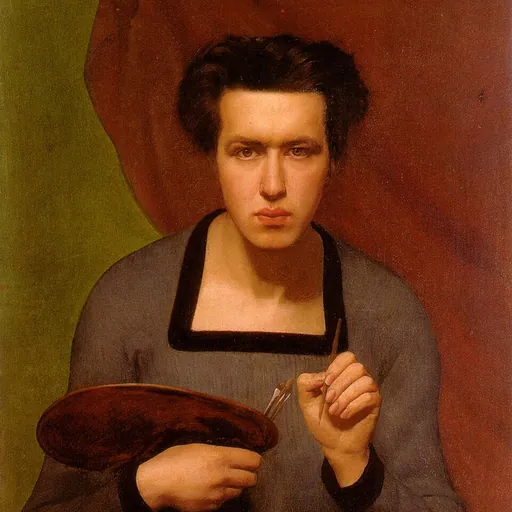
About Louis Janmot
Lived 1814 – 1892 (aged 78). Louis Janmot was a French painter and poet.
Anne-François-Louis Janmot (21 May 1814 – 1 June 1892) was a French painter and poet.
Early years Janmot was born in Lyon, France, of Catholic parents who were deeply religious. He was extremely moved by the death of his brother in 1823 and his sisters in 1829. He became a student at the Royal College of Lyon where he met Frederic Ozanam and other followers of his philosophy professor, Abbe Noirot. In 1831 he was admitted to the École des Beaux-Arts de Lyon and a year later, he won the highest honor, the Golden Laurel. In 1833, he came to Paris to take painting lessons from Victor Orsel and Jean-Auguste-Dominique Ingres. With other Lyon painters, he entered the Society of St. Vincent de Paul. In 1835, he went to Rome with Claudius Lavergne, Jean-Baptiste Frénet and other students and met Hippolyte Flandrin.
After his return to Lyon in 1836, Janmot would attract the attention of critics of the Salon de Paris in conducting large-scale paintings with religious inspiration such as The Resurrection of the son of the widow of Nain (1839) or Christ in Gethsemane (1840). After 1845, he attracted the interest of Charles Baudelaire with his painting Flower of the Fields that allowed him to access to the Salon of 1846. Theophile Gautier was impressed by his Portrait of Lacordaire (1846). But the failure of his Poem of the Soul at the Universal Exhibition of 1855 disappointed him. In December of that year he married Leonie Saint-Paulet, from a noble family in Carpentras.
In 1856, Janmot obtained a commission to paint a fresco (since destroyed) representing the Last Supper for the church of St. Polycarp. Other orders followed, including the decoration of the dome of the Church of St. Francis de Sales and for the town hall that had been renovated by his friend the architect T. Desjardins. He was then appointed professor at the École des Beaux-Arts.
In Paris and Toulon Janmot moved to Paris in 1861 after having been promised a commission for the Church of St. Augustine, but this project was abandoned three years later. In experiencing significant family and financial problems, Janmot accepted a professorship at the Dominican School of Arcueil. At that time, in his home in Bagneux, he made many portraits of the members of his family (only photographs are currently available).
After the birth of her seventh child in August 1870, his wife died in Bagneux. While the Prussian troops approached and occupied his home, he fled to Algiers with his stepfather and made landscape paintings. He returned in June of the following year in Paris and led a solitary life. His house in Bagneux had been looted. In 1878, he produced a fresco in the chapel of the Franciscans in the Holy Land, but this work was not followed by any further commission.
Faced with family and increasing financial problems, Janmot came to Toulon, and despite some orders (new Portrait of Lacordaire (1878, Museum of Versailles), Rosaire (Saint-Germain-en-Laye, 1880), Martyrdom of St. Christine (Solliès-Pont, 1882), he lived a retired life. He finished the second part of the Poem of the Soul that the patron and former industrial Félix Thiollier was willing to publish.
In 1885, Janmot married a former student, Antoinette Currat, and returned to Lyon. He made charcoal drawings on the theme of the underworld, which can be regarded as a kind of continuation of the Poem of the Soul, including Purgatory (1885) and The End of Time (1888). In 1887 was published in Lyon and Paris a book of more than 500 pages book entitled Opinion of an artist on art that includes articles previously written by Janmot. He died five years later at the age of 78.
Art style
Janmot has been seen as a transitional figure between Romanticism and Symbolism, prefiguring the French part of the Pre-Raphaelite Brotherhood; his work was admired by Puvis de Chavannes, Odilon Redon, and Maurice Denis.
Works Poem of the Soul His most significant work, a cycle of 18 paintings and 16 drawings, with verse, called The Poem of the Soul, occupied him for 40 years.
Other works
Self-portrait (1832), musée des beaux-arts de Lyon Le Christ au Jardin des Oliviers (1840), musée des beaux-arts de Lyon Flower of the Fields (1845), musée des beaux-arts de Lyon L'assomption de la vierge (1845), musée d'art moderne de Saint-Étienne Henri Lacordaire (1802-1861), musée national du château de Versailles et de Trianon The Torture of Mezentius (1865), musée d'Orsay
Don’t just read it —
keep it.
Full-length biographies made to live with: read them, listen on the way to work, watch them tonight.
- E-book
- Audio
- Video
Instant download · yours to keep · every purchase keeps this site free
Important facts
People in Louis Janmot's life
Named in this biography and alive at the same time





Related people
Same field, nearest in time


Contemporaries
People whose lives overlapped Louis Janmot's





Frequently asked questions
Who was Louis Janmot?
French painter (1814-1892)
When was Louis Janmot born?
Louis Janmot was born on 21 May 1814 in Lyon.
When did Louis Janmot die?
Louis Janmot died on 1 June 1892 in 2nd arrondissement of Lyon.
What was Louis Janmot's occupation?
Louis Janmot was a painter and poet.
What nationality was Louis Janmot?
Louis Janmot was French.
Sources & further reading
Cite this page
APA: Biography.guide. (2026). Louis Janmot. https://biography.guide/louis-janmot/
MLA: "Louis Janmot." Biography.guide, https://biography.guide/louis-janmot/.
Chicago: "Louis Janmot." Biography.guide. https://biography.guide/louis-janmot/.
Data last updated: 2026-09-22 · Spot an error? Report a correction.
Portrait: Wikimedia Commons · author & licence
Page generated 2026-09-27 05:01 UTC