About Louis Bertrand Castel
Lived 1688 – 1757 (aged 68). Louis Bertrand Castel was a French mathematician, physicist, theologian, scientist, philosopher and inventor.
Louis Bertrand Castel (; 5 November 1688 – 11 January 1757 ) was a French mathematician born in Montpellier, who entered the order of the Jesuits in 1703. Having studied literature, he afterwards devoted himself entirely to mathematics and natural philosophy. After moving from Toulouse to Paris in 1720, at the behest of Bernard de Fontenelle, Castel acted as the science editor of the Jesuit Journal de Trévoux.
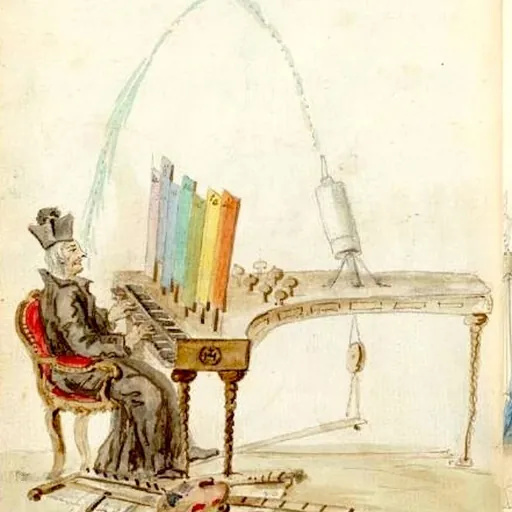
He wrote several scientific works, that which attracted most attention at the time being his (1740), or treatise on the melody of colours. He also wrote (1724), (1728), and a critical account of the system of Sir Isaac Newton in 1743. In 1739 the German composer Telemann went to France to see Castel's Ocular Harpsichord for himself. He ended up composing several pieces for it, as well as writing a description of it.
The ocular harpsichord had sixty small coloured glass panes, each with a curtain that opened when a key was struck. A second, improved model of the harpsichord was demonstrated for a small audience in December 1754. Pressing a key caused a small shaft to open, in turn allowing light to shine through a piece of stained glass. Castel thought of colour-music as akin to the lost language of paradise, where all men spoke alike, and he claimed that thanks to his instrument's capacity to paint sounds, even a deaf listener could enjoy music.
Criticism of Newton Castel's 1740 comparison of Newton's spectral colour description with his explanation in terms of the interaction of light and dark, which Goethe later developed into his Theory of Colours.
It was in 1740 that Louis Bertrand Castel published a criticism of Newton's spectral description of prismatic colour in which he observed that the colours of white light split by a prism depended on the distance from the prism, and that Newton was looking at a special case. It was an argument that Goethe later developed in his Theory of Colours.
Don’t just read it —
keep it.
Full-length biographies made to live with: read them, listen on the way to work, watch them tonight.
- E-book
- Audio
- Video
Instant download · yours to keep · every purchase keeps this site free
Important facts
People in Louis Bertrand Castel's life
Named in this biography and alive at the same time

Related people
Same field, nearest in time




Contemporaries
People whose lives overlapped Louis Bertrand Castel's




Frequently asked questions
Who was Louis Bertrand Castel?
Mathematician, philosopher
When was Louis Bertrand Castel born?
Louis Bertrand Castel was born on 15 November 1688 in Montpellier.
When did Louis Bertrand Castel die?
Louis Bertrand Castel died on 9 January 1757 in Paris.
What was Louis Bertrand Castel's occupation?
Louis Bertrand Castel was a mathematician, physicist, theologian, scientist, philosopher and inventor.
What nationality was Louis Bertrand Castel?
Louis Bertrand Castel was French.
Sources & further reading
· Wikipedia: Louis Bertrand Castel
· DBpedia: Louis Bertrand Castel
Cite this page
APA: Biography.guide. (2026). Louis Bertrand Castel. https://biography.guide/louis-bertrand-castel/
MLA: "Louis Bertrand Castel." Biography.guide, https://biography.guide/louis-bertrand-castel/.
Chicago: "Louis Bertrand Castel." Biography.guide. https://biography.guide/louis-bertrand-castel/.
Data last updated: 2026-09-21 · Spot an error? Report a correction.
Portrait: Wikimedia Commons · author & licence
Page generated 2026-09-27 05:00 UTC