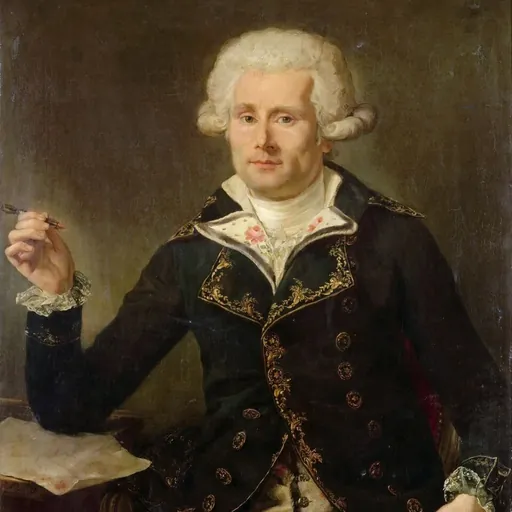
Louis-Antoine de Bougainville
French admiral and explorer
About Louis-Antoine de Bougainville
Lived 1729 – 1811 (aged 81). Louis-Antoine de Bougainville was a French politician, writer, travel writer, seafarer, naval officer and world traveler.
Louis-Antoine, Comte de Bougainville (; ; 12 November 1729 – 31 August 1811) was a French military officer and explorer. After having served in the Seven Years' War and the American Revolutionary War, Bougainville later gained fame for his expeditions, including a circumnavigation of the globe in a scientific expedition in 1763, the first recorded settlement on the Falkland Islands, and voyages into the Pacific Ocean. Bougainville Island of Papua New Guinea as well as the flowering plant Bougainvillea are named in his honour.
Early life Bougainville was born in Paris on November 12, 1729, the youngest of three children to Marie-Françoise d'Arboulin and Pierre-Yves de Bougainville. His father had entered into the minor nobility due to his service as notary for the state and his mother died when he was five. He was then raised by his older brother Jean-Pierre with the help of an aunt. His father had pushed his sons to also take up a legal career and Bougainville enrolled in the University of Paris. While here, he took an interest in philosophy and mathematics, studying under mathematician Jean le Rond d'Alembert.
At the age of twenty-five, Bougainville published the first volume of his treatise on integral calculus, Traité de calcul intégral. His work was presented to the French Academy of Sciences and he received the patronage of Academy member and War Minister, the Comte d’Argenson. Several years later in 1756 he published the second volume and that same year he was made a member of the Royal Society of London while in England on a diplomatic mission.
Shipped back to Europe along with the other French officers, all deprived of military honors by the victors, Bougainville was prohibited by the terms of surrender from any further active duty against the British. He spent the remaining years of the Seven Years' War (1761 to 1763) as a diplomat, helping to negotiate the Treaty of Paris. Under this France ceded most of New France east of the Mississippi River to Great Britain.
Naval career
First French circumnavigation
Îles Malouines settlement After the peace, the French decided to colonise the "Îles Malouines" (the Falkland Islands) in the South Atlantic. These islands were at that time almost unknown. At his own expense, Bougainville undertook the task of resettling Acadians who had been deported to France by the British because of their refusal to sign loyalty oaths.
On 15 September 1763, Bougainville set out from France with the frigate L'Aigle (Eagle) (captained by Nicolas Pierre Duclos-Guyot) and the sloop Le Sphinx (Sphinx) (captained by François Chenard de la Giraudais). This expedition included the naturalist and writer Antoine-Joseph Pernety (known as Dom Pernety), the priest and chronicler accompanying the expedition, together with the engineer and geographer Lhuillier de la Serre.
The expedition arrived in late January 1764 in French Bay (later renamed Berkeley Sound) in the Falkland Islands. They landed at Port Louis, named after King Louis XV. A formal ceremony of possession of the Islands was held on 5 April 1764, after which Bougainville and Pernety returned to France. Louis XV formally ratified possession on 12 September 1764.
Circumnavigation
In 1766, Bougainville received from Louis XV permission to circumnavigate the globe. He would become the 14th navigator, and the first Frenchman, to sail around the world (though some are led to believe that Richard of Normandie, who was part of the fleet of Ferdinand Magellan during his circumnavigation, was the first Frenchman to do so). Completion of his mission bolstered the prestige of France following its defeats during the Seven Years' War. This was the first expedition to circumnavigate the globe with professional naturalists and geographers aboard.
Bougainville left Nantes on 15 November 1766 with two ships: Boudeuse (captain : Nicolas Pierre Duclos-Guyot) and the Étoile (commanded by François Chenard de la Giraudais). This was a large expedition, with a crew of 214 aboard Boudeuse and 116 aboard Étoile. Included in the party was the botanist Philibert Commerçon (who named the flower Bougainvillea) and his valet. Commerson's valet was later revealed to be a woman Jeanne Barret (also Baré or Baret); she would become the first woman known to circumnavigate the globe. Other notable people on this expedition were the astronomer Pierre-Antoine Veron; the surgeon of Boudeuse Dr. Louis-Claude Laporte; the surgeon of the Étoile Dr. François Vives; the engineer and cartographer aboard the Étoile Charles Routier de Romainville; and the writer and historian Louis-Antoine Starot de Saint-Germain.
Bougainville brought to France a Tahitian named Ahutoru who volunteered to come with him. In France, Bougainville introduced Ahutoru to the high society, including introducing him to the King and Queen at Versailles. Bougainville also underwrote part of the costs for Ahutoru's return to Tahiti after a two-year absence. The voyage took place under Marion Dufresne, but Ahutoru died en route of smallpox in October 1771.
Voyage autour du monde Cover page of the English edition of Bougainville's travelogue (1772).
In 1771, Bougainville published his travel log from the expedition under the title Le voyage autour du monde, par la frégate La Boudeuse, et la flûte L'Étoile (a.k.a. Voyage autour du monde and A Voyage Around the World). The book describes the geography, biology and anthropology of Argentina (then a Spanish colony), Patagonia, Tahiti, and Indonesia (then a Dutch colony). The book was a sensation, especially the description of Tahitian society. Bougainville described it as an earthly paradise where men and women lived in blissful innocence, far from the corruption of civilization.
Bougainville's descriptions powerfully expressed the concept of the noble savage, influencing the utopian thoughts of philosophers such as Jean-Jacques Rousseau before the advent of the French Revolution. Denis Diderot's book Supplément au voyage de Bougainville retells the story of Bougainville's landing on Tahiti, narrated by an anonymous reader to one of his friends. Diderot used his fictional approach, including a description of the Tahitians as noble savages, to criticize Western ways of living and thinking.
American Revolutionary War After several years of absence, Bougainville again accepted a naval command. In 1777, he was captain of the 74-gun Bien-Aimé. He took part in the War of American Independence, playing a crucial part in the French victory at the Battle of the Chesapeake.
At the Battle of the Saintes, Bougainville commanded the 80-gun Auguste. He managed to rally eight ships of his own division, and bringing them safely into Saint Eustace after the defeat of Comte de Grasse. He was promoted to chef d'escadre. When he re-entered the French Army, he was commissioned as maréchal de camp.
After Peace of Paris in 1783, Bougainville returned to Paris. He obtained the place of associate of the Académie de Marine. He proposed a voyage of discovery to the North Pole, but did not gain the support of the French government.
Promotion and retirement In 1787, he became a member of the French Academy of Sciences. He obtained the rank of vice-admiral in 1791.
In 1794, having escaped from the Reign of Terror, he retired to his estate in Normandy. Returning to Paris, he was one of the founding members of the Bureau des Longitudes. In 1799, Napoleon Bonaparte, at the time serving as First Consul of the Republic, made him a senator. He died in Paris on 31 August 1811, during Napoleon's reign of the First French Empire.
The heart of Louis Antoine De Bougainville is buried at the Cimetière du Calvaire in Paris, the rest of his body is buried at the Panthéon, also in Paris.
Legacy and honors Bougainville's name is given to the largest eastern island of Papua New Guinea; and to the strait which divides it from the island of Choiseul. It is also applied to the strait between Mallicollo and Espiritu Santo islands of the New Hebrides group. In the Falklands, Port Louis, and "Isla Bougainville" (Lively Island's Spanish name) commemorate him. The genus of South American climbing shrubs with colorful bracts, Bougainvillea, is named after him. 1804, he was made a Grand Officier de la Légion d'honneur in 1804. 1808, Napoleon gave him the title of count (the Comte de Bougainville). Thirteen ships of the French Navy have been named in his honor, see French ship Bougainville.
Notes and references
Don’t just read it —
keep it.
Full-length biographies made to live with: read them, listen on the way to work, watch them tonight.
- E-book
- Audio
- Video
Instant download · yours to keep · every purchase keeps this site free
Important facts
People in Louis-Antoine de Bougainville's life
Named in this biography and alive at the same time
Related people
Same field, nearest in time




Contemporaries
People whose lives overlapped Louis-Antoine de Bougainville's





Frequently asked questions
Who was Louis-Antoine de Bougainville?
French admiral and explorer (1729–1811)
When was Louis-Antoine de Bougainville born?
Louis-Antoine de Bougainville was born on 11 November 1729 in Paris.
When did Louis-Antoine de Bougainville die?
Louis-Antoine de Bougainville died on 31 August 1811 in Paris.
What was Louis-Antoine de Bougainville's occupation?
Louis-Antoine de Bougainville was a politician, writer, travel writer, seafarer, naval officer and world traveler.
What nationality was Louis-Antoine de Bougainville?
Louis-Antoine de Bougainville was French.
Sources & further reading
· Wikipedia: Louis-Antoine de Bougainville
· DBpedia: Louis Antoine de Bougainville
Cite this page
APA: Biography.guide. (2026). Louis-Antoine de Bougainville. https://biography.guide/louis-antoine-de-bougainville/
MLA: "Louis-Antoine de Bougainville." Biography.guide, https://biography.guide/louis-antoine-de-bougainville/.
Chicago: "Louis-Antoine de Bougainville." Biography.guide. https://biography.guide/louis-antoine-de-bougainville/.
Data last updated: 2026-09-22 · Spot an error? Report a correction.
Portrait: Wikimedia Commons · author & licence
Page generated 2026-09-27 05:04 UTC