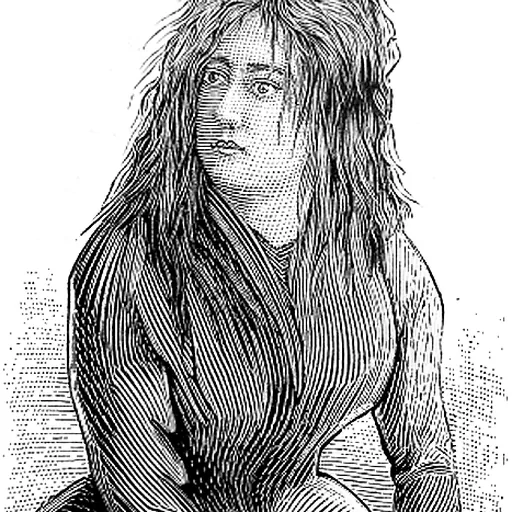
About Lizzie Halliday
Lived 1859 – 1918 (aged 58–59). Lizzie Halliday was a serial killer, known for Electric chair.
Lizzie Halliday (born Eliza Margaret McNally; – June 28, 1918) was an Irish-American serial killer responsible for the deaths of four people in upstate New York during the 1890s. In 1894, she became the first woman to be sentenced to death by the electric chair. Halliday's sentence was commuted and she spent the rest of her life in a mental institution. She killed a nurse while institutionalized and is speculated to have killed her first two husbands.
Biography Halliday, originally Eliza Margaret McNally, was born around 1859 in County Antrim, Ireland. Her family moved to the US when she was young (given as aged three or eight).
In 1879, Halliday married a Greenwich, New York, man known by the alias Charles Hopkins; his real name was Ketspool Brown. Halliday set up a shop, but was later convicted of burning it down for the insurance money. She was sentenced to two years at Philadelphia's Eastern State Penitentiary.
In 1889, now going by the name "Lizzie Brown", she became the housekeeper for Paul Halliday, a twice-widowed 70-year-old farmer living in Burlingham, New York, with his sons. Soon after, she burned down the Halliday barn and mill as well. She attempted to run off with another man, but was arrested and sent to an asylum. She was transferred to another asylum, but was then declared cured and released, returning home to Halliday.
Paul Halliday disappeared that August. She claimed he had gone to a nearby town to do masonry work. Following the neighbors' suspicions that something was not right about her story, a search warrant was obtained, and on September 4 the bodies of two women were found buried in hay in a barn. Both had been shot. The women were later identified as Margaret and Sarah McQuillan, New York residents who were part of the family Lizzie had stayed with in Philadelphia. Little could be ascertained from Halliday as, when questioned, she behaved in an erratic manner, tearing at her clothes and talking incoherently. She was kept in custody, and some thought she was merely faking insanity. A few days after the McQuillans were found, Paul Halliday's mutilated body was discovered under the floorboards of his house. He had also been shot. Lizzie was charged with the murders and held for trial at the Sullivan County jail in Monticello, New York. During her first few months there, she refused to eat, attacked the sheriff's wife, set fire to her own bed, tried to hang herself, and cut her own throat with broken glass, about which she said, "I thought I would cut myself to see if I would bleed."
The revelation that she had been married five times before she wed Paul Halliday, that two of her husbands had died less than a year after their weddings and that Lizzie had tried to poison a third led the press to speculate that she was responsible for at least six deaths. "Whether these men died natural deaths or were murdered is not known", The New York Times noted in June 1894. The coroner's jury found that Margaret and Sarah McQuillan had been shot with a pistol, and that Paul Halliday had been killed and mutilated in the same manner as Lizzie's first husband. During this period, Halliday remained violent in custody; on June 27, as Sheriff Beecher was conducting her into court, she turned and bit him severely on the hand. By late August the wound had become dangerously infected, swelling to the elbow, and it was feared Beecher might lose his arm.
Halliday was sent to the Matteawan State Hospital for the Criminally Insane, where she spent the remainder of her life. She became a model patient and was trusted with sewing privileges, giving her access to tools, including scissors. She grew close to Nellie Wicks, one of the attendants at Matteawan, but she was deeply upset by Wicks's plans to leave the institution. In 1906, she killed Wicks by stabbing her 200 times with a pair of scissors. On September 27, 1906, when Wicks entered a lavatory adjoining the ward at around 8:30 AM, Halliday followed her in, locked the door, knocked her down, and stabbed her in the throat with Wicks's own scissors; Wicks died two hours later. Halliday had explicitly warned Wicks she would kill her before allowing her to leave, but the threat had been dismissed as one of many idle warnings.
Halliday died of Bright's disease on June 28, 1918, after spending nearly half her life in the asylum.
Don’t just read it —
keep it.
Full-length biographies made to live with: read them, listen on the way to work, watch them tonight.
- E-book
- Audio
- Video
Instant download · yours to keep · every purchase keeps this site free
Important facts
Related people
Same field, nearest in time


Contemporaries
People whose lives overlapped Lizzie Halliday's



Frequently asked questions
Who was Lizzie Halliday?
Irish-American serial killer
When was Lizzie Halliday born?
Lizzie Halliday was born in 1859 in County Antrim.
When did Lizzie Halliday die?
Lizzie Halliday died on 28 June 1918 in Beacon.
What was Lizzie Halliday's occupation?
Lizzie Halliday was a serial killer.
What was Lizzie Halliday known for?
Lizzie Halliday was known for Electric chair.
What nationality was Lizzie Halliday?
Lizzie Halliday's recorded nationality: Irish American.
Sources & further reading
Cite this page
APA: Biography.guide. (2026). Lizzie Halliday. https://biography.guide/lizzie-halliday/
MLA: "Lizzie Halliday." Biography.guide, https://biography.guide/lizzie-halliday/.
Chicago: "Lizzie Halliday." Biography.guide. https://biography.guide/lizzie-halliday/.
Data last updated: 2026-09-22 · Spot an error? Report a correction.
Portrait: Wikimedia Commons · author & licence
Page generated 2026-09-27 05:03 UTC