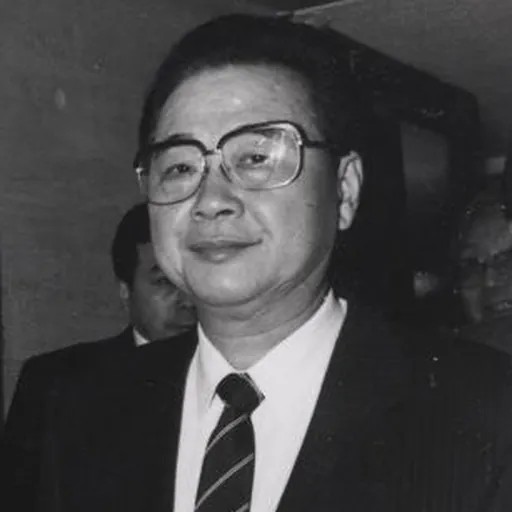
About Li Peng
Lived 1928 – 2019 (aged 90). Li Peng was a Chinese politician.
Early career In 1941, Li Peng began studying at the Yan'an Institute of Natural Science (a predecessor of the Beijing Institute of Technology). In July 1946, Li was sent to work in Zhangjiakou. According to his own recollection, in 1947, he journeyed through Shandong and North Korea, eventually ending up in Harbin where he began managing some work for a lard processing plant. In 1948, Li Peng was sent to study at the Moscow Power Engineering Institute, majoring in hydroelectric engineering. A year later, in 1949, Zhou Enlai became Premier of the newly declared People's Republic of China. Li graduated in 1954. During his time in the Soviet Union, Li was the head of the Chinese Students Association in the Soviet Union.
When Li returned to China in 1955, the country was firmly under the control of the Communist Party. Li took part in technical, then management work in the power industry, beginning his career in Northeast China. At the outset of the Cultural Revolution, Li was sent to Beijing to head up the municipal power bureau. He played a leading role in the construction of the Tuhe Powerplant in Tangshan and the Gaojing Powerplant in Beijing. During his time at Gaojing, he worked three days and three nights supervising the construction of the site. On 4 October 1974, he was struck by a vehicle while riding his bicycle home from work. From Tiananmen Square, the protesters later expanded into the surrounding streets. Non-violent protests also occurred in cities throughout China, including Shanghai and Wuhan. Rioting occurred in Xi'an and Changsha.
The Tiananmen protests were partially protests against the affluence of the children of high-ranking Communist Party officials, and the perception that second-generation officials had received their fortunes through exploiting their parents' influence. Li, whose family had often been at the center of corruption allegations within the Chinese power industry, was vulnerable to these charges.
An editorial published in the People's Daily on 26 April and bearing the name of Deng Xiaoping, denounced the demonstrations as "premeditated and organized turmoil with anti-Party and anti-socialist motives". The article had the effect of worsening the demonstrations by angering its leaders, who then made their demands more extreme. Zhao Ziyang later wrote in his autobiography that although Deng had stated many of those sentiments in a private conversation with Li Peng shortly before the editorial was written, Li had the comments disseminated to Party members and published as the editorial without Deng's knowledge or consent.
Li strictly refused to negotiate with the Tiananmen protesters out of principle, and became one of the officials most objected to by protesters. Among the other senior members of the central government, Li became the one who most strongly favored violence and known as the "Butcher of Beijing" for his role in the crackdown. After winning the support of most of his colleagues, apparently including Deng Xiaoping, Li officially declared martial law in Beijing on 20 May 1989 and promised "resolute and decisive measures to put an end to the turmoil". The protests were crushed by the military on 3–4 June. Most estimates of the dead range from several hundred to several thousand people. Li later described the crackdown as a historic victory for communism, After the fifth plenary session of the 13th Central Committee in November 1989, Li established a State Council Production Commission to better coordinate the implementation of the plans.
On 18 April 1990, Li spoke at a celebration for the fifth anniversary of the Shanghai Volkswagen Corporation. During his speech, Li stated that "some policies of the economic and technological zones and Special Economic Zones can be implemented in the Pudong area". The meeting was the beginning of China's shift to a more active role in international environmental policy. At the conference, Li stated that the pursuit of environmental protection should not cause neglect of economic development and that international environmental cooperation should not infringe on national sovereignty.
In 1996, Li started one of the earliest controls of the Chinese government over the Internet that later grew into what is called the Great Firewall when he signed State Council Order No. 195, issuing the "Interim Regulations on the Management of International Networking of Computer Information Networks". Article 6 of the Regulations states: "Computer information networks that directly connect to the international network must use the international entry and exit channels provided by the Ministry of Posts and Telecommunications’ national public telecommunications network. No unit or individual may establish or use other channels to connect to the international network on their own." This regulation was later widely used to punish "climbing over the firewall".
Chairman of the Standing Committee of the National People's Congress (1998–2003) Li remained premier until 1998, when he was constitutionally limited to two terms. After his second term expired, he became the chairman of the Standing Committee of the National People's Congress. Support for Li for the position was relatively low, as he received less than 90% of the vote at the first session of the 9th National People's Congress, where he was the only candidate.
Li spent much of the 1990s expanding and managing an energy monopoly, State Power Corporation of China. Because the company was staffed by Li's relatives, Li was accused of turning China's energy industry into a "family fiefdom". At its height, Li's power company controlled 72% of all energy-producing assets in China, and was ranked as the sixtieth-largest company in the world by Fortune magazine. After Li's departure from government, Li's energy monopoly was split into five smaller companies by the Chinese government.
On 22 August 2000, Li was in New York for a UN meeting. At the Waldorf-Astoria Hotel, a licensed private investigator served him with a legal summons in connection with human rights litigation involving the Tiananmen square crackdown. After the retirement of Luo Gan during 17th Party Congress, Li's influence waned considerably. He was subject to frequent speculation over corruption issues that plague him and his family. In addition, perhaps more than any other leader, Li's public image had become inextricably associated with memory of the 1989 Tiananmen crackdown, and as a result he continued to be a widely despised figure among a substantial segment of the Chinese population well into the 21st century. The Critical Moment was characterized by reviewers as largely an attempt to minimize Li's culpability during the most egregious stages of the crackdown; some also say he attempted to shift blame to Deng.
Li died on 22 July 2019 at the age of 90. He had been receiving medical treatment in a hospital in Beijing at the time of his death. His official obituary described him as an "outstanding Communist Party member, a loyal Communist warrior who endured many trials, a prominent proletarian revolutionary, statesman, and brilliant party and national leader". His funeral was held on 29 July 2019. Attendees of the funeral included CCP General Secretary Xi Jinping, Premier Li Keqiang, and former General Secretary Jiang Zemin.
Family Li Peng was married to Zhu Lin , a deputy manager in "a large firm in the south of China". Li's elder son, Li Xiaopeng; Li's daughter, Li Xiaolin; and, Li's younger son, Li Xiaoyong. Li Xiaoyong is married to Ye Xiaoyan, the daughter of Communist veteran Ye Ting's second son, Ye Zhengming.
Li's family benefited from Li's high position during the 1980s and 1990s. Two of Li's children, Li Xiaopeng and Li Xiaolin, inherited and ran two of China's electrical monopolies. State-run Chinese media have publicly questioned whether it is in China's long-term interest to preserve the "new class of monopoly state capitalists" that Li's family represents. Li Xiaopeng entered politics in Shanxi and became its governor in 2012 and then in 2016, he became Minister of Transport. Li Xiaolin served as chief executive of China Power International Development, before being transferred out in 2016 to a minor executive post at a different power company.
Honours
Don’t just read it —
keep it.
Full-length biographies made to live with: read them, listen on the way to work, watch them tonight.
- E-book
- Audio
- Video
Instant download · yours to keep · every purchase keeps this site free
Important facts
Family & relationships
People in Li Peng's life
Named in this biography and alive at the same time



Related people
Same field, nearest in time






Contemporaries
People whose lives overlapped Li Peng's

Frequently asked questions
Who was Li Peng?
4th Premier of the People's Republic of China (1928–2019)
When was Li Peng born?
Li Peng was born on 20 October 1928 in Shanghai.
When did Li Peng die?
Li Peng died on 22 July 2019 in Beijing.
What was Li Peng's occupation?
Li Peng was a politician.
What nationality was Li Peng?
Li Peng was Chinese.
Sources & further reading
Cite this page
APA: Biography.guide. (2026). Li Peng. https://biography.guide/li-peng/
MLA: "Li Peng." Biography.guide, https://biography.guide/li-peng/.
Chicago: "Li Peng." Biography.guide. https://biography.guide/li-peng/.
Data last updated: 2026-09-22 · Spot an error? Report a correction.
Portrait: Wikimedia Commons · author & licence
Page generated 2026-09-27 05:04 UTC