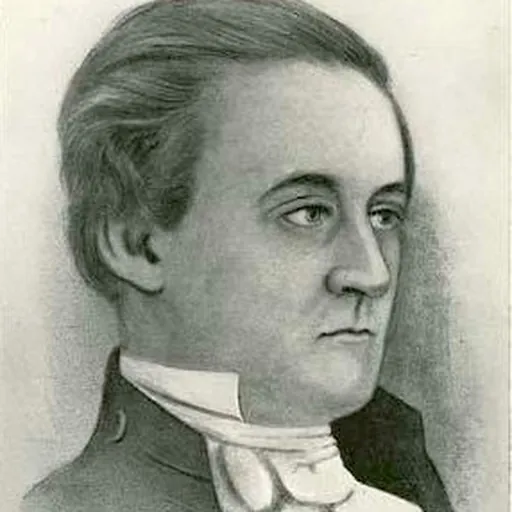
About Lewis Thomas Drummond
Lived 1813 – 1882 (aged 69). Lewis Thomas Drummond was a Canadian judge and politician.
Lewis Thomas Drummond (May 28, 1813 – November 24, 1882) was a lawyer, political figure, and judge in Lower Canada (now Quebec).
Family and early life
Drummond was born in Coleraine, County Londonderry, Ireland in 1813, the son of Lewis Drummond and Susan Harkin. His father was a prominent attorney in Ireland, but he died while Lewis Thomas was young. His mother emigrated to Lower Canada in 1825, bringing Lewis Thomas with her.
He studied at the Séminaire de Nicolet, then articled with a leading Tory lawyer in Montreal, Charles Dewey Day. Drummond was called to the bar of Lower Canada in 1836. He set up practice in Montreal and defended a number of persons involved in the Lower Canada Rebellions of 1837 and 1838.
In 1843 and 1844 a split developed in the French-Canadian Group, between the older members such as Denis-Benjamin Viger and John Neilson, who had their roots in pre-Rebellion politics, and the newer reform members, led by LaFontaine and his campaign for responsible government. When one of the members from Montreal resigned his seat in 1844, Drummond stood for election against Viger's favoured candidate. Fluently bilingual, Drummond was able to appeal to French-Canadian voters. He was also able to gain the votes of Irish-Catholic workers, and won the hard-fought by-election. His victory was seen as a significant shift in support away from the older wing of the reformers, and a popular affirmation of LaFontaine's policy.
Drummond had again campaigned vigorously for LaFontaine in the elections, including speaking at a major campaign dinner in Montreal. He stood for re-election in Montreal, but was defeated by George Moffat, a Tory businessman. This time, the Irish-Catholic voters supported the more conservative candidates in Montreal. However, Drummond was able to get elected in the vacant seat of Portneuf, which he won by acclamation. In Parliament, Drummond caucused in a small group of "English" Liberals from Canada East rather than the French-Canadian Group, but continued to support LaFontaine on major issues. He also continued to speak for the Irish-Catholic workers in some of their disputes with employers.
LaFontaine–Baldwin ministry: 1848–1851
In the general elections in 1848, the reform coalition of LaFontaine and Baldwin won a majority in both Canada East and Canada West. As well, the British government had instructed the new governor general, the Earl of Elgin, that he was to govern under the principles of responsible government, appointing the government from whichever groups had a majority in the Legislative Assembly. Elgin accordingly appointed LaFontaine and Baldwin as leaders of the ministry, and their choice of members of the Executive Council.
Drummond had been re-elected to the Assembly in the general elections, this time for the Shefford constituency, defeating the incumbent member, Sewell Foster. When LaFontaine and Baldwin formed the government, Drummond was appointed solicitor general for Canada East, making him a member of the government, although not in the Executive Council. He was re-elected in the resulting ministerial by-election, and held the position of solicitor-general for the term of the LaFontaine–Baldwin ministry, from 1848 to 1851. Drummond was also appointed Queen's Counsel in 1848.
In 1849, there was a growing annexationist movement centred in Montreal, calling for the peaceful annexation of the Province of Canada by the United States. It culminated in the Montreal Annexation Manifesto, signed mainly by leading members of the Montreal business community. Drummond was a strong opponent of the annexation movement, and used the patronage powers of the government to remove supporters of annexation from public offices in Montreal and the Eastern Townships. At one point, he suggested that the British government should send more troops to Canada to reinforce the provincial government.
From Bleu to Rouge: 1851–1861
In 1851, LaFontaine and Baldwin both retired from politics. In the new ministry, headed by Francis Hincks and Augustin-Norbert Morin, Drummond was appointed Attorney General for Lower Canada and was a member of the Executive Council. In addition to his position as Attorney General, he was one of the government's representative on the board of the Grand Trunk Railway, which had received considerable subsidies from the government. He was re-elected in Shefford in the general elections of 1851, 1854, and 1857.
The members of the new ministry from Canada East were mainly the Ministerialists, later known as the Parti bleu, which developed from the more conservative wing of the French-Canadian Group. Drummond was part of a small group of English Conservatives which supported the government, and was hostile to the growing Clear Grit movement in Upper Canada, which he considered to be clearly marked with socialism.
Although he had become a seigneur by marriage, Drummond as Attorney General developed legislation limiting seigneurial privileges which was later amended to abolish seigneurial tenure. The seigneurs ceased to be feudal superiors and became landlords. The habitant farmers could in theory buy their farms outright, at a price fixed by the seigneurial commission, or could become tenant farmers.
Drummond continued to hold the position of Attorney General until 1856, when John A. Macdonald and Étienne-Paschal Taché formed a new ministry. Drummond attempted to replace Taché as the co-premier from Canada East and threatened to resign. Macdonald and Taché instead accepted his resignation and appointed George-Étienne Cartier as Attorney General for Lower Canada. Two years later, when George Brown and Antoine-Aimé Dorion formed a Reform–Rouge ministry, Drummond left the Bleu–Conservative grouping and switched to the Parti rouge. Brown and Dorion appointed him Attorney General for Lower Canada. However, their ministry only lasted a few days. They were defeated on a confidence vote in the Assembly, and Macdonald and Cartier returned to office in the Double Shuffle.
Commercial activities
Drummond was a director of the Montreal City and District Savings Bank, a new bank established with the patronage of Bishop Ignace Bourget to provide banking services to French-Canadians. He was also president of the Stanstead, Shefford and Chambly Railroad and helped found the Garden River Mining Company.
Judgeship and later life
In 1864, he was appointed a judge of the Court of Queen's Bench. He retired due to poor health in 1873. He died in Montreal in 1882 from chronic bronchitis.
Don’t just read it —
keep it.
Full-length biographies made to live with: read them, listen on the way to work, watch them tonight.
- E-book
- Audio
- Video
Instant download · yours to keep · every purchase keeps this site free
Important facts
People in Lewis Thomas Drummond's life
Named in this biography and alive at the same time




Related people
Same field, nearest in time

Contemporaries
People whose lives overlapped Lewis Thomas Drummond's




Frequently asked questions
Who was Lewis Thomas Drummond?
Canadian judge
When was Lewis Thomas Drummond born?
Lewis Thomas Drummond was born on 28 May 1813 in Coleraine.
When did Lewis Thomas Drummond die?
Lewis Thomas Drummond died on 24 November 1882 in Montreal.
What was Lewis Thomas Drummond's occupation?
Lewis Thomas Drummond was a judge and politician.
What nationality was Lewis Thomas Drummond?
Lewis Thomas Drummond was Canadian.
Sources & further reading
· Wikipedia: Lewis Thomas Drummond
· DBpedia: Lewis Thomas Drummond
Cite this page
APA: Biography.guide. (2026). Lewis Thomas Drummond. https://biography.guide/lewis-thomas-drummond/
MLA: "Lewis Thomas Drummond." Biography.guide, https://biography.guide/lewis-thomas-drummond/.
Chicago: "Lewis Thomas Drummond." Biography.guide. https://biography.guide/lewis-thomas-drummond/.
Data last updated: 2026-09-20 · Spot an error? Report a correction.
Portrait: Wikimedia Commons · author & licence
Page generated 2026-09-27 04:58 UTC