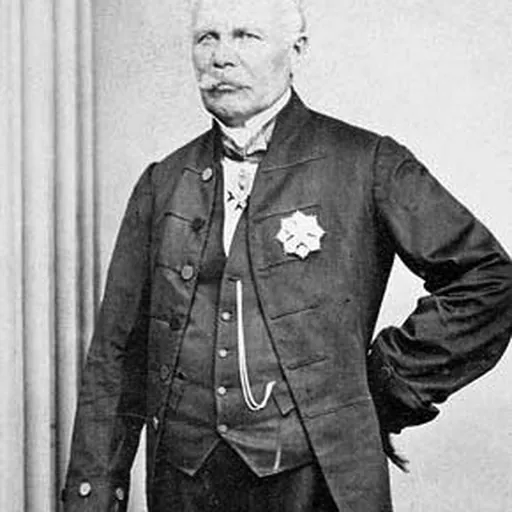
About Étienne-Paschal Taché
Lived 1795 – 1865 (aged 69). Étienne-Paschal Taché was a Canadian politician and physician, known for Fathers of Confederation.
Sir Étienne-Paschal Taché (5 September 1795 – 30 July 1865) was a Canadian medical doctor, politician, and Father of Confederation. His family had a long history in New France, but suffered serious financial reverses due to the Seven Years' War and the siege of Quebec. He was considered a self-made man, who became a physician, a militia soldier, and a politician. He served twice as joint premier of the Province of Canada.
Taché was a strong supporter of the Confederation of the British North American provinces, and the maintenance of the British connection. From June 1864, he was the formal head of the Great Coalition which pushed for Confederation, containing John A. Macdonald, George-Étienne Cartier and George Brown, but he died in office in 1865, two years before Confederation and the creation of Canada.
Early life and family
Taché was born in St. Thomas, Lower Canada (now Montmagny, Quebec) in 1795, the third son of Charles Taché and Geneviève Michon. The Taché family had been wealthy prior to the Conquest. Taché's grandfather, Jean Taché, was a Paris merchant who emigrated to New France in 1730 and became one of the leading merchants and ship-owners in Quebec City. Jean Taché also married well; his wife was Marie-Anne Jolliet de Mingan, the granddaughter of the explorer Louis Jolliet. However, the family fortunes were badly damaged by the Seven Years' War and the siege of Quebec. The Taché family was of the seigneurial class, but the traditional seigneury did not provide much income for the family. As a result, in light of his successes in life, Étienne-Paschal Taché was considered to be a self-made man.
Alexandre Antonin Taché, who entered the priesthood and became Archbishop of St. Boniface in Manitoba, was his nephew.
Military service
Taché studied at the Petit Séminaire de Québec until the War of 1812. Although still a teenager, he left school and joined the 5th Battalion of the Select Embodied Militia of the Lower Canada militia as an ensign. He was later promoted to lieutenant and fought in the Chasseurs Canadiens. He was present at two key battles, the Battle of the Châteauguay, which saved Montreal from being occupied by the invading American forces, and the Battle of Plattsburgh, which ended the British attempt to invade the United States via Lake Champlain.
After the battle, there were conflicting claims for the credit of the victory, by the Governor General, the general commanding British North American troops, and Lieutenant Colonel de Salaberry. A pseudonymous letter appeared shortly afterwards in the Montreal Gazette by a "témoin oculaire" ("eye-witness") stating that the victory had been won by de Salaberry's leadership. Several years after the battle, Taché stated that he knew that the letter had been written by Michael O'Sullivan, aide-de-camp to de Salaberry, who had been in the heat of the battle. The letter is important contemporary evidence concerning the battle, and Taché's statement was significant for confirming its authenticity.
Taché retained a life-long interest in military affairs, which he relied upon during his political career. He rose to the rank of colonel in the Canadian militia, and was appointed an honorary colonel in the British Army. Hearing rumours of Taché's activities, the British authorities issued a search warrant for his house in January 1839. Taché was absent when the search occurred. No firearms were found and he was not arrested. Although Taché did not support armed rebellion, neither did he condemn those who took up arms. In his view, they were only a few hundred men who were driven to despair by the actions of the British government.
Taché now embarked on a political career. Closing down his medical practice, he was a candidate in the 1841 general election for the new Legislative Assembly of the Province of Canada. Campaigning against the union of the Canadas, he was unopposed in the constituency of L'Islet and was elected by acclamation. When the first Parliament was summoned, Taché was a member of the French-Canadian Group. He voted against the principle of the union, opposed the policies of Governor-General Lord Sydenham, and generally voted in favour of the reform proposals of La Fontaine and Robert Baldwin, particularly responsible government.
He held numerous posts in successive administrations, including, for a time, joint-premier of the province (1856–1857, 1864–1865) as well as Minister of Militia and Defence for the Province of Canada (1855 to 1860). These ideas reflected the ideas of the conservative Parti bleu (with which Taché was associated).
An avid supporter of the British Crown, Taché expressed ideas of loyalty even before the debates regarding the creation of Canada's confederation: "in 1848, he delivered his famous idea of French-Canadian loyalty to the British crown: ... 'we will never forget our allegiance till the last cannon which is shot on this continent in defence of Great Britain is fired by the hand of a French-Canadian. This can certainly explain why Taché worked with future Prime Minister John A. Macdonald and other significant characters who were Fathers of the Confederation and who shared similar views. Therefore, these alliances led to the Great Coalition of 1864 – 'a government led by Cartier, Brown and Macdonald under the premiership of a bleu elder statesman, Sir Étienne-Paschal Taché' - responsible for the Canadian Confederation. For this matter, Taché presided of over the Quebec City conference of 1864. When Edward, Prince of Wales, toured British North America in 1860, Taché was specially attached to the Prince's staff.
Honours and recognition 1858: knighted by Queen Victoria 1860: appointed honorary colonel in the British Army and aide-de-camp to Queen Victoria 1862: appointed to the Order of St. Gregory the Great 1937: designated a National Historic Person by the federal government
Works Quelques réflexions sur l'organisation des volontaires et de la milice de cette province, par un vétéran de 1812 (Quebec 1863)
Don’t just read it —
keep it.
Full-length biographies made to live with: read them, listen on the way to work, watch them tonight.
- E-book
- Audio
- Video
Instant download · yours to keep · every purchase keeps this site free
Important facts
more
Sir Etienne Paschal Tache, Taché, Etienne-Pascal, Etienne-Pascal Tache, E.P. Tache, Tache, Etienne Paschal Tache, Étienne Taché, Sir Étienne-Paschal, Sir Étienne-Paschal Taché, Etienne Tache, Sir Etienne-Paschal TachePeople in Étienne-Paschal Taché's life
Named in this biography and alive at the same time


Related people
Same field, nearest in time



Contemporaries
People whose lives overlapped Étienne-Paschal Taché's





Frequently asked questions
Who was Étienne-Paschal Taché?
Canadian politician (1795-1865)
When was Étienne-Paschal Taché born?
Étienne-Paschal Taché was born on 5 September 1795 in Montmagny.
When did Étienne-Paschal Taché die?
Étienne-Paschal Taché died on 30 July 1865 in Montmagny.
What was Étienne-Paschal Taché's occupation?
Étienne-Paschal Taché was a politician and physician.
What was Étienne-Paschal Taché known for?
Étienne-Paschal Taché was known for Fathers of Confederation.
What nationality was Étienne-Paschal Taché?
Étienne-Paschal Taché was Canadian.
Sources & further reading
· Wikipedia: Étienne-Paschal Taché
· DBpedia: Étienne-Paschal Taché
Cite this page
APA: Biography.guide. (2026). Étienne-Paschal Taché. https://biography.guide/etienne-paschal-tache/
MLA: "Étienne-Paschal Taché." Biography.guide, https://biography.guide/etienne-paschal-tache/.
Chicago: "Étienne-Paschal Taché." Biography.guide. https://biography.guide/etienne-paschal-tache/.
Data last updated: 2026-09-23 · Spot an error? Report a correction.
Portrait: Wikimedia Commons · author & licence
Page generated 2026-09-27 05:07 UTC