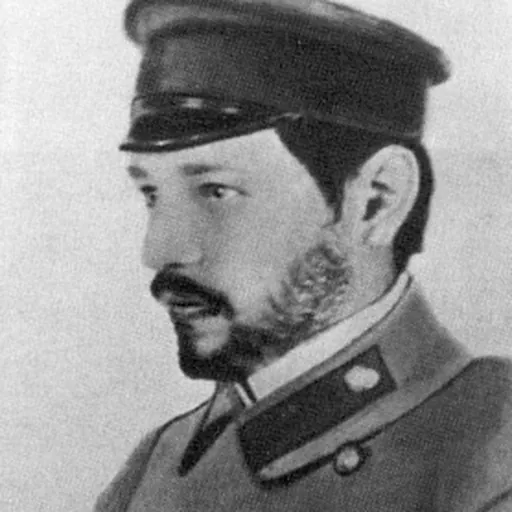
About Lev Kobylinsky
Lived 1879 – 1947 (aged 68). Lev Kobylinsky was a Russian linguist, poet, translator, literary historian, history and philosopher.
Lev Lvovich Kobylinsky (; 2 August 1879, Moscow, Russian Empire – 17 November 1947, Locarno, Switzerland) was a poet, translator, theorist of symbolism, the Christian philosopher and historian of literature. His pseudonym was Ellis.
Biography
Lev Kobylinsky was born in Moscow. He was an illegitimate son of the director of private gymnasium Lev Polivanoff. In 1902, he graduated from the law faculty of Moscow University. Together with Andrei Bely organized a poetic circle of " Argonauts ". In the years 1904–1909 an active member of the magazine Libra. During 1910–1917, along with Andrew White and Emily Medtner founded the publishing house "Musaget". He emigrated to Switzerland in 1911. Like his friend Andrei Bely, became interested in anthroposophy of Rudolf Steiner, but later he accepted Catholicism and joined the Society of Jesus. Ellis wrote literary and philosophical works in German. He died in Locarno, Switzerland.
Alignment
Christian worldview Ellis Kobylinsky was not orthodox.
Ellis defended the idea of reincarnation in his view the multiplicity of personalities - the result of the sinfulness of human nature. He considered the highest form of art symbolism and was a supporter of the aristocratic individualism and fan of Friedrich Nietzsche. His intuition considered as the essence of the symbolic contemplation, contemplation logically distinguishing purely intellectual, artistic and mystical.
Creativity
Ellis's poems "written under the influence of Soloviev, Bryusov, Bely and Balmont, according to the religious understanding of the world and the quest that come from the children's proximity to supermaterial world, that of religion permeated the life of the Middle Ages".
Criticism "Immorteli." In 2 vols., 1904 "Russian Symbolists', 1910 «Vigilemus», 1914 Collections of poetry «Stigmata», 1911 "Argo: Two books of poetry and the poem", 1914 Philosophical writings Platon und Solowjew, Mainz, 1926 Christliche Weisheit, Basel, 1929 ("Christian wisdom") WA Joukowski, Paderborn, 1933 Alexander Puschkin, der religiose Genius Russlands, Ölten, 1948 "The Kingdom of Saint Peter"
Publications
Ellis. Poems. Tomsk: Aquarius, 1996. Ellis. Russian Symbolists. Tomsk: Aquarius, 1996. - 288. Ellis. Unpublished and Uncollected. Tomsk: Aquarius, 2000. - 460. Baudelaire "Flowers of Evil" and the prose poem in translation Ellis. Tomsk: Aquarius, 1993. - 400 s.
Don’t just read it —
keep it.
Full-length biographies made to live with: read them, listen on the way to work, watch them tonight.
- E-book
- Audio
- Video
Instant download · yours to keep · every purchase keeps this site free
Important facts
People in Lev Kobylinsky's life
Named in this biography and alive at the same time



Related people
Same field, nearest in time

Contemporaries
People whose lives overlapped Lev Kobylinsky's





Frequently asked questions
Who was Lev Kobylinsky?
Russian poet and translator (1879–1947)
When was Lev Kobylinsky born?
Lev Kobylinsky was born on 2 August 1879 in Moscow.
When did Lev Kobylinsky die?
Lev Kobylinsky died on 17 November 1947 in Locarno.
What was Lev Kobylinsky's occupation?
Lev Kobylinsky was a linguist, poet, translator, literary historian, history and philosopher.
What nationality was Lev Kobylinsky?
Lev Kobylinsky was Russian.
Sources & further reading
Cite this page
APA: Biography.guide. (2026). Lev Kobylinsky. https://biography.guide/lev-kobylinsky/
MLA: "Lev Kobylinsky." Biography.guide, https://biography.guide/lev-kobylinsky/.
Chicago: "Lev Kobylinsky." Biography.guide. https://biography.guide/lev-kobylinsky/.
Data last updated: 2026-09-20 · Spot an error? Report a correction.
Portrait: Wikimedia Commons · author & licence
Page generated 2026-09-27 04:58 UTC