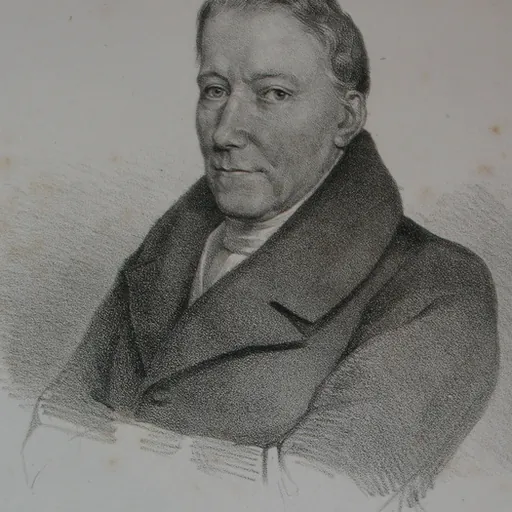
About Leopold Trattinnick
Lived 1764 – 1849 (aged 84). Leopold Trattinnick was an Austrian botanist, mycologist, mineralogist and entomologist, known for Botany and Linnaean taxonomy.
Leopold Trattinnick (26 May 1764 in Klosterneuburg – 24 January 1849 in Vienna) was an Austrian botanist and mycologist. He was a curator of the Royal Natural History collection in Vienna. He published several mycological and other botanical works. Most of these works were illustrated with engravings and many of them were hand coloured (pre-colour printing). He also gave out collections of wax replicas of species of fungi and later sponges.
Biography
Leopold Trattinnick was born on 26 May 1764 near Vienna to a wealthy and influential family.
He originally began to study law but his interests in nature grew and he started studying Science and divided his time amongst the fields of entomology, mineralogy and botany. His main area of Interest was mycology and spermatophytes.
In 1797, he published 'Anleitung zur Cultur der ächten Baumwolle in Österreich' (translated as 'Introduction to the culture of true cotton in Austria'). It was his first botanical publication. This was followed by 'Genera Plantarum Methodo Naturali Disposita', in 1802, which was a proposal for a natural arrangement of some plant genera. A second collection (with edible sponges) was made in 1830. The Mycological Cabinet was numbered in Arabic numerals (1-42). The second collection of sponges is numbered with letters (A-FF). Several places still have these wax collections including the 'Museo Civico di storia naturale' in Trieste, Italy (only up to no. 18), the portrait collection of the National Library in Vienna, which has wax models from both series, the University of Veterinary Medicine in Vienna, which also has wax models from both series and the 'Department of Botany' in the Hungarian National Museum in Budapest. It contained 80 plates.
He did not have an official botanical position until 1806 when he became the “Landschafts-Phytographen von Niederösterreich”,(plant illustrator of the landscape of Lower Austria).
Between 1811 and 1818, he published 'Archiv der Gewächskunde' (Archives of the Greenhouse Customer). This two-volume work included 250 engravings of plants.
Between 1812 and 1822, he published 'Auswahl vorzüglich schöner, seltener, berühmter, und sonst sehr merkwürdiger Gartenpflanzen, in getreuen Abbildungen nebst Erläuterungen über ihre Charakteristik, Verwandschaft, Klassification, Geschichte, Verwendung, Cultur, und ästhetischen Ansichten' (translation: Selection of Exquisitely Beautiful, Rare, Famous and Otherwise Very Strange Garden Plants, in faithful pictures together with explanations of their characteristics, relationships/ kinship, classification, history, use, culture and aesthetic properties). It included 219 engraved plates, 218 of them hand-coloured. A set sold in 1999 for £9,775 It was first thought that the name was invalid, as a Verbena (now known as Cornutia) had already been named "Hosta", but Linnaeus then re-classified the plant as a 'Verbena'. In 1905, the International Botanical Congress voted that the name 'Hosta' could be used.
Between 1816 and 1822 he published two volumes of the 'Flora der Oesterreichischen Kaiserthumes' (Flora of the Austrian Empire), but the complete work was never finished. The illustrations were taken from his archive. The text is partially filled with poetic verse as well as botanical observations. Specimens of this taxon were sent to Trattinick by Count Berchtold. This was later classified as a synonym of Coleanthus subtilis.
In 1819, he published 'Oesterreichischer Blumenkranz', (Flower Wreaths of Austria) which was described as “not botany in verse, but pure botanical poetry, representing the work of the important Austrian botanist; 200 plants from the white lily to the sharp stonecrop poetically imagined”. Trattinick published this name change in 'Rosacearum monographia' page233 in 1823. The 'Monograph of the Rose Family' covered generic and species descriptions of plants in the rose family, although it was not illustrated.
In 1825, Trattinnick published 'Genera Nova Plantarum Iconibus Observationibusque Illustrata', which appeared in 24 fascicles. The illustrations were not coloured but were very highly regarded. They described 400 hybrids of Pelargoniums from Germany, all of which were named or renamed in Latin. Before 1843 he published 2 more volumes of the same title. Which included 264 illustrations, as a full-page engraving which was hand-coloured. In his later publications, some of the plants were illustrated by single flowers and several plants were included on a page.
In 1828, Trattinick, on seeing Rafflesia (a species of parasitic flowering plant), wrote that the plant should be assigned to a special taxonomic category called Vegetablische Verrucktheiten, or “Vegetable Craziness.”
Among all his varied publications, Trattinnick is credited with the original Latin descriptions of around 405 plant names. the 17th edition of the "Zander Hand dictionary of plant names" has the more accurate spelling "Trattinnick".
A complete list of his publications can be found in 'Wurzbach's Encyclopedia' Vol. 46, in 1882. Burseraceae contains many species of trees and shrubs, which includes the sub-tribes Protieae, Bursereae, and Canarieae. Canarieae is composed of Canarium (75 species and is the largest in this tribe), Dacryodes, Haplolobus, Pseudodacryodes, Rosselia, Santiria, Scutinanthe, and Trattinnickia (with 26 species).
In Klosterneuburg, (his birth town) in Lower Austria, there is a road named after him.
Selected bibliography Guide to outlaw culture of cotton in Austria. Vienna 1797 Genera plantarum methodo naturali disposita. Vindobonae (Vienna) 1802 Fungi Austriaci, iconibus illustrati. Vienna 1804-1806 The edible sponges of the Austrian Empire. 1809, 2nd ed. 1830 Archives of a greenhouse customer. Vienna 1811–1818. Flora of the Austrian Empire. 1816–1822. Thesaurus botanicus. Vienna 1805, 2nd ed. 1819 Rosacearum Monographia. 1823–1824. Genera plantarum nova iconibus observationesque illustrata. Self-Verlag, 1825 (24 copper plates). New types of geraniums German origin. 1825–1843.
Don’t just read it —
keep it.
Full-length biographies made to live with: read them, listen on the way to work, watch them tonight.
- E-book
- Audio
- Video
Instant download · yours to keep · every purchase keeps this site free
Important facts
Related people
Same field, nearest in time



Contemporaries
People whose lives overlapped Leopold Trattinnick's





Frequently asked questions
Who was Leopold Trattinnick?
Austrian botanist and mycologist (1764-1849)
When was Leopold Trattinnick born?
Leopold Trattinnick was born on 26 May 1764 in Klosterneuburg.
When did Leopold Trattinnick die?
Leopold Trattinnick died on 24 January 1849 in Vienna.
What was Leopold Trattinnick's occupation?
Leopold Trattinnick was a botanist, mycologist, mineralogist and entomologist.
What was Leopold Trattinnick known for?
Leopold Trattinnick was known for Botany and Linnaean taxonomy.
What nationality was Leopold Trattinnick?
Leopold Trattinnick was Austrian.
Sources & further reading
· Wikipedia: Leopold Trattinnick
· DBpedia: Leopold Trattinnick
Cite this page
APA: Biography.guide. (2026). Leopold Trattinnick. https://biography.guide/leopold-trattinnick/
MLA: "Leopold Trattinnick." Biography.guide, https://biography.guide/leopold-trattinnick/.
Chicago: "Leopold Trattinnick." Biography.guide. https://biography.guide/leopold-trattinnick/.
Data last updated: 2026-09-20 · Spot an error? Report a correction.
Portrait: Wikimedia Commons · author & licence
Page generated 2026-09-27 04:57 UTC