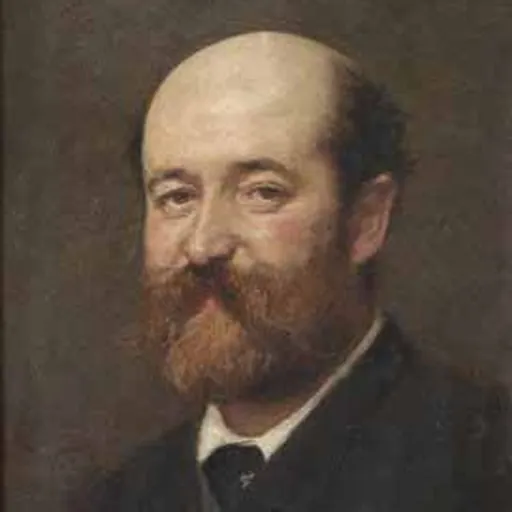
About Léon Germain Pelouse
Lived 1838 – 1891 (aged 52). Léon Germain Pelouse was a French painter.
Léon Germain Pelouse in his atelier, painted by in 1891, the year Pelouse died at age 52. Léon Germain Pelouse (1 October 1838 – 31 July 1891) was a largely self-taught painter born in Pierrelaye, France. His work was most often said to descend from that of Corot and Daubigny, but was from the beginning unique in its depiction of an often stark, obsessively detailed nature largely devoid of human figures. At the time of his death at age 52 in Paris, Pelouse was "considered one of the great landscape painters of his time."
Life and career Pelouse was born and spent his first eleven years in the small village of Pierrelaye, into a family of little means. In 1849 his family moved to Paris and, five years later, on the death of his father, Léon-Germain, having to earn a living, at sixteen began working as a traveling salesman for his uncle, a draper.
He began painting as an amateur and took some evening classes. The work made a strong impression, especially coming from a painter without the usual Academic education. "From the beginning," wrote Albert Patin de La Fizelière, Pelouse displayed "the easy grace, brilliance, and suppleness of execution that have since been admired in his canvases." From 1873, when he received a second-class medal at the Salon, for Vallée de Cernay, he gained mounting success and critical acclaim.
Pelouse became a prolific and sought-after artist. In 1884, Eugène Montrosier wrote, "Díaz de la Peña produces paintings like apple trees give apples, it has been said. One could write as much of M. Pelouse who, without a master, by the sole force of his will, has succeeded in a few years to take one of the first places among modern landscape painters" and to become "one of the most distinguished painters of the young school."
Pelouse's fame spread to North America. Scribner's Monthly, reviewing the Paris Salon of 1878, wrote that Pelouse's "style is impressive, his pictures rich and daring in color, the execution marked by the greatest breadth and freedom of handling....he shows an imagination equal to that of Daubigny." In the 1880s, Pelouse was "the most prestigious" of the French artists whose work was imported to Canada by W. Scott & Sons of Montreal.
In 1878 Pelouse was made a Chevalier of the Legion of Honor. In 1889 he was awarded a gold medal at the Universal Exhibition in Paris. From 1884 to 1890 he served on the jury of the Paris Salon.
Pelouse died in 1891, at age 52, of complications from diabetes. He was interred in a vault in the cemetery of Le Pré-Saint-Gervais in Paris. At his funeral, William-Adolphe Bouguereau spoke of Pelouse's character:"What a frank, loyal, and cheerful nature! How happy we felt to be with him. What inexhaustible verve, what fine wit, what benevolence and kindness! His pupils, who lived next door to him in the country, can tell what treasures this heart contained. And in difficult times, how good and consoling was his faithful friendship! His sensitive soul was indignant at injustices. With what gratitude he cherished the memory of the slightest services that others had been able to render him!"
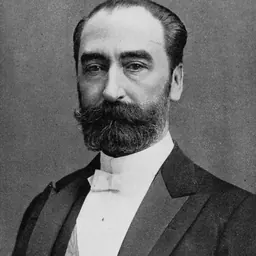
A posthumous retrospective of more than 250 of his works, inaugurated by the President of the Republic, Sadi Carnot, was exhibited in 1892 at the École des Beaux-Arts in Paris. In 1897, a monument to his memory, surmounted by a bronze bust by Alexandre Falguière, was erected and dedicated in Cernay. the Musée Malraux, and the Musée des Beaux-Arts de Nantes. His works are also held in the Metropolitan Museum in New York, and in museums in San Francisco, Ghent, Oslo, Munich, and Sydney.
École de Cernay; students P.S. Krøyer, Le Déjeuner des artistes à Cernay-la-Ville, 1879. Pelouse is the standing figure at right. During the Franco-Prussian War of 1870, Pelouse enlisted in the national guard. During his service, he spent time in the town of Cernay-la-Ville, near Paris, and experienced a powerful attraction to the surrounding scenery. After the war, in 1871, Pelouse walked on foot from Paris to Cernay, which had been ransacked by the Prussians, and took lodgings at the inn of Léopold Lequesne. He would eventually have numerous ateliers in the area, including "a barn next to the tiny church that the Rothschilds, those gold powerhouses, had restored."
"Poverty made him frugal, handy, and ingenious...he made his own clothes and even his hats and shoes; he wanted to save his money for brushes and paints." It was Pelouse's habit to wear a peasant blouse and sabots, setting out with his easel and paints at daybreak, "often forgetting meals and only returning a long time after sunset."
Pelouse, known for "his natural bonhomie, his insouciance and his good-natured gaiety," and attracted an international coterie of pupils. They socialized in the welcoming inns of Place de Cernay-la-Ville, in particular the establishment of Léopold Lequesne, which became known as Au Rendezvous des Artistes. and "le plus Cernaysien" of landscape painters.
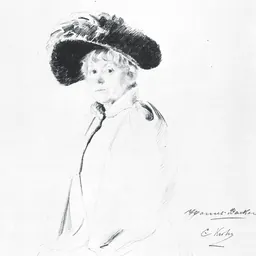
Often compared and contrasted to the realist landscape painters of the Barbizon school, for his paintings of Brittany Pelouse was "counted among the artists known as 'Les Barbizon bretons'". , , Allan Edson, Eugène Galien-Laloue, , , Kitty Lange Kielland, , Émile Le Marié des Landelles, , Albert Rigolot, , and . and her compatriot and friend Harriet Backer. They accompanied Pelouse on an excursion to Rochefort-en-Terre, in Brittany. Backer later recalled:Léon Pelouse had proposed to us two women that we spend the summer in his company in a location he had discovered and kept secret: it was a way of getting a jump on new and original subjects, instead of the well-worn themes exhibited at the Salon...Under a discreet disguise, we set out with Pelouse, his wife, and two of his male pupils...Pelouse is the most natural man I've ever met...I'm sure if you were to arrive one evening while we're at the table, you'd be extremely surprised. Pelouse and each scream louder than the other to make themselves heard, to the point that one wonders if they'll come to blows—then it all ends with outbursts of laughter, so loud we have to cover our ears.
In the spring and summer of 1879, the Danish painter Peder Severin Krøyer stayed at Pelouse's home in Cernay, and painted Le Déjeuner des artistes à Cernay-la-Ville, which captures the social scene at Léopold Lequesne's inn. Pelouse can be seen standing at right, wearing a hat and smoking, framed by the glow of light from the window.
Robert Louis Stevenson was another visitor. "Cernay had Pelouse," he later wrote, "the admirable, placid Pelouse, smilingly critical of youth, who, when a full-blown commercial traveller, suddenly threw down his samples, bought a colour-box, and became the master whom we have all admired."
Other locations While based in Cernay, Pelouse made numerous excursions to paint the scenery at Pont-Aven, Rochefort-en-Terre, Concarneau, Honfleur, Trouville, Marlotte in the Forest of Fontainebleau, and beyond France to Belgium and Holland.
In 1884, the Pelouse family left Cernay to return to Paris. Between 1886 and 1888, the artist painted near Besançon, in the Loue valley dear to Gustave Courbet. About sixty paintings date from this period.
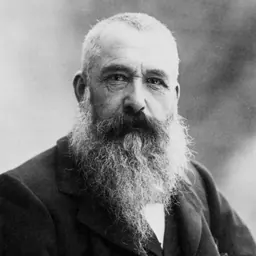
Ernest Raingo's sister Alice was the wife first of Hoschedé, and then, the year after Hoschedé's death in 1891, of Claude Monet.
In 1890, in failing health, Pelouse officially adopted Lucy's son by Ernest Raingo, Jean, who took the name Raingo-Pelouse. Jean's sons Germain, Bernard and Pierre also took this hypehated name. (1893–1963) became a noted artist, but never knew his grandfather and namesake, as their lifespans did not overlap. Germain Raingo-Pelouse's aunt was Alice Hoschedé, and his uncle, by her second marriage, was Claude Monet.
Themes and reception
Renate Treydel in the Allgemeines Künstlerlexikon notes that Pelousetakes his cue from Camille Corot, Henri Joseph Harpignies, Charles-François Daubigny and , but his main source of inspiration is nature, in which he develops a keen sense of the choice of motifs. At the Salon debut in Paris in 1865, he was attested to a high degree of technical virtuosity and natural talent, as well as praised for his light-handed, loose brushwork. He prefers unspectacular, tranquil views, often just trees, inconspicuous things like earth or moss, lush, wild nature with impenetrable thickets, and lonely villages...Pelouse works intuitively, quickly and exclusively in nature...The sober composition of Banc de rochers à Concarneau (1880, Brest) is considered a bold and early anticipation of the art of Charles Cottet due to its omission of picturesque features and a gloomy coloring.
After the death of Charles-François Daubigny in 1878, Pelouse was considered to have taken Daubigny's place as the foremost landscape painter in France. After Pelouse's death "at his height as an artist,"
Celebrated in life and in death, in subsequent decades Pelouse's fame faded as the realist landscape painters of the Barbizon school and the École de Cernay were supplanted by the rapidly evolving modern schools of French art.
Gallery
Don’t just read it —
keep it.
Full-length biographies made to live with: read them, listen on the way to work, watch them tonight.
- E-book
- Audio
- Video
Instant download · yours to keep · every purchase keeps this site free
Important facts
People in Léon Germain Pelouse's life
Named in this biography and alive at the same time




Related people
Same field, nearest in time
Contemporaries
People whose lives overlapped Léon Germain Pelouse's

Frequently asked questions
Who was Léon Germain Pelouse?
French artist (1838-1891)
When was Léon Germain Pelouse born?
Léon Germain Pelouse was born on 1 October 1838 in Pierrelaye.
When did Léon Germain Pelouse die?
Léon Germain Pelouse died on 31 July 1891 in 17th arrondissement of Paris.
What was Léon Germain Pelouse's occupation?
Léon Germain Pelouse was a painter.
What nationality was Léon Germain Pelouse?
Léon Germain Pelouse was French.
Sources & further reading
· Wikipedia: Léon Germain Pelouse
· DBpedia: Léon Germain Pelouse
Cite this page
APA: Biography.guide. (2026). Léon Germain Pelouse. https://biography.guide/leon-germain-pelouse/
MLA: "Léon Germain Pelouse." Biography.guide, https://biography.guide/leon-germain-pelouse/.
Chicago: "Léon Germain Pelouse." Biography.guide. https://biography.guide/leon-germain-pelouse/.
Data last updated: 2026-09-20 · Spot an error? Report a correction.
Page generated 2026-09-27 05:10 UTC