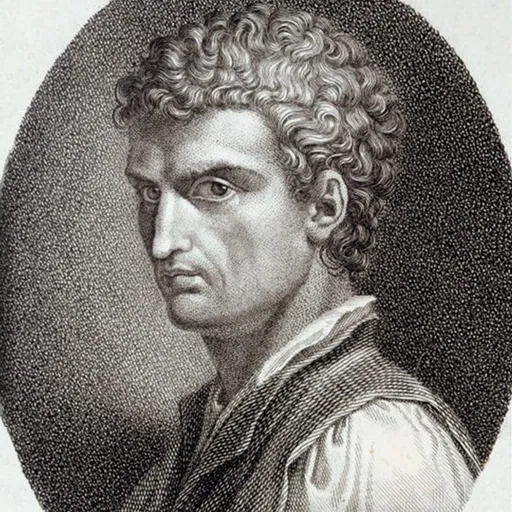
About Leon Battista Alberti
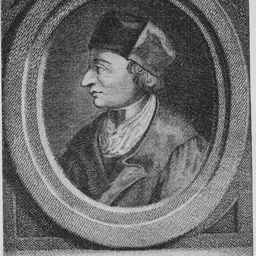
Lived 1404 – 1472 (aged 68). Leon Battista Alberti was a philosopher, linguist, cryptographer, poet, architect and architectural theoretician.
Leon Battista Alberti (; 14 February 1404 – 25 April 1472) was an Italian Renaissance humanist author, artist, architect, poet, priest, linguist, philosopher, and cryptographer; he epitomised the nature of those identified now as polymaths. He is considered the founder of European cryptography, a claim he shares with Johannes Trithemius.
He is often considered primarily an architect. However, according to James Beck, "to single out one of Leon Battista's 'fields' over others as somehow functionally independent and self-sufficient is of no help at all to any effort to characterize Alberti's extensive explorations in the fine arts". Although Alberti is known mostly as an artist, he was also a mathematician and made significant contributions to that field. Among the most famous buildings he designed are the churches of San Sebastiano (1460) and Sant'Andrea (1472), both in Mantua.
Alberti's life was told in Giorgio Vasari's Lives of the Most Excellent Painters, Sculptors, and Architects.
Biography Early life A portrait of Alberti by Filippino Lippi is thought to exist in the Brancacci Chapel, as part of Lippi's completion of the Masaccio painting, the Raising of the Son of Theophilus and St. Peter Enthroned. Leon Battista Alberti was born in 1404 in Genoa. His mother was Bianca Fieschi. His father, Lorenzo di Benedetto Alberti, was a wealthy Florentine who had been exiled from his own city but was allowed to return in 1428. Alberti was sent to boarding school in Padua, then studied law at Bologna. He lived for a time in Florence, then in 1431 travelled to Rome, where he took holy orders and entered the service of the papal court.
Leon Battista Alberti was thought to be a tall, strong athlete skilled in horseback riding. gifted in many ways. In 1452, he completed , a treatise on architecture, using as its basis the work of Vitruvius and influenced by the ancient roman buildings. The work was not published until 1485. It was followed in 1464 by his less influential work, De statua, in which he examines sculpture. Alberti died in Rome on 25 April 1472 at the age of 68.
Publications
Alberti considered mathematics as the foundation of arts and sciences. "To make clear my exposition in writing this brief commentary on painting," Alberti began his treatise, Della Pittura (On Painting) dedicated to Brunelleschi, "I will take first from the mathematicians those things with which my subject is concerned."
Della pittura (also known in Latin as De Pictura) relied on the study classical optics to approach the perspective in artistic and architectural representations. Alberti was well-versed in the sciences of his age. His knowledge of optics was connected to the tradition of the Kitab al-manazir (The Optics; De aspectibus) of the Arab polymath Alhazen (Ibn al-Haytham, d. ), which was transmitted by Franciscan optical workshops of the thirteenth-century Perspectivae traditions of scholars such as Roger Bacon, John Peckham, and Witelo (similar influences are also traceable in the third commentary of Lorenzo Ghiberti, Commentario terzo). English title page of the first edition of Giacomo Leoni's translation of Alberti's De Re Aedificatoria (1452); the book is bilingual, with the Italian version being printed on the left and the English version printed on the right. In both Della pittura and De statua, Alberti stressed that "all steps of learning should be sought from nature". The ultimate aim of an artist is to imitate nature. Painters and sculptors strive "through by different skills, at the same goal, namely that as nearly as possible the work they have undertaken shall appear to the observer to be similar to the real objects of nature". were inspired by the essay De architectura written by the Roman architect and engineer Vitruvius (fl. 46–30 BC). Alberti's work was the first architectural treatise of the Renaissance. It covered a wide range of subjects, from history to town planning, from engineering to the aesthetics. , a large and expensive book, was not published until 1485, after which it became a major reference for architects. However, the book was written "not only for craftsmen but also for anyone interested in the noble arts", as Alberti put it.
In Rome he was employed by Pope Nicholas V for the restoration of the Roman aqueduct of Acqua Vergine, which debouched into a simple basin designed by Alberti, which was later replaced by the Baroque Trevi Fountain.
Some researchers suggested that the Villa Medici in Fiesole might have been designed by Alberti, rather than by Michelozzo. This hilltop residence commissioned by Giovanni de' Medici, Cosimo il Vecchio's second son, with its view over the city, is sometimes considered the first example of a Renaissance villa: it reflects the writing by Alberti about country residential buildings as "villa suburbana". The building later inspired numerous other similar projects buildings from the end of the fifteenth century.
Tempio Malatestiano, Rimini The Tempio Malatestiano in Rimini (1447, 1453–60) is the rebuilding of a Gothic church. The façade, with its dynamic play of forms, was left incomplete.
Alberti is said to appear in Mantegna's great frescoes in the Camera degli Sposi, as the older man dressed in dark red clothes, who whispers in the ear of Ludovico Gonzaga, the ruler of Mantua. In Alberti's self-portrait, a large plaquette, he is clothed as a Roman. To the left of his profile is a winged eye. On the reverse side is the question, Quid tum? (what then), taken from Virgil's Eclogues: "So what, if Amyntas is dark? (quid tum si fuscus Amyntas?) Violets are black, and hyacinths are black."
Contributions and cultural influence
Alberti made a variety of contributions to several fields: Alberti was the creator of a theory called "historia". In his treatise De pictura (1435) he explains the theory of the accumulation of people, animals, and buildings, which create harmony amongst each other, and "hold the eye of the learned and unlearned spectator for a long while with a certain sense of pleasure and emotion". De pictura ("On Painting") contained the first scientific study of perspective. An Italian translation of De pictura (Della pittura) was published in 1436, one year after the original Latin version and addressed Filippo Brunelleschi in the preface. The Latin version had been dedicated to Alberti's humanist patron, Gianfrancesco Gonzaga of Mantua. He also wrote works on sculpture, De statua. Alberti used his artistic treatises to propound a new humanistic theory of art. He drew on his contacts with early Quattrocento artists such as Brunelleschi, Donatello, and Ghiberti to provide a practical handbook for the renaissance artist. Alberti developed the concept of the Albertian Window, explained in his book De Pictura, a foundational concept in the development of linear perspective, which is in use today in fields from architecture to computer graphics. Also, the multiple-perspective methods of modern art of Cubism might be in debt to Alberti, as well as the advance in physics in delineating what is known now as an 'inertial frame of reference' and relative motion problems solved by Albert Einstein. These advances in the state of the art, using the same methods of observation--window, frame of reference-- are only speculatively associated at this time. Alberti wrote an influential work on architecture, , which by the sixteenth century had been translated into Italian (by Cosimo Bartoli), French, Spanish, and English. An English translation was by Giacomo Leoni in the early eighteenth century. Newer translations are now available. Whilst Alberti's treatises on painting and architecture have been hailed as the founding texts of a new form of art, breaking from the Gothic past, it is impossible to know the extent of their practical impact during his lifetime. His praise of the Calumny of Apelles led to several attempts to emulate it, including paintings by Botticelli and Signorelli. His stylistic ideals have been put into practice in the works of Mantegna, Piero della Francesca, and Fra Angelico. But how far Alberti was responsible for these innovations and how far he was simply articulating the trends of the artistic movement, with which his practical experience had made him familiar, is impossible to ascertain. He was so a skilled composer of Latin verse: a comedy he wrote when twenty years old, entitled Philodoxius, would later deceive the younger Aldus Manutius, who edited and published it as the genuine work of 'Lepidus Comicus'.
He has been credited with being the author, or alternatively, the designer of the woodcut illustrations, of the Hypnerotomachia Poliphili, a strange fantasy novel. Apart from his treatises on the arts, Alberti also wrote: Philodoxus ("Lover of Glory", 1424), De commodis litterarum atque incommodis ("On the Advantages and Disadvantages of Literary Studies", 1429), Intercoenales ("Table Talk", c. 1429), Della famiglia ("On the Family", begun 1432), Vita S. Potiti ("Life of St. Potitus", 1433), De iure (On Law, 1437), Theogenius ("The Origin of the Gods", c. 1440), Profugorium ab aerumna ("Refuge from Mental Anguish",), Momus (1450), and De Iciarchia ("On the Prince", 1468). These and other works were translated and printed in Venice by the humanist Cosimo Bartoli in 1586. Alberti was an accomplished cryptographer by the standard of his day and invented the first polyalphabetic cipher, which is now known as the Alberti cipher, and machine-assisted encryption using his Cipher Disk. The polyalphabetic cipher was, at least in principle (for it was not properly used for several hundred years) the most significant advance in cryptography since classical times. Cryptography historian David Kahn called him the "Father of Western Cryptography", pointing to three significant advances in the field that can be attributed to Alberti: "the earliest Western exposition of cryptanalysis, the invention of polyalphabetic substitution, and the invention of enciphered code". The first known recorded explanation of cryptanalysis was given six centuries prior by Al-Kindi, a 9th-century Arab polymath. According to Alberti, in a short autobiography written c. 1438 in Latin and in the third person, (many but not all scholars consider this work to be an autobiography) he was capable of "standing with his feet together, and springing over a man's head." The autobiography survives thanks to an eighteenth-century transcription by Antonio Muratori. Alberti also claimed that he "excelled in all bodily exercises; could, with feet tied, leap over a standing man; could in the great cathedral, throw a coin far up to ring against the vault; amused himself by taming wild horses and climbing mountains". Needless to say, many in the Renaissance promoted themselves in various ways and Alberti's eagerness to promote his skills should be understood, to some extent, within that framework. Alberti claimed in his "autobiography" to be an accomplished musician and organist, but there is no hard evidence to support this claim. In fact, musical posers were not uncommon in his day (see the lyrics to the song Musica Son, by Francesco Landini, for complaints to this effect.) He held the appointment of canon in the metropolitan church of Florence, and thus – perhaps – had the leisure to devote himself to this art, but this is only speculation. Vasari also agreed with this. Borsi states that Alberti's writings on architecture continue to influence modern and contemporary architecture stating: "The organicism and nature-worship of Wright, the neat classicism of van der Mies, the regulatory outlines and anthropomorphic, harmonic, modular systems of Le Corbusier, and Kahn's revival of the 'antique' are all elements that tempt one to trace Alberti's influence on modern architecture."
Works in print
De Pictura, 1435. On Painting, in English, De Pictura, in Latin, ; Della Pittura, in Italian (1804 ). Momus, Latin text and English translation, 2003 De re aedificatoria (1452, Ten Books on Architecture). Alberti, Leon Battista. De re aedificatoria. On the art of building in ten books. (translated by Joseph Rykwert, Robert Tavernor and Neil Leach). Cambridge, Mass.: MIT Press, 1988. . . Latin, French and Italian editions and in English translation. De Cifris A Treatise on Ciphers (1467), trans. A. Zaccagnini. Foreword by David Kahn, Galimberti, Torino 1997.
"Leon Battista Alberti. On Painting. A New Translation and Critical Edition", Edited and Translated by Rocco Sinisgalli, Cambridge University Press, New York, May 2011, , (books.google.de ) I libri della famiglia, Italian edition "Dinner pieces". A Translation of the Intercenales by David Marsh. Center for Medieval and Early Renaissance Studies, State University of New York, Binghamton 1987. "Descriptio urbis Romae. Leon Battista Alberti's Delineation of the city of Rome". Peter Hicks, Arizona Board of Regents for Arizona State university 2007.
(LA) Leon Battista Alberti, De re aedificatoria, Argentorati, excudebat M. Iacobus Cammerlander Moguntinus, 1541. (LA) Leon Battista Alberti, De re aedificatoria, Florentiae, accuratissime impressum opera magistri Nicolai Laurentii Alamani. Leon Battista Alberti, Opere volgari. 1, Firenze, Tipografia Galileiana, 1843. Leon Battista Alberti, Opere volgari. 2, Firenze, Tipografia Galileiana, 1844. Leon Battista Alberti, Opere volgari. 4, Firenze, Tipografia Galileiana, 1847. Leon Battista Alberti, Opere volgari. 5, Firenze, Tipografia Galileiana, 1849. Leon Battista Alberti, Opere, Florentiae, J. C. Sansoni, 1890. Leon Battista Alberti, Trattati d'arte, Bari, Laterza, 1973. Leon Battista Alberti, Ippolito e Leonora, Firenze, Bartolomeo de' Libri, prima del 1495. Leon Battista Alberti, Ecatonfilea, Stampata in Venesia, per Bernardino da Cremona, 1491. Leon Battista Alberti, Deifira, Padova, Lorenzo Canozio, 1471. Leon Battista Alberti, Teogenio, Milano, Leonard Pachel, circa 1492. Leon Battista Alberti, Libri della famiglia, Bari, G. Laterza, 1960. Leon Battista Alberti, Rime e trattati morali, Bari, Laterza, 1966. Franco Borsi, Leon Battista Alberti: Opera completa, Electa, Milano, 1973;
In popular culture Leon Battista Alberti is a major character in Roberto Rossellini's three-part television film The Age of the Medici (1973), with the third and final part, Leon Battista Alberti: Humanism, centering on him, his works (such as Santa Maria Novella), and his thought. He is played by Italian actor Virginio Gazzolo. Mentioned in the 1994 film Renaissance Man or Army Intelligence starring Danny DeVito. Mentioned in the 2004 book The Rule of Four by Ian Caldwell and Dustin Thomason Mentioned in the board game Alma mater in cards with special powers. Dr Peter Weller, an actor renowned for his role in the 1987 film RoboCop and appearing in over seventy films and television shows, authored Leon Battista Alberti in Exile: Tracing the Path to the First Modern Book on Painting, in this work published by Cambridge University Press on March 6th, 2025. Weller argues that Leon Battista Alberti’s seminal treatise De pictura was profoundly shaped by his experiences in exile in cities such as Padua, Bologna, and Rome, rather than solely by his later return to Florence. Weller contends that Alberti’s humanist education, mathematical training, and exposure to diverse artistic traditions in these cities provided the intellectual and visual foundation for his groundbreaking integration of humanism and art theory, which elevated painting to the status of a liberal art.
Don’t just read it —
keep it.
Full-length biographies made to live with: read them, listen on the way to work, watch them tonight.
- E-book
- Audio
- Video
Instant download · yours to keep · every purchase keeps this site free
Important facts
more
L. B. AlbertiPeople in Leon Battista Alberti's life
Named in this biography and alive at the same time
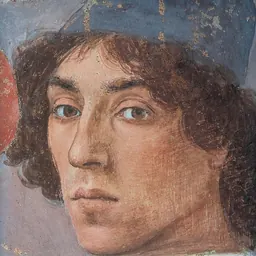
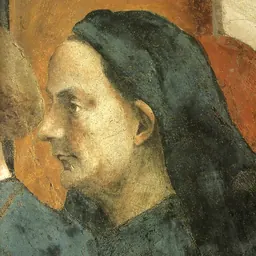
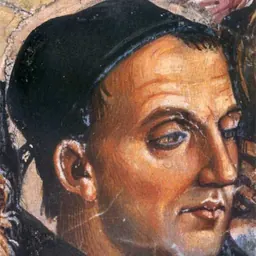

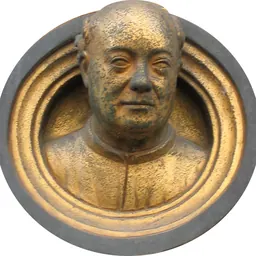
Related people
Same field, nearest in time



Contemporaries
People whose lives overlapped Leon Battista Alberti's


Frequently asked questions
Who was Leon Battista Alberti?
Italian architect and writer (1404-1472)
When was Leon Battista Alberti born?
Leon Battista Alberti was born on 14 February 1404 in Genoa.
When did Leon Battista Alberti die?
Leon Battista Alberti died on 25 April 1472 in Rome.
What was Leon Battista Alberti's occupation?
Leon Battista Alberti was a philosopher, linguist, cryptographer, poet, architect and architectural theoretician.
What nationality was Leon Battista Alberti?
Leon Battista Alberti's recorded nationality: Republic of Genoa.
Sources & further reading
· Wikipedia: Leon Battista Alberti
· DBpedia: Leon Battista Alberti
Cite this page
APA: Biography.guide. (2026). Leon Battista Alberti. https://biography.guide/leon-battista-alberti/
MLA: "Leon Battista Alberti." Biography.guide, https://biography.guide/leon-battista-alberti/.
Chicago: "Leon Battista Alberti." Biography.guide. https://biography.guide/leon-battista-alberti/.
Data last updated: 2026-09-20 · Spot an error? Report a correction.
Page generated 2026-09-27 05:09 UTC