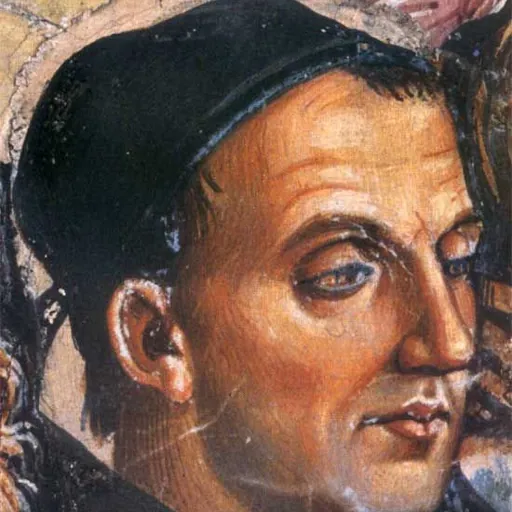
About Fra Angelico
Lived 1400 – 1455. Fra Angelico was an Italian painter, illuminator, architectural drafter, miniature painter and fresco painter.
Fra Giovanni da Fiesole (born Guido di Pietro; – 18 February 1455), known posthumously as Fra Angelico ( , ; 'Angelic Friar/Brother') or in Italian as Beato Angelico ('Blessed Angelic One'), was an Italian Dominican friar and painter active during the early Florentine Renaissance.
Angelico created a series of frescoes for the Dominican convent of San Marco in Florence, where he received the patronage of Cosimo de' Medici. His works include the San Marco Altarpiece and the Deposition of Christ, both made for the convent of San Marco. Painting exclusively religious subjects throughout his career, Angelico completed commissions in Rome under the patronage of Popes Eugene IV and Nicholas V. Angelico was a pioneer of the artistic trends that came to distinguish the early Renaissance, namely linear perspective and a greater attention to depth and form than had been practised in the late Medieval period.
Angelico was beatified by Pope John Paul II in 1982. In 1984, John Paul declared him the patron of artists, especially painters.
Biography He was known to his contemporaries as ('Friar John of Fiesole'), reflecting the town where he joined the Dominican Order, and ('Angelic Brother John'). In modern Italian, he is referred to as ('Blessed Angelic One') following his beatification by Pope John Paul II.
Early life, 1395–1436 Fra Angelico was born around 1395 in the Tuscan region of Mugello, specifically in the town of Vicchio near Fiesole. He was baptised Guido di Pietro and had a younger brother named Benedetto. The earliest known record of him is dated 17 October 1417, when he attended a religious confraternity or guild at the Church of Our Lady of Mount Carmel under the name Guido di Pietro. Payments made to Guido di Pietro in January and February 1418 for work at the church of Santo Stefano del Ponte in Florence indicate that he was already working as a painter.
By 1423, Angelico had joined the convent of San Domenico in Fiesole. Following the custom of adopting a new name upon entering a religious order, he adopted the name Fra Giovanni (Friar John). As a Dominican, he relied on alms and donations for his livelihood. Angelico initially trained as a manuscript illuminator and may have collaborated with his brother Benedetto, who also joined the Dominican Order. Some illuminated manuscripts have been attributed to him or his workshop, though these attributions remain debated. He may have been influenced by Lorenzo Monaco, though direct training is not documented, and influences from the Sienese school are evident in his work. Angelico trained with Master Varricho in Milan. According to Giorgio Vasari, Angelico's first major work was an altarpiece and a painted screen for the Charterhouse (Carthusian monastery) of Florence, though nothing remains of these today. By 1418, he had returned to Fiesole, where he painted a number of works for the monastery, including the Fiesole Altarpiece. A predella of the altarpiece depicting Christ in Glory alongside over 250 figures, including beatified Dominicans, is conserved in the National Gallery. Around 1427, Angelico produced an altarpiece depicting the Coronation of the Virgin, which remained at San Domenico until 1812 when artist and collector Vivant Denon acquired it for the Louvre. Angelico also produced a Madonna of Humility now kept in the Thyssen-Bornemisza Museum. Also completed at this time were an Annunciation and a Madonna of the Pomegranate , both of which are now in the Prado Museum.
San Marco, Florence, 1436–1445
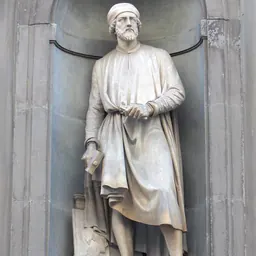
In 1436, Angelico was one of a number of friars from Fiesole who moved to the newly built convent of San Marco in Florence. This move placed him at the heart of the artistic life of the region. During these years in Florence, he was certainly in contact with the three artistic circles in the city in the early 15th century: the school of miniaturists, the workshops of the last Giottesque students (followers of Giotto), and a group of young sculptors and architects destined for great fame: Jacopo della Quercia, Lorenzo Ghiberti, Filippo Brunelleschi and Donatello.
Angelico soon attracted the patronage of Cosimo de' Medici, one of the wealthiest and most powerful members of the city's governing authority, the Signoria, and the founder of the Medici Dynasty that was to dominate Florentine politics for much of the Renaissance. Cosimo had a cell reserved for himself at the convent as a retreat from the world. Vasari reports that Cosimo commissioned Angelico to decorate the convent with frescoes, which were greatly admired at the time. They include the magnificent fresco of the chapter house, the much-reproduced Annunciation at the top of the stairs leading to the cells, the Maestà (or Coronation of the Madonna) with Saints (cell 9), and many other smaller devotional frescoes in the cells depicting stories of the Nativity and Passion of Jesus.
In 1439, Angelico completed one of his most famous and influential works: the San Marco Altarpiece. It created a new religious genre, sacra conversazione (sacred conversation), later used by artists including Giovanni Bellini, Titian, Perugino and Raphael. Although representations of the enthroned Madonna and Child surrounded by saints were common, they were depicted in a heaven-like setting, hovering as spiritual presences rather than with earthly substance. In the San Marco Altarpiece, the saints stand squarely within the space, grouped in a natural way as if conversing about their shared witness of the Virgin Mary.thumb
The Vatican, 1445–1455 In 1445, Pope Eugene IV summoned Angelico to Rome to paint the frescoes of the Chapel of the Holy Sacrament at St Peter's, later demolished by Pope Paul III. Vasari suggests that at this time Angelico was offered the Archbishopric of Florence by Pope Nicholas V, which he rejected, recommending another friar in his place. However, the story does not align with the historical facts. In 1445 the Pope was Eugene IV and Nicholas was not to be elected until two years later in March 1447. The archbishop in question during 1446–1459 was the Dominican Antoninus of Florence (Antonio Pierozzi), who was canonized by Pope Adrian VI in 1523.
In 1447, Angelico and his pupil, Benozzo Gozzoli, travelled to Orvieto to produce works for the Cathedral of the Assumption of Mary. Among his other pupils was Zanobi Strozzi.
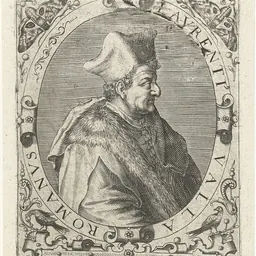
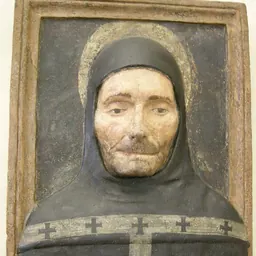
From 1447 to 1449, Angelico was again at the Vatican, designing the frescoes for the Niccoline Chapel for Nicholas V. The scenes from the lives of the two martyred deacons of the Early Christian Church, St. Stephen and St. Lawrence may have been executed wholly or in part by assistants. The small chapel, with its brightly frescoed walls and gold leaf decorations, gives the impression of a jewel box. From 1449 until 1452, Angelico returned to the convent in Fiesole, where he became Prior. Angelico was interred in a niche near the altar in a marble tomb. The tombstone is an effigy carved in relief depicting Angelico in a Dominican habit. Above the tomb are two epitaphs, probably by Lorenzo Valla. The first reads:
Pope John Paul II beatified Angelico on 3 October 1982 and in 1984 declared him patron of Catholic artists. John Paul II noted that:
He is commemorated by the current Roman Martyrology on 18 February, the date of his death in 1455. There the Latin text reads Beatus Ioannes Faesulanus, cognomento Angelicus ("Blessed John of Fiesole, known as the Angelic").
Evaluation The Day of Judgement, upper panel of an altarpiece in the convent of San Marco, Florence. (1425–1430)
Background Angelico worked during a period of significant change in European artistic style, marked by the transition from the Medieval tradition to the Early Renaissance. This shift began in the fourteenth century with artists such as Giotto and Giusto de' Menabuoi. Both Angelico and de' Menabuoi produced major works in Padua, while Giotto had earlier trained in Florence under the Gothic painter Cimabue.
Giotto's fresco cycle depicting the life of Saint Francis at the Basilica of Santa Croce represented a departure from earlier conventions through its emphasis on naturalism, spatial coherence, and emotional expression. His approach influenced a number of later painters who adopted and expanded upon his techniques, such as the brothers Pietro and Ambrogio Lorenzetti and their developments towards narrative clarity and realism. This painting incorporates the expensive pigments, gold leaf and elaborate design typical of Vatican commissions.
When Fra Angelico went to the Vatican to decorate the chapel of Pope Nicholas, he was again confronted with the need to please the very wealthiest of clients. The walls are decked with the brilliance of colour and gold that are found in the most lavish creations of the Gothic painter Simone Martini at the Lower Church of St Francis of Assisi, a hundred years earlier. Yet Angelico created designs that reveal his own preoccupation with humanity, humility, and piety. According to Vasari, "in their bearing and expression, the saints painted by Angelico come nearer to the truth than the figures done by any other artist."
Artistic legacy Through Fra Angelico's pupil Benozzo Gozzoli's portraiture and technical style in the art of fresco we see a link to Domenico Ghirlandaio, who was commissioned by the wealthy patrons of Florence, and through Ghirlandaio to his pupil Michelangelo and the High Renaissance.
When Michelangelo took up the Sistine Chapel commission, he was working within a space that had already been extensively decorated by other artists. Around the walls the Life of Christ and Life of Moses were depicted by a range of artists including his teacher Ghirlandaio, Raphael's teacher Perugino and Botticelli.
Within the cells of San Marco, Fra Angelico had demonstrated that painterly skill and the artist's personal interpretation were sufficient to create memorable works of art, without the expensive trappings of blue and gold. In the use of the unadorned fresco technique, the clear, bright colours, the careful arrangement of a few significant figures and the skillful use of expression, motion and gesture, Michelangelo showed himself to be the artistic descendant of Fra Angelico. Frederick Hartt describes Fra Angelico as "prophetic of the mysticism" of painters such as Rembrandt, El Greco and Zurbarán. Possibly Fra Angelico's only signed work. Oxford, England The Crucifixion with the Virgin, Saint John the Evangelist and the Magdalen. early 1420s. Ashmolean Museum, Oxford. Purchased from a private collection in November 2024. Cortona Annunciation, c. 1430, Diocesan Museum, Cortona Fiesole Coronation of the Virgin, altarpiece with predellas of Miracles of St Dominic, Church of San Domenico, Louvre, Paris Virgin and Child between Saints Thomas Aquinas, Barnabas, Dominic and Peter Martyr, altarpiece, San Domenico, 1424 Christ in Majesty, predella, National Gallery, London. Florence: Basilica di San Marco Dormition of the Virgin, 1431 Florence: Santa Trinita Deposition of Christ, altarpiece, National Museum of San Marco, Florence. Coronation of the Virgin, c. 1432, Uffizi, Florence Coronation of the Virgin, c. 1434–1435, Louvre, Paris Florence: Santa Maria degli Angeli Last Judgement, Accademia, Florence Florence: Santa Maria Novella Coronation of the Virgin, altarpiece, Uffizi.
San Marco, Florence, 1436–1445 Altarpiece for chancel – Virgin with Saints Cosmas and Damian, attended by Saints Dominic, Peter, Francis, Mark, John Evangelist and Stephen. Cosmas and Damian were patrons of the Medici. The altarpiece was commissioned in 1438 by Cosimo de' Medici. It was removed and disassembled during the renovation of the convent church in the seventeenth century. Two of the nine predella panels remain at the convent; seven are in Washington, Munich, Dublin and Paris. Two missing side panels depicting Dominican saints were found in the 2000s.
Altarpiece? – Madonna and Child with Twelve Angels (life sized); Uffizi. Altarpiece – The Annunciation San Marco Altarpiece Two versions of the Crucifixion with St Dominic; in the Cloister Very large Crucifixion with Virgin and 20 Saints; in the Chapter House The Annunciation; at the top of the Dormitory stairs. This is probably the most reproduced of all Fra Angelico's paintings. Virgin Enthroned with Four Saints; in the Dormitory passage
In The Annunciation, the interior reproduces that of the cell in which it is located. Each cell is decorated with a fresco which matches in size and shape the single round-headed window beside it. The frescoes are apparently for contemplative purposes. Many of Fra Angelico's finest and most reproduced works are among them. There are, particularly in the inner row of cells, some of the less inspiring quality and of the more repetitive subject, perhaps completed by assistants. During Napoleon's Italian campaigns, they were dispersed, with the whereabouts of two remaining unknown for centuries. Around 2005, those two were discovered in Oxford in the home of Jean Preston, a curator of medieval manuscripts at the Huntington Library and Princeton University Library. Preston and her amateur collector father, Kerrison Preston, had purchased them in California in 1965 for around $200–400 Michael Liversidge, a former dean of art history at the University of Bristol, evaluated the panels at Preston's house, describing them as a "once in a lifetime" find. After her death in 2006, the collection in her estate was auctioned off by Duke's, an auction house in Dorset. In April 2007, Florentine antiquarian Fabrizio Moretti
Don’t just read it —
keep it.
Full-length biographies made to live with: read them, listen on the way to work, watch them tonight.
- E-book
- Audio
- Video
Instant download · yours to keep · every purchase keeps this site free
Important facts
more
Fra Giovanni Angelico da Fiesole, Fra Giovanni Da Fiesole Angelico, Fra Giovanni, da Fiesole Angelico, da Fiesole Giovanni, Guido di Piero da Mugello Angelico, di Piero Guido, Guido da Vicchio, Guido di Piero, fra Angelico, Giovanni Angelico, Beato Angelico da Fiesole, Angelico (fra), Beato (Fra), Giovanni (Fra), Giovanni Angelico da Fiesole (Fra), Guido di Pietro da Mugello, Guidolino di Pietro da Mugello, Fra Angelico da Fiesole, Beata Da Fiesole, Beata Angelica da Fiesole, B. Angelico, Beato Giovanni, B. Gio. Angelo da Fiesole, fra angelico. fiesole, Fiesole, Beato Gio: Angelico da Fiesole, Da Fiesolé, B. Angelico da Fiesole, Da Fiesole, Fra Giovanni da Fiesole gen. Fra Angelico, beato fra Angelico, Beato Gio: Angelico, Beato Gio. Angelo di Fiesole, don Giovanni Angelico, Beato Giov. Angelico, Beato Gio. Angelo da Fiesole, fra Giovanni da Fiesole domenicano, beato Giovanni Angelico domenicano, called Il Beato Angelico Fra. Giovanni da Fiesole, florentino Beato Juan, angelic masterPeople in Fra Angelico's life
Named in this biography and alive at the same time


Related people
Same field, nearest in time
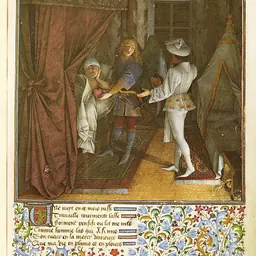

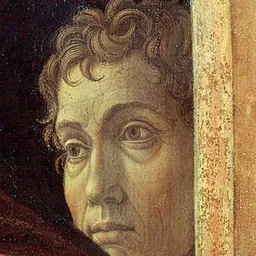
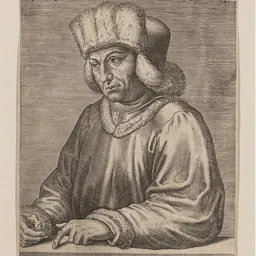
Contemporaries
People whose lives overlapped Fra Angelico's


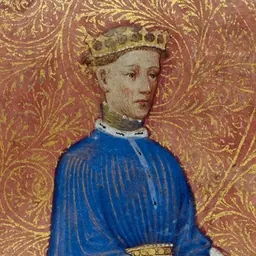

Frequently asked questions
Who was Fra Angelico?
Italian Early Renaissance painter
When was Fra Angelico born?
Fra Angelico was born in 1400 in Vicchio.
When did Fra Angelico die?
Fra Angelico died on 18 February 1455 in Florence, Rome.
What was Fra Angelico's occupation?
Fra Angelico was a painter, illuminator, architectural drafter, miniature painter and fresco painter.
What nationality was Fra Angelico?
Fra Angelico was Italian.
Sources & further reading
Cite this page
APA: Biography.guide. (2026). Fra Angelico. https://biography.guide/fra-angelico/
MLA: "Fra Angelico." Biography.guide, https://biography.guide/fra-angelico/.
Chicago: "Fra Angelico." Biography.guide. https://biography.guide/fra-angelico/.
Data last updated: 2026-09-20 · Spot an error? Report a correction.
Portrait: Wikimedia Commons · author & licence
Page generated 2026-09-27 05:14 UTC