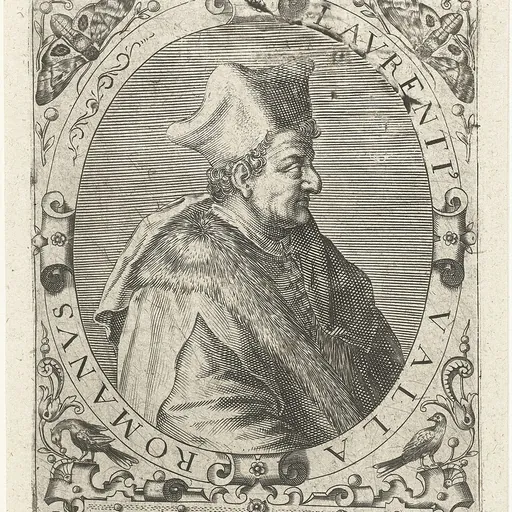
About Lorenzo Valla
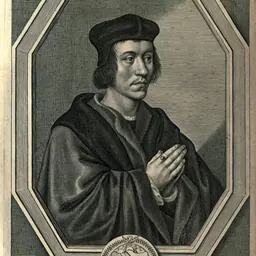
Lived 1407 – 1457 (aged 49–50). Lorenzo Valla was a writer, philologist, university teacher, philosopher, latin Catholic priest and renaissance humanist.
Lorenzo Valla (; also latinized as Laurentius; 1 August 1457) was an Italian Renaissance humanist scholar, rhetorician, educator, and Catholic priest. He is best known for his historical-critical textual analysis that proved that the Donation of Constantine was a forgery, therefore impugning and undermining the presumption of temporal power claimed by the papacy.
Life Valla was born in Rome, with a family background of Piacenza; his father, Luciave della Valla, was a lawyer who worked in the Papal Curia. He was educated in Rome, attending the classes of teachers including Leonardo Bruni and Giovanni Aurispa, from whom he learned Latin and Greek. He is thought otherwise to have been largely self-taught.
Bruni was a papal secretary; Melchior Scrivani, Valla's uncle, was another. But Valla had caused offence, to Antonio Loschi, by championing the rhetorician Quintilian in an early work. In 1431, Valla was ordained as a priest; the same year he tried in vain to secure a position as apostolic secretary to China. He was unsuccessful, despite his network of contacts. He became a papal scribe and, in 1455, a papal secretary. Today, there is a memorial to Valla in the Lateran. Kock highlights Valla's book, De voluptate for its Epicurean take on persuasion: not the stringent logic of the Medieval scholastics, but rather taking pleasure at the thought of the course which, according to the rhetor in question, should be taken, is what distinguishes rhetorical persuasion. In addition, Kock notes a similarity between Valla's thoughts on the common sense and practical rhetorical language with 20th century ordinary language philosophy.
Works On the Donation of Constantine Between 1439 and 1440, Valla wrote the essay, De falso credita et ementita Constantini Donatione declamatio, which analyzed the document usually known as the Donation of Constantine. The Donation suggests that Constantine I gave the whole of the Western Roman Empire to the Roman Catholic Church. This was supposedly an act of gratitude for having been miraculously cured of leprosy by Pope Sylvester I.
From 1435 to 1445, Valla was employed in the court of Alfonso V of Aragon, who became involved in a territorial conflict with the Papal States, then under Pope Eugene IV. This relationship possibly motivated his work; in any case, he was put on trial before the Catholic Inquisition in 1444, but was protected from imprisonment by the intervention of Alfonso V. In addition, Valla believed that the quality of Latin for such a supposedly important text was undeniably poor, evidencing this by the fact that the text constantly switched tenses from "we have proclaimed" to "we decree", for instance.
Textual criticism
A specialist in Latin translation, Valla made numerous suggestions for improving on Petrarch's study of Livy. The emendation of Livy was also a topic discussed in book IV of his Antidotum in Facium, an invective against Bartolomeo Facio. In this part of the treatise, which also circulated independently under the title Emendationes in T. Livium, Valla elucidates numerous corrupt passages and criticises the attempts at emendation made by Panormita and Facio, his rivals at the court of Alfonso V.
In his critical study of the official Bible used by the Roman Catholic Church, Jerome's Latin Vulgate, Valla called into question the church's system of penance and indulgences. He argued that the practice of penance rested on Jerome's use of the Latin word paenitentia (penance) for the Greek metanoia, which he believed would have been more accurately translated as "repentance". Valla's work was praised by later critics of the Church's penance and indulgence system, including Erasmus.
Manuscript works Valla made a contemporary reputation with two works: his dialogue De Voluptate and his treatise De Elegantiis Latinae Linguae. Richard Claverhouse Jebb said that his De Elegantiis "marked the highest level that had yet been reached in the critical study of Latin". Initial dateInitial titleScopeVersions, comments1431De Voluptate "On Pleasure". In this work he contrasted the principles of the Stoics unfavourably with the tenets of Epicurus, showing sympathy for the natural appetites.Version of 1433 as De vero bono (On the true good). He also concluded that Valla had reintroduced to the Latin West a type of argument that had fallen into disuse. 1440De falso credita et ementita Constantini Donatione declamatio On the Donation of Constantine.In the Opera Omnia (Basle) as Contra Donationis, quae Constantini dicitur, privilegia, ut falso creditum declamatio. De libero arbitrio.On Free WillContains an attack on book V of The Consolation of Philosophy. 1449 An early work Collation Novi Testamenti (1447). Revised in the 1450s.
Printed editions Collected editions of Valla's works, not quite complete, were published at Basel in 1540 and at Venice in 1592, and Elegantiae linguae Latinae was reprinted nearly sixty times between 1471 and 1536.
Opera omnia, Basel 1540; reprinted with a second volume (Turin: Bottega d'Erasmo, 1962). Repastinatio dialectice et philosophie, ed. G. Zippel, 2 vols. (First critical edition of the three versions: Padua: Antenore, 1982). Elegantiae linguae Latinae, Venice 1471, edited by S. López Moreda (Cáceres: Universidad de Extremadura, 1999). De vero falsoque bono, edited by M. de Panizza Lorch, Bari, 1970. Collatio Novi Testamenti, edited by A. Perosa (Florence: Sansoni, 1970). De falso credita et ementita Constantini donatione, ed. W. Setz (Weimar: Hermann Böhlaus Nachfolger, 1976; reprinted Leipzig: Teubner, 1994). Ars Grammatica, ed. P. Casciano with Italian translation (Milan: Mondadori, Fondazione Lorenzo Valla, 1990). On the Donation of Constantine. The I Tatti Renaissance Library (Cambridge, Massachusetts: Harvard University Press, 2007). Dialectical Disputations. The I Tatti Renaissance Library (Cambridge: Harvard University Press, London, 2012). Correspondence, ed. Cook, Brendan. The I Tatti Renaissance Library (Cambridge, Massachusetts: Harvard University Press, 2013).
English translations On the donation of Constantine translated by G. W. Bowersock, Cambridge, Massachusetts: Harvard University Press, 2008. Dialogue on Free Will, translated by C. Trinkaus. In: 'The Renaissance Philosophy of Man', edited by Ernst Cassirer et al., Chicago: University of Chicago Press, 1948. The profession of the religious and selections from The falsely-believed and forged donation of Constantine translated, and with an introduction and notes, by Olga Zorzi Pugliese, Toronto: Centre for Reformation and Renaissance Studies, 1998. De vero falsoque bono translated by A. K. Hieatt and M. Lorch, New York: Abaris Books 1977. In Praise of Saint Thomas Aquinas, translated by M. E. Hanley. In Renaissance Philosophy, ed. L. A. Kennedy, Mouton: The Hague, 1973. Dialectical Disputations, Latin text and English translation of the Repastinatio by B. P. Copenhaver and L. Nauta, Harvard University Press, 2012 (I Tatti Renaissance Library, two volumes).
Don’t just read it —
keep it.
Full-length biographies made to live with: read them, listen on the way to work, watch them tonight.
- E-book
- Audio
- Video
Instant download · yours to keep · every purchase keeps this site free
Important facts
People in Lorenzo Valla's life
Named in this biography and alive at the same time



Related people
Same field, nearest in time


Contemporaries
People whose lives overlapped Lorenzo Valla's


Frequently asked questions
Who was Lorenzo Valla?
Italian Renaissance humanist (c. 1407–1457)
When was Lorenzo Valla born?
Lorenzo Valla was born in 1407 in Rome.
When did Lorenzo Valla die?
Lorenzo Valla died on 1 August 1457 in Rome.
What was Lorenzo Valla's occupation?
Lorenzo Valla was a writer, philologist, university teacher, philosopher, latin Catholic priest and renaissance humanist.
Sources & further reading
Cite this page
APA: Biography.guide. (2026). Lorenzo Valla. https://biography.guide/lorenzo-valla/
MLA: "Lorenzo Valla." Biography.guide, https://biography.guide/lorenzo-valla/.
Chicago: "Lorenzo Valla." Biography.guide. https://biography.guide/lorenzo-valla/.
Data last updated: 2026-09-20 · Spot an error? Report a correction.
Page generated 2026-09-27 05:10 UTC