
About Leo I
Lived 401 – 474 (aged 72–73). Leo I was a Byzantine politician and military personnel.
Leo I (; 401 – 18 January 474), also known as the Thracian (; ), (Despite the regular use of the nickname Thrax by modern sources, this was not used by contemporary writers.) Ancient sources rather call him the Butcher (; ), referencing the murder of Aspar and his son. He is commemorated as a saint in the Eastern Orthodox Church, with his feast day on 20 January.
Early life
He was born in Thracia or in Dacia Aureliana province in the year 401 to a Thraco-Roman family. His Dacian origin is mentioned by Candidus Isaurus, while John Malalas believes that he was of Bessian Thracian stock.
According to the Patria of Constantinople he had one sister, Euphemia, who never married; Leo is said to have visited her in Constantinople on a weekly basis, and she later erected a statue in his honor. The late and not particularly reliable source for Euphemia leaves her existence open to doubt.
Leo served in the Roman army, rising to the rank of comes rei militaris.
Reign He was the last of a series of emperors placed on the throne by Aspar, the Alan serving as commander-in-chief of the army, who thought Leo would be an easy puppet ruler. Instead, Leo became more and more independent from Aspar, causing tension that would culminate in Aspar's assassination. he went to Hagia Sophia and deposited his crown at the altar. As he left the church, the Patriarch of Constantinople placed the crown back on his head, a fact which symbolized the transformation of Roman imperial traditions into Medieval Roman and Christian ones. This Christian coronation ritual was later imitated by courts all over Europe.
His coronation adventus gave a key role to Aspar, who rode with Leo in his chariot during the procession in Constantinople and offered him a golden crown when they arrived at the Forum of Constantine.
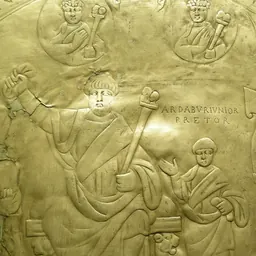
Leo I made an alliance with the Isaurians and was thus able to eliminate Aspar. The price of the alliance was the marriage of Leo's daughter to Tarasicodissa, leader of the Isaurians, who, as Zeno, became emperor in 474. and very nearly succeeded. Finally, in 471, Aspar's son Ardabur was implicated in a plot against Leo but was killed by palace eunuchs acting on Leo's orders.
Leo sometimes overestimated his abilities and made mistakes that threatened the internal order of the Empire. The Balkans were ravaged by the Ostrogoths, after a disagreement between the Emperor and the young chief Theodoric the Great, who had been raised at Leo's court in Constantinople, where he was steeped in Roman government and military tactics. There were also some raids by the Huns. However, none of these attackers had the siege engines necessary to capture Constantinople, whose walls had been rebuilt and reinforced in the reign of Theodosius II.
Leo's reign was also noteworthy for his influence in the Western Roman Empire, marked by his appointment of Anthemius as Western Roman emperor in 467. He attempted to build on this political achievement with an expedition against the Vandals in 468. 1,113 ships carrying 100,000 men participated in the expedition, which ended in defeat because of bad leadership from Leo's brother-in-law Basiliscus.
Leo died of dysentery at the age of 73 on 18 January 474.
Marriage and children Probable portrait head of Ariadne on an antique but unrelated bust, Museo della Basilica di S. Giovanni in Laterano Leo and Verina had three children. Their eldest daughter Ariadne was born prior to the death of Marcian (reigned 450–457). Ariadne had a younger sister, Leontia. Leontia was first betrothed to Patricius, a son of Aspar, but their engagement was probably annulled when Aspar and another of his sons, Ardabur, were assassinated in 471. Leontia then married Marcian, a son of Emperor Anthemius and Marcia Euphemia. The couple led a failed revolt against Zeno in 478–479. They were exiled to Isauria following their defeat. This predecessor was probably Leo I, the tale attributing a third daughter to Leo. Cyril Toumanoff identified two children of this marriage: Mithridates of Iberia; and Leo of Iberia. This younger Leo was father of Guaram I of Iberia. The accuracy of the descent is unknown.
Don’t just read it —
keep it.
Full-length biographies made to live with: read them, listen on the way to work, watch them tonight.
- E-book
- Audio
- Video
Instant download · yours to keep · every purchase keeps this site free
Important facts
Family & relationships
People in Leo I's life
Named in this biography and alive at the same time


Related people
Same field, nearest in time


Contemporaries
People whose lives overlapped Leo I's




Frequently asked questions
Who was Leo I?
Eastern Roman emperor from 457 to 474
When was Leo I born?
Leo I was born in 401 in Dacia, Thrace.
When did Leo I die?
Leo I died on 19 January 474 in Constantinople.
What was Leo I's occupation?
Leo I was a politician and military personnel.
What nationality was Leo I?
Leo I was Byzantine.
Sources & further reading
Cite this page
APA: Biography.guide. (2026). Leo I. https://biography.guide/leo-i/
MLA: "Leo I." Biography.guide, https://biography.guide/leo-i/.
Chicago: "Leo I." Biography.guide. https://biography.guide/leo-i/.
Data last updated: 2026-09-20 · Spot an error? Report a correction.
Page generated 2026-09-27 05:23 UTC