About Anthemius
Lived 400 – 500. Anthemius was a Roman politician, diplomat, statesperson and military personnel.
Anthemius (Greek: Άνθέμιος, 400–414) was a statesman of the Later Roman Empire. He is notable as a praetorian prefect of the East in the later reign of Arcadius and the first years of Theodosius II, during which time he led the government of the Eastern Roman Empire on behalf of the child emperor and supervised the construction of the first set of the Theodosian Walls.
Biography
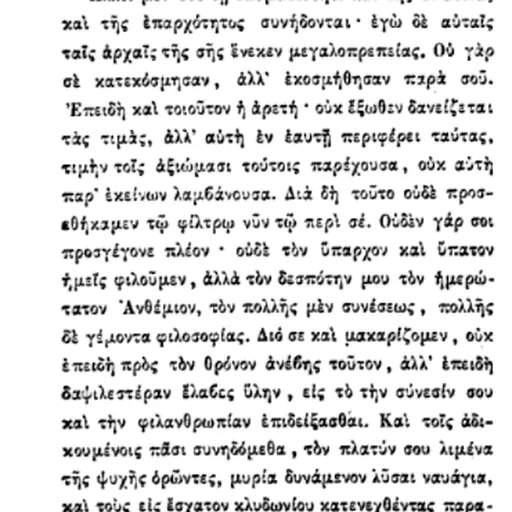
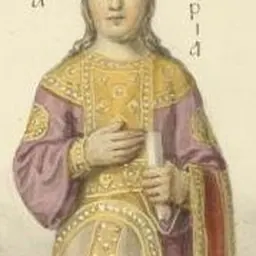
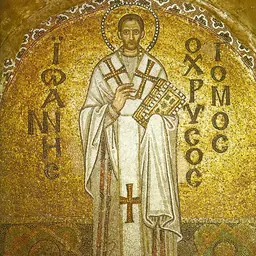
Early life Anthemius was the grandson of Flavius Philippus, praetorian prefect of the East in 346. He rose to prominence during the reign of Arcadius, when he was appointed comes sacrarum largitionum ("Count of the Sacred Largesses") around or in 400 and later magister officiorum ("Master of the Offices") in 404. He occupied the latter position during the disturbances which followed John Chrysostom's final deposition from the patriarchate (Easter, 404). John's enemies demanded troops from him with which to disperse the crowd. At first he refused, but then yielded, declaring that they were responsible for the consequences.
Rise to power In 405 he was appointed consul for the Eastern Roman Empire (with Stilicho as a colleague for the Western Empire). After the death of the Augusta Eudoxia he succeeded Eutychianus in the same year as praetorian prefect of the East, becoming thus the second most powerful man in the Eastern Empire after the Emperor himself. On April 28, 406, he was elevated to the rank of patricius. The esteem in which he was held by some can be seen from Chrysostom's letter of congratulations to him on his appointment to the praetorian prefecture, saying that "the office was more honoured by his tenure than he by the office". During the remaining years of Arcadius' reign he tried to maintain the autonomy and integrity of the Eastern Empire despite continuous challenges. According to some Eastern sources antagonistic to Stilicho, the Western general desired to take over the prefecture of Illyricum from the East. At the same time, Anthemius had to deal with the presence of Alaric I and his Gothic people in the Illyricum, and the continued insurgency of the Isaurians, who were devastating the southern provinces of Asia Minor. Furthermore, the court led by Anthemius passed a number of new laws against paganism, Judaism and heresy.
When Arcadius died in 408, his son and successor Theodosius II was a child of seven years. Anthemius assumed leadership, with an unusual longevity as praetorian prefect. He initiated a new peace treaty with Sassanid Persia, and, thanks also to Stilicho's death, was able to contribute in restoring harmony in the relations of the Imperial courts of Constantinople and Ravenna. He strengthened the fleet of the Danube, which protected the provinces of Moesia and Scythia, after the successful repulsion of an invasion in 409 by the Hunnic king Uldin. He also took measures to ensure the regular collection of taxes (409), but in 414, he also gave a tax remit of all arrears for the years 368–407.
Theodosian Walls The one work of Anthemius' that is still standing today is the main wall of the Theodosian Walls. In the early 5th century, Constantinople had begun to outgrow the bounds set by Constantine the Great, and so Anthemius initiated the construction of a new wall, about 1,500 m westwards from the old one, which stretched for 6.5 kilometers between the Sea of Marmara and the suburb of Blachernae near the Golden Horn. The extended new wall was completed in 413 and almost doubled the size of the city, a feat for which Bury later called him "in a sense, the second founder of Constantinople".
In 414, Anthemius suddenly disappeared from the scene, while the prefecture was assumed by Monaxius. His fate remains unknown; some historians postulate he was dismissed by Augusta Pulcheria, while other scholars argue he retired or died of old age. After his departure, his descendants still retained political power. Through his daughter's marriage to magister militum Procopius, he became maternal grandfather to the later Western Emperor Anthemius. He was also the father of Anthemius Isidorus, praetorian prefect of the East in 435-436 and Eastern Consul in 436. According to a legendary saint's life, he had a daughter named Apolinaria who lived as a monk.
Footnotes
Don’t just read it —
keep it.
Full-length biographies made to live with: read them, listen on the way to work, watch them tonight.
- E-book
- Audio
- Video
Instant download · yours to keep · every purchase keeps this site free
Important facts
People in Anthemius's life
Named in this biography and alive at the same time



Related people
Same field, nearest in time

Contemporaries
People whose lives overlapped Anthemius's



Frequently asked questions
Who was Anthemius?
Pretorian Prefect of the East
When was Anthemius born?
Anthemius was born in 400 in Diocese of Egypt.
When did Anthemius die?
Anthemius died in 500.
What was Anthemius's occupation?
Anthemius was a politician, diplomat, statesperson and military personnel.
What nationality was Anthemius?
Anthemius was Roman.
Sources & further reading
· DBpedia: Anthemius (praetorian prefect)
Cite this page
APA: Biography.guide. (2026). Anthemius. https://biography.guide/anthemius/
MLA: "Anthemius." Biography.guide, https://biography.guide/anthemius/.
Chicago: "Anthemius." Biography.guide. https://biography.guide/anthemius/.
Data last updated: 2026-09-22 · Spot an error? Report a correction.
Portrait: Wikimedia Commons · author & licence
Page generated 2026-09-27 05:01 UTC