
About Nilus of Sinai
Lived 365 – 430 (aged 64–65). Nilus of Sinai was a monk, beamter and writer.
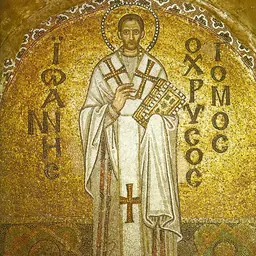
Life A native of Constantinople, Nilus was a layman, married, with two children. As a relatively young man, he was appointed eparch of the city. He was a disciple of the patriarch, John Chrysostom (before his first exile: 398–403). He directed Nilus in the study of Scripture and in works of piety.
Nilus and his son were at Sinai until about the year 410 when Saracen raiders captured Theodulos and took him prisoner. They eventually sold him as a slave, and he came into the possession of the Bishop of Elusa in Palestine. The Bishop received Theodulos among his clergy and made him door-keeper of the church. Meanwhile, Nilus, having left to find his son, at last met him at Elusa. The bishop then ordained them both priests and allowed them to return to Sinai. For forty years a cave served as their dwelling. Nilus was a well known person throughout the Eastern Church; through his writings and correspondence he played an important part in the history of his time. He was known as a theologian, Biblical scholar and ascetic writer, and people of all kinds, from the emperor down, sought his counsel. or 451. His remains were brought to Constantinople in the reign of Justin the Younger, and deposited in the church of the apostles there. His works can be classified into four types:
Works about virtues and vices in general:"Of the vice opposed to virtues "On the word of the Gospel of Luke". In his treatise "On Prayer", he recommends one ask of God, in the first place, the gift of prayer. "Works about the monastic life": — Concerning the slaughter of monks on Mount Sinai, in seven parts, telling the story of the author's life at Sinai, the invasion of the Saracens, captivity of his son, etc.; Concerning Albianos, a Nitrian monk whose life is held up as an example; "Of Asceticism" (Logos asketikos, about the monastic ideal; "Of voluntary poverty" (peri aktemosynes; "Of the superiority of monks"; "To Eulogios the monk". "Admonitions" (Gnomai) or "Chapters" (kephalaia), about 200 precepts drawn up in short maxims (ib., 1239–62). These are probably made by his disciples from his discourses. "Letters": — Possinus published 355, Allatius 1061 letters, divided into four books (P. G., 79, 81-585). Many are not complete, several overlap, or are not really letters but excerpts from Nilus' works; some are spurious. Apocalyptic in nature, it has been variously interpreted depending on individual perspectives. With the advent of the Internet, the work has taken on the status of urban legend, widely wrongly imputed to Nilas of Sinai.
Don’t just read it —
keep it.
Full-length biographies made to live with: read them, listen on the way to work, watch them tonight.
- E-book
- Audio
- Video
Instant download · yours to keep · every purchase keeps this site free
Important facts
People in Nilus of Sinai's life
Named in this biography and alive at the same time
Related people
Same field, nearest in time


Contemporaries
People whose lives overlapped Nilus of Sinai's


Frequently asked questions
Who was Nilus of Sinai?
Egyptian saint
When was Nilus of Sinai born?
Nilus of Sinai was born in 365 in Ankara.
When did Nilus of Sinai die?
Nilus of Sinai died on 12 November 430 in Mount Sinai.
What was Nilus of Sinai's occupation?
Nilus of Sinai was a monk, beamter and writer.
What nationality was Nilus of Sinai?
Nilus of Sinai's recorded nationality: Bithynia et Pontus.
Sources & further reading
Cite this page
APA: Biography.guide. (2026). Nilus of Sinai. https://biography.guide/nilus-of-sinai/
MLA: "Nilus of Sinai." Biography.guide, https://biography.guide/nilus-of-sinai/.
Chicago: "Nilus of Sinai." Biography.guide. https://biography.guide/nilus-of-sinai/.
Data last updated: 2026-09-20 · Spot an error? Report a correction.
Page generated 2026-09-27 05:19 UTC