
About Lancelot de Mole
Lived 1880 – 1950 (aged 70). Lancelot de Mole was an Australian inventor, known for Tank.
Lancelot Eldin "Lance" de Mole (13 March 1880 – 6 May 1950) was an Australian engineer and inventor.
He made several approaches to the British authorities, in 1912, 1914, and 1916, with plans for a vehicle driven by a type of caterpillar track, believing that it could have a military application. It was ahead of its time because in 1912 the need for such a military device had not yet arisen. To further complicate matters, his correspondence was set aside due to various bureaucratic blunders, and was not given to the appropriate officers.
In 1919, three years after the first military tanks had been built and used in warfare during World War I, a Royal Commission acknowledged the potential of de Mole's innovative vehicle. The commission noted the unfortunate consequences of his submissions being overlooked, and that while his designs had no influence on the actual development of the tank, tanks might have been developed much earlier if his idea had been properly investigated.
Family and early life The de Mole family at tea, c.1896s: left to right: Florence, Mrs. de Mole, Clive, Gladys, Lance, Winifred, and Mr. de Mole, foreground.
The eldest of the five children of William Frederick de Mole (1852–1939), an architect and surveyor, and Emily de Mole (1858–1941), née Moulden, Lancelot Eldin de Mole was born in Willunga, South Australia, on 13 March 1880.
His family moved to Victoria when he was seven years old, and he was educated at the Melbourne Church of England Grammar School until 1891, and then at the Berwick Grammar School. After leaving school he trained as an engineering draftsman.
He had three sisters and one brother: Florence Louise de Mole (1881–1966) (later Mrs. Feldtmann), Winifred Emily de Mole (1886–1903), Clive Moulden de Mole (1886–1934), and Gladys Rose de Mole (1887–1979). Clive de Mole enlisted in the First Australian Imperial Force on 9 September 1914. He was wounded in action in the Dardanelles on 28 June 1915, receiving a gunshot wound and a fracture to his left arm, and was invalided back to Australia in March 1916. He was promoted to Second Lieutenant on 1 January 1919, and to Lieutenant on 1 April 1919. He was discharged from the AIF in the U.K. in September 1919.
Lancelot de Mole married Harriet Josephine Walter (1890–1957) on 21 July 1915.
Pioneering design for a tracked fighting vehicle
In 1911, while he was working as a surveyor in Western Australia, travelling through rough terrain inspired de Mole to work on ideas for tracked vehicles. These included a tracked armoured fighting vehicle ("chain-rail vehicle which could be easily steered and carry heavy loads over rough ground and trenches"), which he submitted to the British War Office in 1912. In June 1913, he received a reply that his idea had been rejected.
Military service
Following the outbreak of World War I, de Mole volunteered for overseas service with the Australian Imperial Force (AIF). For three years he was rejected as medically unfit was finally accepted for active service on 26 September 1917. He was assigned to the 10th Battalion, in France. He was with the battalion in April 1918, during the Battle of Hazebrouck, but spent the last few months of the war in hospital after contracting influenza.
Royal Commission on Awards to Inventors de Mole wrote to the British Munitions Inventions Department on 19 June 1919 seeking remuneration for the expenses he had incurred in submitting his invention to the Department for use during the war.
His inventions were among those assessed in 1919 by the British Royal Commission on Awards to Inventors, conducted by Mr Justice Sargant, investigated the claims of twelve persons (10 individuals, including de Mole, and one pair) relating to the invention of tanks, delivered its findings and recommendations on 27 November 1919.
The commission's Report announced that "in estimating the value of the invention of the Tanks for the purpose of [our] recommendations, we have taken into account not merely the precise class of Tanks which went into action at the Battle of the Somme, but also any modified or improved classes of Tanks which may fairly be considered to result from the normal development of the inherent potentialities of the original invention". Notwithstanding this, however, the Report continued, "we have not taken into account any special or exceptional inventions which may subsequently have been applied and have resulted in substantial extra utility". and Lieutenant Robert Francis Macfie were each awarded £500 for the separate and independent "conception, embodiment, and communication of the same set of ideas". Commodore M.F. Sueter, Major Thomas Gerard Hetherington — the separate claims of Boothby, Sueter, and Hetherington were rejected on the grounds that the important services that they had rendered came within the scope of their military employment on the basis that they had "worked loyally and very hard" at their allotted tasks, they had been well-paid as consulting engineers, and had neither invented nor discovered any of the special features that were ultimately incorporated in the tanks.
Later life and honours He was made an honorary corporal in 1919; and, early in 1920, it was announced from London that he had been appointed a Commander of the Most Excellent Order of the British Empire (CBE). At the formal investiture of the award, on 28 July 1921, in the ballroom of the New South Wales' State Government House, Lord Forster, the seventh Governor-General of Australia, was so nervous that he dropped the decoration before it could be pinned on de Mole's chest.
de Mole also made his case for financial compensation to the Australian government. Inquiries from that government to the British one yielded little but polite responses that de Mole's ideas had unfortunately been too advanced for their time and thus were not recognized as they should have been.
After the war de Mole became an engineer in the design branch of the Sydney Water Board.
He died at Liverpool, New South Wales, on 6 May 1950.
A model of the fighting vehicle he proposed in 1912 is displayed at the Australian War Memorial, Canberra.
Patents
Applications for Australian patents 1902: Australasian Mining Patents: Oylndrical ore concentrator, West Australia, February 7. No.3723 — L. E. de Mole, Kalgoorlie, W.A. 1902: Australasian Mining Patents: Concentrator — L. E. de Mole, Brighton, Victoria: A cylindrical ore concentrator. Victoria, May 14, No.19,079. 1902: Inventions and Patents: An improved method of and apparatus for automatically operating telephone exchanges (provisional); No.7898; application made week ending 30 August 1902.
US patents US patent no.1,408,569, (held by Lancelot Eldin de Mole), dated 7 March 1922 (filed 4 March 1920), for a "Road Vehicle". US patent no.1,448,056, (held by Lancelot Eldin de Mole), dated 13 March 1923 (filed 17 July 1920), for a "Differential or Balance Gear". US patent no.1,737,573, (held by Lancelot Eldin de Mole), dated 3 December 1929 (filed 14 March 1925), for a "Changing Sign and Display Apparatus".
Don’t just read it —
keep it.
Full-length biographies made to live with: read them, listen on the way to work, watch them tonight.
- E-book
- Audio
- Video
Instant download · yours to keep · every purchase keeps this site free
Important facts
People in Lancelot de Mole's life
Named in this biography and alive at the same time

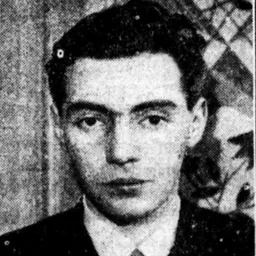

Related people
Same field, nearest in time


Contemporaries
People whose lives overlapped Lancelot de Mole's




Frequently asked questions
Who was Lancelot de Mole?
Engineer and inventor (1880-1950)
When was Lancelot de Mole born?
Lancelot de Mole was born on 13 March 1880 in Adelaide.
When did Lancelot de Mole die?
Lancelot de Mole died on 6 May 1950 in City of Liverpool.
What was Lancelot de Mole's occupation?
Lancelot de Mole was an inventor.
What was Lancelot de Mole known for?
Lancelot de Mole was known for Tank.
What nationality was Lancelot de Mole?
Lancelot de Mole was Australian.
Sources & further reading
Cite this page
APA: Biography.guide. (2026). Lancelot de Mole. https://biography.guide/lancelot-de-mole/
MLA: "Lancelot de Mole." Biography.guide, https://biography.guide/lancelot-de-mole/.
Chicago: "Lancelot de Mole." Biography.guide. https://biography.guide/lancelot-de-mole/.
Data last updated: 2026-09-22 · Spot an error? Report a correction.
Page generated 2026-09-27 05:23 UTC