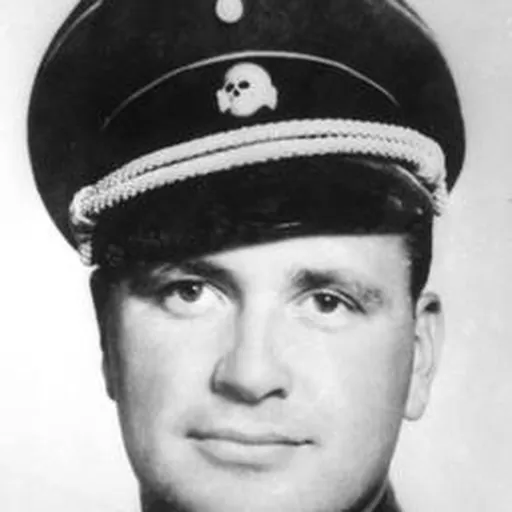
Kurt Franz
SS officer, third commandant of Treblinka extermination camp
About Kurt Franz
Lived 1914 – 1998 (aged 84). Kurt Franz was a German cook and concentration camp guard.
Early career Kurt Franz was born in 1914 in Düsseldorf. He attended public school in Düsseldorf from 1920 to 1928, and then worked as a messenger and as a cook. Franz's father, a merchant, died early. His mother was an observant Catholic. When she remarried, it was to a man with a strong right-wing nationalist outlook. Franz joined several right-wing national groups and served in the voluntary labor corps. He also trained with a master butcher for one year.
Franz joined the Nazi Party in 1932, and was conscripted into the German Army in 1935. After performing the military service in October 1937, he joined the SS-Totenkopfverbände (SS-TV). First he received training with the Third Death Head Regiment Thuringia at Weimar, and then served as cook and guard at the Buchenwald concentration camp, where he attained the rank of Unterscharführer (corporal). In late 1941, he was assigned as cook at T4 headquarters.
On 20 April 1942, Franz was promoted to Oberscharführer (staff sergeant). In spring of 1942, Franz, along with other veterans of Action T4, went to Lublin concentration camp complex in the Generalgouvernement, and was posted to the Bełżec extermination camp, where he stayed until the end of August 1942.
In the testimony (27 February 1946) of one Samuel Rajzman at the major war crimes trial held in Nuremberg, Franz was "the commander of the camp" and orchestrated the building of the railway station at Treblinka. Rajzman said, "When the persons descended from the trains, they really had the impression that they were at a very good station from where they could go to Suwalki, Vienna, Grodno, or other cities." Rajzman also stated that Franz was responsible for the death of renowned psychologist Sigmund Freud's sister.
At first, Kurt Franz supervised work commandos, the unloading of transports, and the transfer of Jews from the undressing rooms to the gas chambers. Facts prove otherwise. Despite visible damage to the camp during the revolt, the gas chambers were left intact and the killing of Polish Jews under Kurt Franz continued, albeit at a reduced speed with only ten boxcars "processed" at a time until the last transport of victims arrived on 19 August with 7,600 survivors of the Białystok Ghetto Uprising. Franz followed Odilo Globocnik to Trieste in November 1943.
Barry the dog
Franz was known for being unusually cruel and sadistic. He often made his rounds of the camp riding a horse, and would take his St. Bernard dog, Barry, along with him. Barry was trained to follow Franz's command, which was usually to bite the genitalia or buttocks of prisoners.
The Treblinka song As reported by lower-ranking SS officers and soldiers, Kurt Franz also wrote the lyrics to a song which celebrated the Treblinka extermination camp. Prisoner Walter Hirsch wrote them for him.
Further torment of prisoners Kurt Franz reviewed the prisoner roll call and participated in meting out punishments. For instance, when seven prisoners attempted to escape the camp, Franz had them taken to the Lazarett and shot. He ordered a roll call and announced that if there were further attempted escapes, and especially if they were successful, ten prisoners would be shot for every escapee.
Franz enjoyed shooting at prisoners or those still in the rail cars with his pistol or a hunting rifle. He frequently selected bearded men from the newly arriving transports and asked them whether they believed in God. When the men replied "yes", Franz told each man to hold up a bottle as a target. He would then say to them, "If your God indeed exists, then I will hit the bottle, and if He does not exist, then I will hit you." Then Franz would shoot at them.
Kurt Franz also had experience as a boxer before arriving at Treblinka. He put this training to sadistic use by victimizing Jews as punching bags. On occasion he would "challenge" a Jew to a boxing duel (of course the prisoner had to oblige), and gave the prisoner a boxing glove, while keeping one for himself, to give the illusion of a fair fight. But Franz kept a small pistol in the glove that he kept for himself, and he would proceed to shoot the prisoner dead once the gloves were on and they had assumed the starting boxing position.
Oscar Strawczinski wrote:
He rode through the camp with great pleasure and self-confidence. Barry, his big, curly-haired dog would lazily drag along behind...."Lalke" would never leave the place without leaving some memento for somebody. There was always some reason to be found. And even if there were no reason—it made no difference. He was an expert at whipping, twenty-five or fifty lashes. He did it with pleasure, without hurrying. He had his own technique for raising the whip and striking it down. To practice boxing, he would use the heads of Jews, and naturally there was no scarcity of those around. He would grab his victim's lapel and strike with the other hand. The victim would have to hold his head straight so that Franz could aim well. And indeed he did this expertly. The sight of a Jew's head after a "training session" of this sort is not difficult to imagine.
Once Lalka was strolling along the platform with a double-barrelled shotgun in his hand and Barry in his wake. He discovered a Jew in front of him, a neighbour of mine from Czestochowa, by the name of Steiner. Without a second thought, he aimed the gun at the man's buttocks and fired. Steiner fell amidst cries of pain. Lalka laughed. He approached him, commanded him to get up, pull down his pants, and then glanced at the wound. The Jew was beside himself with pain. His buttocks were oozing blood from the gashes caused by the lead bullets. But Lalka was not satisfied. He waved his hand and said, "Damn it, the balls haven't been harmed!" He continued his stroll to look for a new victim.
Franz was promoted to Untersturmführer (second lieutenant) and became an appointed official on 21 June 1943 on the orders of Heinrich Himmler. On 2 August 1943, Franz along with four SS men and sixteen Ukrainians went for a swim in the nearby Bug River, which depleted the security at Treblinka significantly and helped to improve the chances of success of the prisoner revolt that took place at the camp that day. After the revolt, the camp's commandant Franz Stangl left. Kurt Franz served as his replacement, and he was instructed to dismantle the camp and to eliminate every trace of evidence that it had ever existed.
Separate indictments included:
V. Slaughtering a child Shooting a child and his parents Killing an infant Killing an infant in the women's dressing area Killing another infant in the women's dressing area Shooting of an 18-year-old Jewish woman in a hospital Killing a Jew with a rifle butt The death of the Jewess Inka Salzwasser Killing an old Jew Killing another old Jew
VI. Shooting of at least 10 prisoners in early September 1942 in retaliation for the attack on Max Biala Selection of at least 80 working Jews the day after the death of Max Biala and their transfer to the shooting in the military hospital Shooting of the Itzek Choncinsky on the latrine Death of the Jewish doctor Roland Choranzicky Injury of a prisoner from a shot with the hunting rifle and its liquidation in the hospital Death of Hans Burg Shooting of 7 inmates Shooting of a prisoner who removed his Star of David Shooting of a young prisoner in the upper camp Shooting of inmates Chaim Edelmann, Jakob Edelmann and Salk Wolfowicz Shooting of two prisoners in the military hospital for sport Shooting of a prisoner in the military hospital, which he had previously injured by a lashing on the eye Shooting of the prisoner Eliasz Adlerstein in the upper camp Shooting of the prisoner Mendel Nuessenbaum in the upper camp from his horse Killing of a prisoner in the military hospital, who had previously been injured by a shot in the hip Shooting of a prisoner bitten by Barry in the hospital Hanging of a prisoner in the upper camp Liquidation of the prisoner from at least 25 persons of the Restkommando still alive at end of November 1943
VII. The death of the young coachman Shooting of a prisoner in the military hospital previously abused on the beating bench Shooting of a prisoner on the sorting station Shooting of a prisoner for a piece of bread Shooting of a prisoner near the carrot bed Shooting of a prisoner for attempted suicide Killing of a young working Jew in the execution of grading on the sorting station Shooting of a prisoner in the infirmary who wanted to give water to the Goldjuden* Stern Killing of a Young Prisoner near the potato camp Hanging of the Prisoner Sklarczyk Whipping and killing of a prisoner in the lower camp Hanging of three prisoners
VIII. The death of a man who did not want to go to the upper camp The killing of a working Jew by the sorting command due to several abdominal shots and a shot in the head Hanging of two inmates, one of them called Langner The shooting of the boxer from Krakow Shooting of three inmates of the sorting command The hanging of three inmates for conspiracy The hanging of two prisoners who wanted to flee in a loaded freight car Killing of a young Goldjude Shooting of a logger in the death camp Fatal mangling of a prisoner by the dog Barry near the so-called "cash register" The killing of prisoners from the kitchen of the Ukrainians by Barry The death of the Latrinenkapo The killing of several prisoners in bottle-shooting The killing of a prisoner who had arrived too late in the Appell (Appellplatz) The killing of 12 inmates of the wood chipper command The shooting of the Częstochowa Stajer Shooting of about 350 prisoners by volleys from submachine guns Shooting of a Polish farmer
At the Treblinka Trials in 1965, Franz denied having ever killed a person, having ever set his dog on a Jew, and claimed to have only beaten a prisoner once. On 3 September he was found guilty of collective murder of at least 300,000 people, 35 counts of murder involving at least 139 people, and for attempted murder. He was sentenced to life imprisonment. Kurt Franz died in Wuppertal in 1998. In 2014, the New England Holocaust Institute and Museum acquired Kurt Franz's uniform.
Don’t just read it —
keep it.
Full-length biographies made to live with: read them, listen on the way to work, watch them tonight.
- E-book
- Audio
- Video
Instant download · yours to keep · every purchase keeps this site free
Important facts
People in Kurt Franz's life
Named in this biography and alive at the same time




Related people
Same field, nearest in time




Contemporaries
People whose lives overlapped Kurt Franz's


Frequently asked questions
Who was Kurt Franz?
SS officer, third commandant of Treblinka extermination camp
When was Kurt Franz born?
Kurt Franz was born on 17 January 1914 in Düsseldorf.
When did Kurt Franz die?
Kurt Franz died on 4 July 1998 in Wuppertal.
What was Kurt Franz's occupation?
Kurt Franz was a cook and concentration camp guard.
What nationality was Kurt Franz?
Kurt Franz was German.
Sources & further reading
Cite this page
APA: Biography.guide. (2026). Kurt Franz. https://biography.guide/kurt-franz/
MLA: "Kurt Franz." Biography.guide, https://biography.guide/kurt-franz/.
Chicago: "Kurt Franz." Biography.guide. https://biography.guide/kurt-franz/.
Data last updated: 2026-09-23 · Spot an error? Report a correction.
Portrait: Wikimedia Commons · author & licence
Page generated 2026-09-27 05:05 UTC