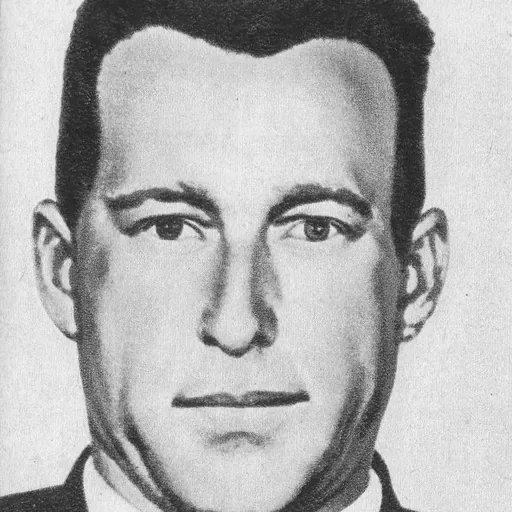
Franz Stangl
Austrian-born SS officer, commandant at first Sobibór extermination camp and then Treblinka extermination camp
About Franz Stangl
Lived 1908 – 1971 (aged 63). Franz Stangl was an Austrian police officer, military officer and politician.
Franz Paul Stangl
Stangl, an employee of the T-4 Euthanasia Program and an SS commander in Nazi Germany, became commandant of the camps during the Operation Reinhard phase of the Holocaust. After the war he fled to Brazil for 16 years. In those 16 years he worked for Volkswagen do Brasil before he was arrested in 1967, extradited to West Germany, and tried there for the mass murder of one million people. In 1970, he was found guilty and sentenced to the maximum penalty, life imprisonment. He died of heart failure six months later.
Early life and Nazi affiliations Stangl was born in 1908 in Altmünster, located in the Salzkammergut region of Austria. He was the son of a night watchman and had such an emotionally distressing relationship with his father that he was deeply frightened by and hated the sight of the elder Stangl's Habsburg Dragoons uniform. Stangl claimed his father had died of malnutrition in 1916. To help support his family, Franz learned to play the zither and earned money giving zither lessons. Stangl completed his public schooling in 1923.
In his teens, he secured an apprenticeship as a weaver, qualifying as a master weaver in 1927. Concerned that this trade offered few opportunities for advancement – and having observed the poor health of his co-workers – Stangl sought a new career. He moved to Innsbruck in 1930 and applied for an appointment in the Austrian federal police. Stangl later suggested that he liked the security and cleanliness that the police uniforms represented to him. He was accepted in early 1931 and trained for two years at the federal police academy in Linz. After the war he denied having been a Nazi since 1931 and claimed that he had enrolled as member of the party only to avoid arrest following the Anschluss of Austria into Nazi Germany in May 1938. Records suggest that Stangl contributed to a Nazi aid fund but he disavowed knowing about the intended party purpose of the fund. Stangl had Nazi Party number 6,370,447 and SS number 296,569.
In 1935, Stangl was accepted into the Kriminalpolizei as a detective in the Austrian town of Wels. Stangl joined the SS in May 1938.
T-4 Euthanasia program, 1940 – March 1943 After the onset of World War II, in early 1940, Stangl was instructed to report for work at the Public Service Foundation for Institutional Care (Gemeinnützige Stiftung für Anstaltspflege), a front organization of the T-4 Euthanasia Program. Around that time Stangl also had further dealings with Wirth, who was running extermination camps at Bełżec and Chelmno. Between 16 and 18 May 1942, Sobibor became fully operational. However, Stangl quickly realized that the extermination process was being encumbered by constant turnover among its prisoner labor force. He ended arbitrary culling of "work Jews" and established semi-permanent work teams, each overseen by a kapo. In the three months before Stangl was transferred to Treblinka, Yitzak Arad estimates that 90,000 Jews were killed at Sobibor.
Stangl avoided interacting with his victims, and he was rarely seen except when he greeted arriving prisoner transports. On these occasions he stood out because of the all-white linen riding coat he would wear, an affectation which earned him the nickname "White Death". Prisoners who did interact with him regarded him as one of the "moderates" among the camp staff. He was only ever accused of a single act of hands-on violence, and on one occasion, he convened a meeting to address what he regarded as Kurt Bolender's "bullying" of the Sonderkommando prisoners working in the extermination area. Stangl took an interest in one prisoner, Shlomo Szmajzner, who was forced to make gold jewelry for the SS officers. After the war, Szmajzner recalled Stangl as an arrogant man who stood out for "his obvious pleasure in his work and his situation. None of the others – although they were, in different ways, so much worse than he – showed this to such an extent. He had this perpetual smile on his face."
Around 100,000 Jews are believed to have been killed there while Stangl was the administrator until the furnaces broke down in October, by which time Stangl had left.
Treblinka, September 1942 – August 1943
On 28 August 1942, Odilo Globočnik ordered Stangl to become Kommandant at the newly opened but disorganized death camp, Treblinka, then under the incompetent command of Irmfried Eberl. Globočnik trusted that Stangl could restore order at Treblinka, since Stangl had a reputation as a highly competent administrator and people manager with an excellent grasp of detail.
Stangl assumed command of Treblinka on 1 September 1942. Stangl wanted his camp to look attractive, so he ordered the paths paved and flowers planted along the sides of Seidel Street, near camp headquarters and SS living quarters. Despite being directly responsible for the camp's operations, Stangl said he limited his contact with Jewish prisoners as much as possible. Stangl rarely intervened with unusually cruel acts (other than gassing) perpetrated by his subordinate officers at the camp. He usually wore a white uniform and carried a whip, which caused prisoners to nickname him the "White Death". Stangl accepted and grew accustomed to the killings, perceiving prisoners not as humans but merely as "cargo" that must be destroyed. Stangl accepted the extermination of the Jews as a fact. At about this time, Stangl began drinking heavily. He is quoted as saying:
To tell the truth, one did become used to it ... they were cargo. I think it started the day I first saw the Totenlager [extermination area] in Treblinka. I remember Wirth standing there, next to the pits full of black-blue corpses. It had nothing to do with humanity – it could not have. It was a mass — a mass of rotting flesh. Wirth said "What shall we do with this garbage?" I think unconsciously that started me thinking of them as cargo ... I rarely saw them as individuals. It was always a huge mass. I sometimes stood on the wall and saw them in the "tube" – they were naked, packed together, running, being driven with whips... According to Jankiel Wiernik: "When the new gas chambers were completed, the Hauptsturmführer [Stangl] came and remarked to the SS men who were with him: 'Finally the Jewish city is ready' ". and he reached Syria using a Red Cross passport. Stangl was joined by his wife and family, and lived in Syria for three years. In 1951, they moved to Brazil. After years in other jobs, he found work with the help of friends, at the Volkswagen do Brasil plant in São Bernardo do Campo, still using his own name.
According to Brazilian Holocaust survivor, Gabriel Waldman, he dated Stangl's daughter while in Brazil, not knowing her father was an SS agent.
Arrest, trial, and death Although Stangl's role in the mass murder of men, women and children was known to the Austrian authorities, a warrant for his arrest was not issued until 1961. During his escape, in Italy, he briefly changed his name in order to obtain Red cross traveling documents. Bishop Alois Hudal was the one who helped him. Upon arriving to Brasil, he again changed his name to Franz. Despite being registered under his real name at the Austrian consulate in São Paulo, it took another six years before he was tracked by Nazi hunter Simon Wiesenthal and arrested by Brazilian federal police on 28 February 1967. He never used an assumed name during his escape, and it is not clear why it took so long to apprehend him. After his extradition to West Germany by Brazilian authorities, he was tried for the deaths of around 1,000,000 people. He admitted to these killings but argued: "My conscience is clear. I was simply doing my duty..." Stangl's attempt to justify his actions as non-criminal in the face of German law was quoted by Arad:
What I had to do while I continued my efforts to get out was to limit my own actions to what I – in my own conscience – could answer for. At police training school they taught us that the definition of a crime must meet four requirements: there has to be a subject, an object, an action and intent. If any of these four elements is missing, then we are not dealing with a punishable offence ... I could apply this to my own situation – if the subject was the government, the "object" the Jews, and the action the gassing, I could tell myself that for me, the fourth element, "intent", (I called it free will) was missing. The Schwurgericht Düsseldorf court found Stangl guilty on 22 December 1970 and sentenced him to the maximum penalty, life imprisonment. While in prison, Stangl was interviewed extensively by Gitta Sereny for a study of him, published under the title Into That Darkness. Sereny wrote, quoting him:
During his prison interview, Sereny later wrote:
Stangl had pronounced the words "my guilt": but more than the words, the finality of it was in the sagging of his body, and on his face. After more than a minute he started again, a half-hearted attempt, in a dull voice. "My guilt," he said, "is that I am still here. That is my guilt."
On 28 June 1971, 19 hours after the conclusion of that interview, Stangl died of heart failure in a Düsseldorf prison.
Don’t just read it —
keep it.
Full-length biographies made to live with: read them, listen on the way to work, watch them tonight.
- E-book
- Audio
- Video
Instant download · yours to keep · every purchase keeps this site free
Important facts
People in Franz Stangl's life
Named in this biography and alive at the same time





Related people
Same field, nearest in time



Contemporaries
People whose lives overlapped Franz Stangl's


Frequently asked questions
Who was Franz Stangl?
Austrian-born SS officer, commandant at first Sobibór extermination camp and then Treblinka extermination camp (1908-1971)
When was Franz Stangl born?
Franz Stangl was born on 26 March 1908 in Altmünster.
When did Franz Stangl die?
Franz Stangl died on 28 June 1971 in Düsseldorf.
What was Franz Stangl's occupation?
Franz Stangl was a police officer, military officer and politician.
What nationality was Franz Stangl?
Franz Stangl was Austrian.
Sources & further reading
Cite this page
APA: Biography.guide. (2026). Franz Stangl. https://biography.guide/franz-stangl/
MLA: "Franz Stangl." Biography.guide, https://biography.guide/franz-stangl/.
Chicago: "Franz Stangl." Biography.guide. https://biography.guide/franz-stangl/.
Data last updated: 2026-09-22 · Spot an error? Report a correction.
Portrait: Wikimedia Commons · author & licence
Page generated 2026-09-27 05:03 UTC